Robinhood Markets (NASDAQ: HOOD) has been named an underwriter on the initial public offering of smart-ring maker Oura, as first reported by the Wall Street Journal.
The listing puts Robinhood among roughly 18 banks named in Oura’s public S-1, filed with the Securities and Exchange Commission on 3 September 2026. But Robinhood sits last in that syndicate, behind lead bookrunners Goldman Sachs, Morgan Stanley, JPMorgan, Allen & Co. and Jefferies, according to a filing breakdown reported by Parameter.io.
A first for Robinhood, but a small one
Oura had confidentially filed for its IPO in May 2026 before making the registration public last week. The filing shows revenue growth of 74% year-on-year heading into the offering, according to SiliconANGLE. Oura is targeting a Nasdaq listing under the ticker OURA, with reports pointing to a valuation north of $16bn, up from roughly $11bn in its last private round, per Yahoo Finance. That October 2025 round, led by Fidelity Management & Research, raised roughly $875m-$900m, according to TechFundingNews.
Robinhood’s inclusion, alongside banks such as Barclays and Wells Fargo Securities, signals retail-investor access rather than a lead execution role, Tech Times reported. Lead banks typically take the bulk of fees and control allocation; a slot at the bottom of a large syndicate carries prestige value more than economic weight.
Shares near 20-day high
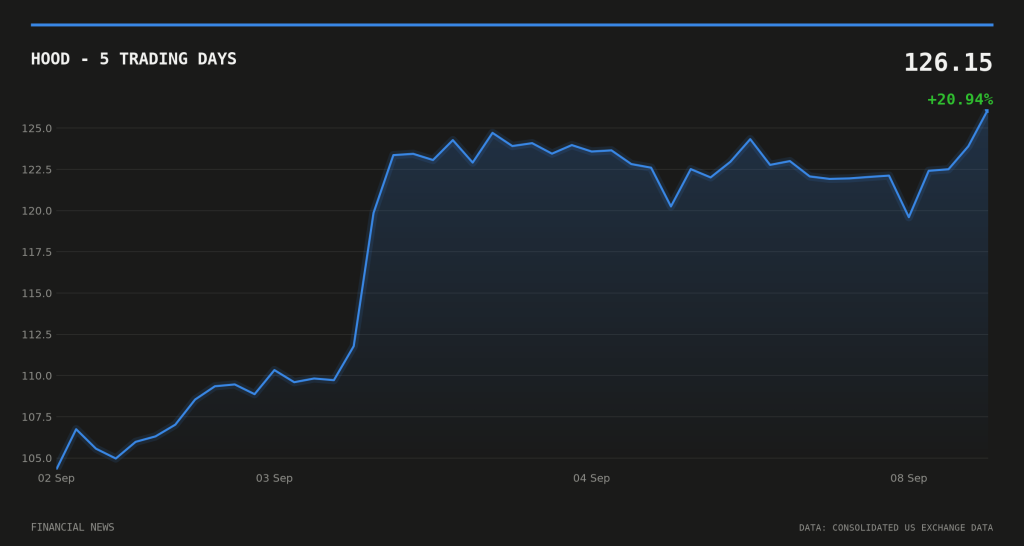
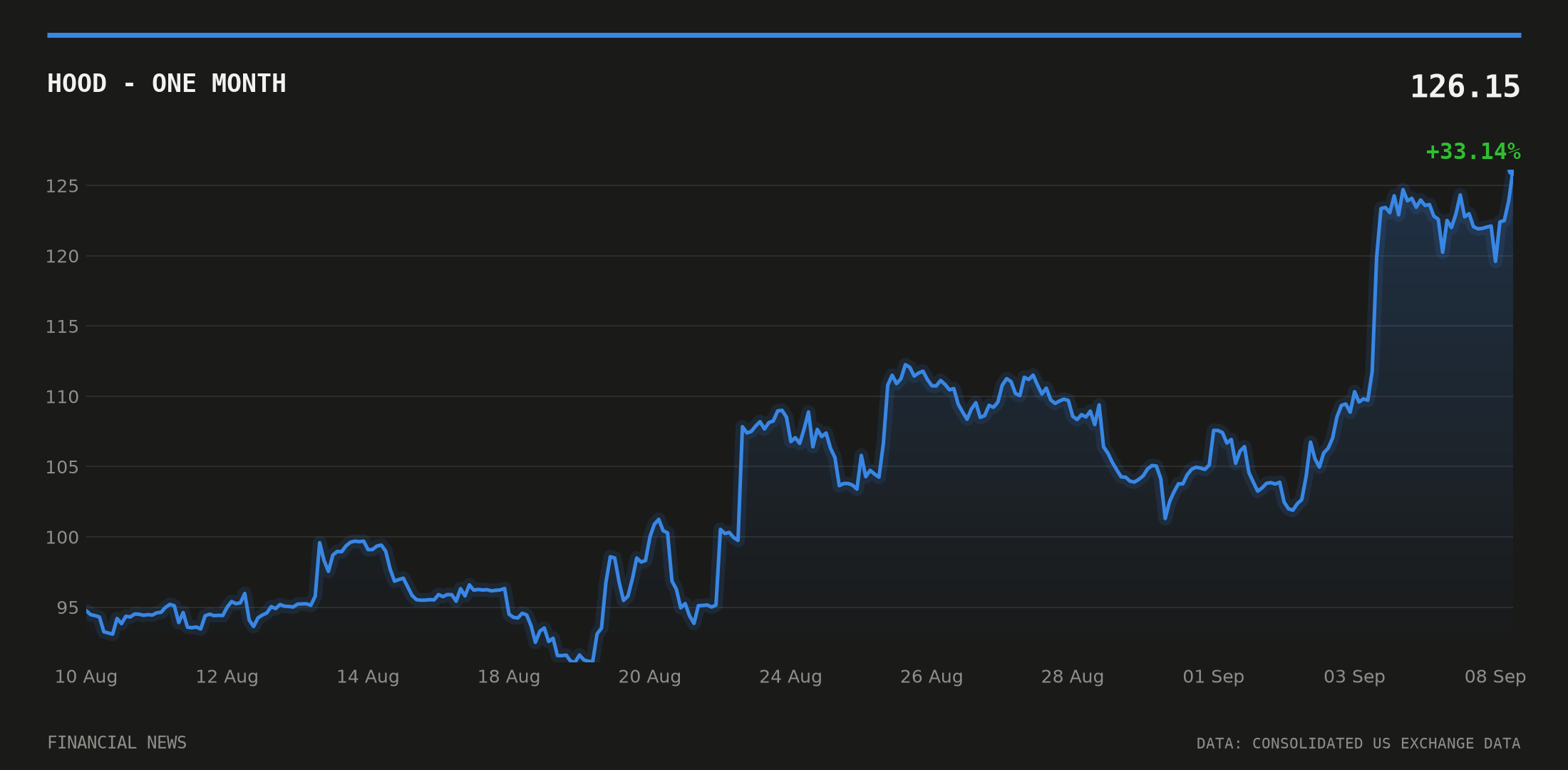
HOOD shares last traded at $125.45 as of 8 September, up 2.87% on the day and 33.9% over the prior 20 sessions, having touched a 20-day high of $125.45 against a 20-day low of $91.09. Trading volume sat well below its 20-day average on the day, suggesting the move has not been driven by a single burst of activity.
Robinhood’s positioning in options and cash-settled products has grown alongside its brokerage business, and the company has increasingly pushed into adjacent financial services, from crypto trading to advisory tools. An underwriting credential, however junior, adds a line to that expansion narrative even if it does not immediately move the fee line on Robinhood’s income statement.
The numbers behind the narrative
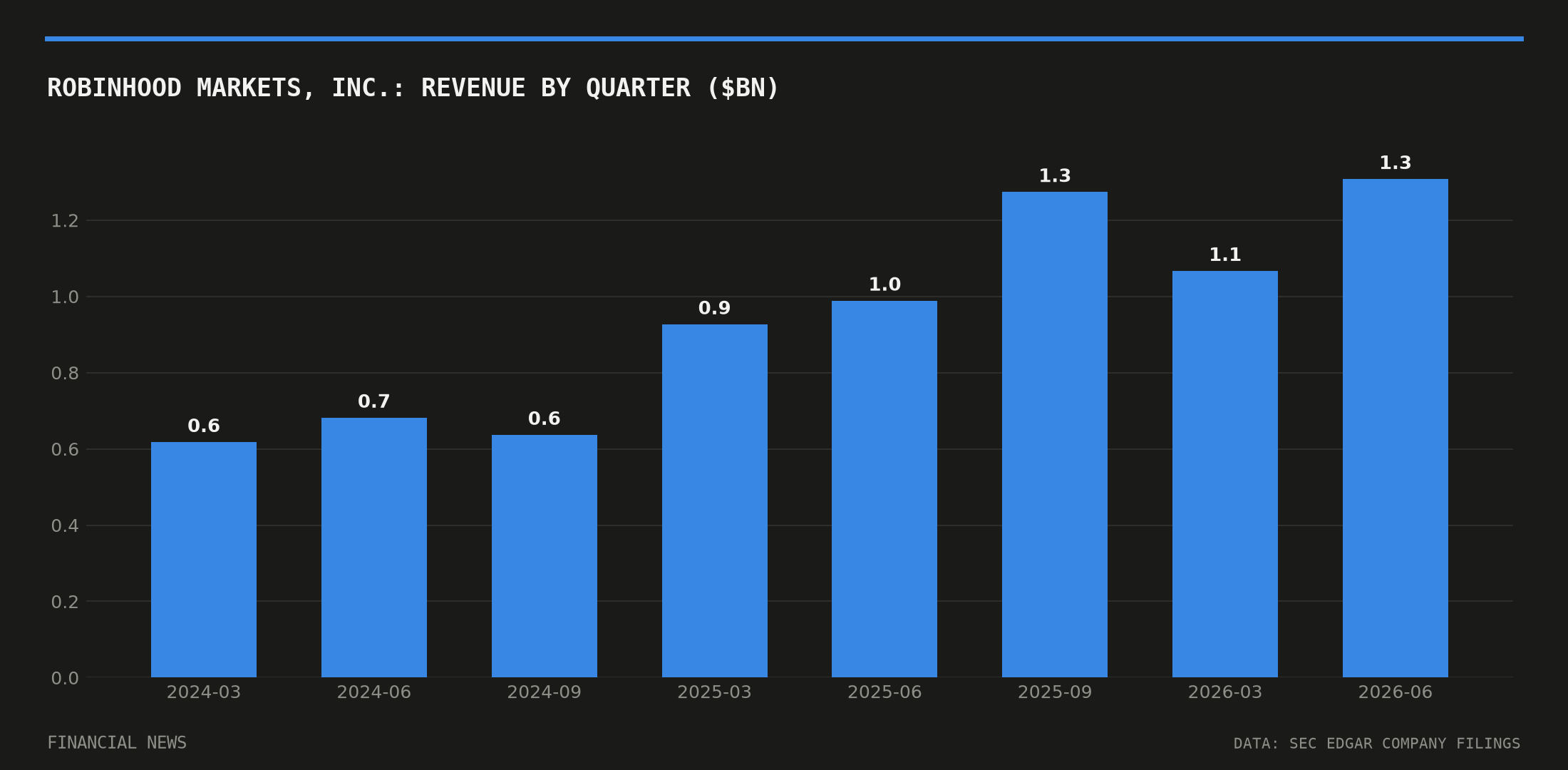
Robinhood’s own financial trajectory has been steadily improving. The company reported net income of $561m and diluted earnings per share of $0.62 for the second quarter of 2026, according to its 10-Q filed with the SEC. That compares with net income of $350m and diluted EPS of $0.38 in the first quarter of 2026, and marks a sharp climb from the $157m net income and $0.18 diluted EPS Robinhood posted in the first quarter of 2024.
Quarterly revenue has followed a similar path, rising from $618m in the first quarter of 2024 to $1.308bn in the second quarter of 2026, more than doubling over roughly two years. The company’s revenue base has broadened from its early reliance on trading commissions and payment-for-order-flow arrangements towards a wider mix of subscription, interest and crypto-related income, a shift underscored by the string of consecutive profitable quarters visible in its EDGAR filings since early 2025.
Short-selling activity in Robinhood shares has stayed contained through the period. FINRA’s daily short-sale volume data show the short ratio ranging between roughly 0.46 and 0.62 across late August and early September, with no marked spike around the Oura disclosure. That suggests the rally in HOOD shares has not attracted heavy bearish positioning, though short-sale ratios capture only a slice of overall short activity.
The broader rates backdrop has also been calm. The 10-year Treasury yield stood at 4.77% as of 3 September, down slightly from 4.79% previously, while the 2-year yield eased to 4.34% from 4.39%, according to Federal Reserve data. Modestly easing yields have coincided with a wave of IPO filings this year, though Oura’s own valuation ambitions rest chiefly on its growth story rather than the rate environment.
What the filing means for Robinhood
For Robinhood, the Oura mandate is less a fee-generating win than a credibility marker as it tries to build an investment-banking identity alongside its retail brokerage roots. Whether the company converts a bottom-of-the-list underwriting slot into a more senior role on future offerings would depend on how it performs distributing Oura shares to its retail user base once the deal prices, a detail investors are likely to watch when Oura sets terms for its Nasdaq debut.
This article is for information only and is not investment advice or a recommendation to buy or sell any asset. Markets move quickly; figures are correct as sourced at the time of writing. Always do your own research before making financial decisions.