
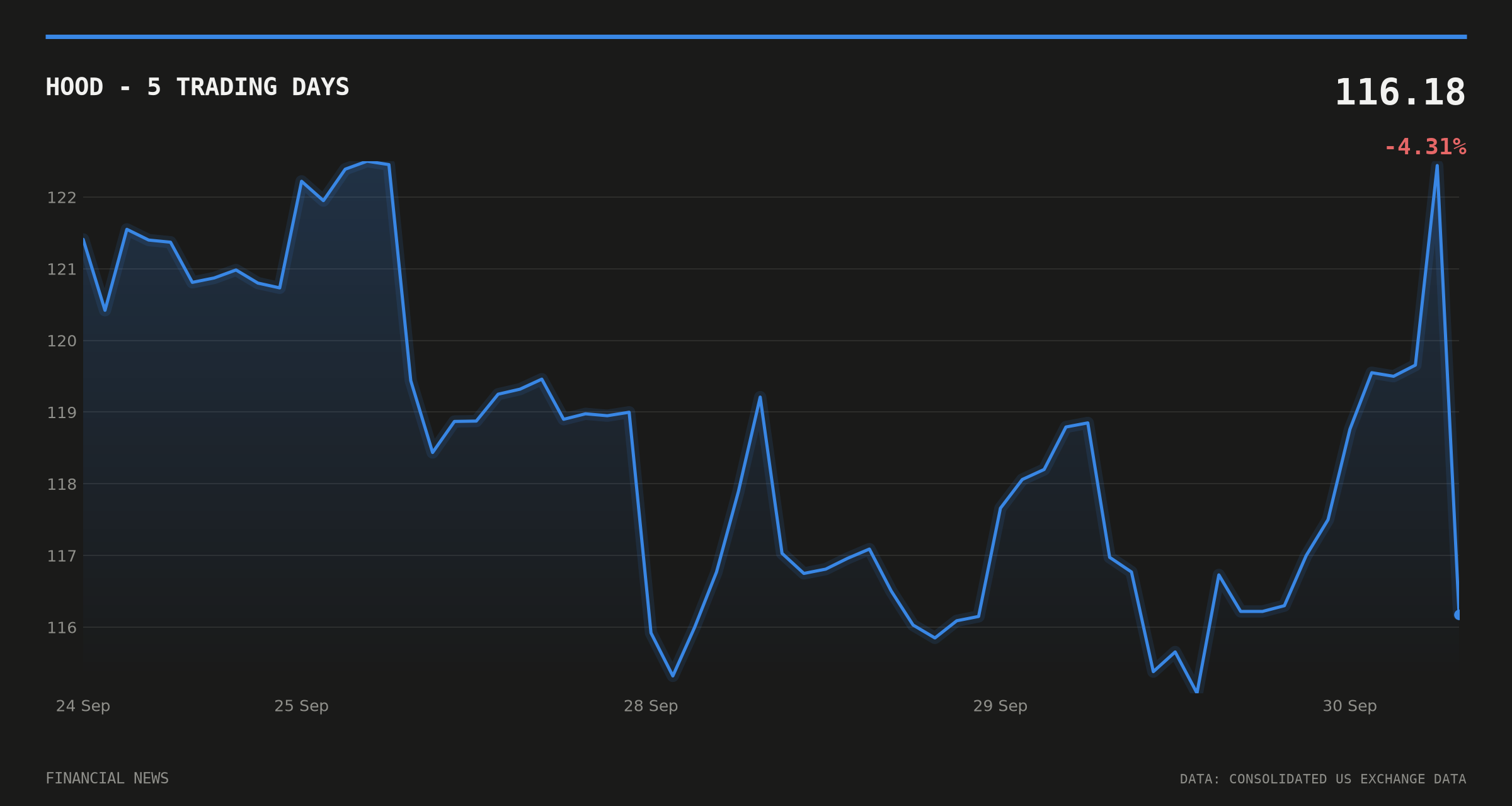

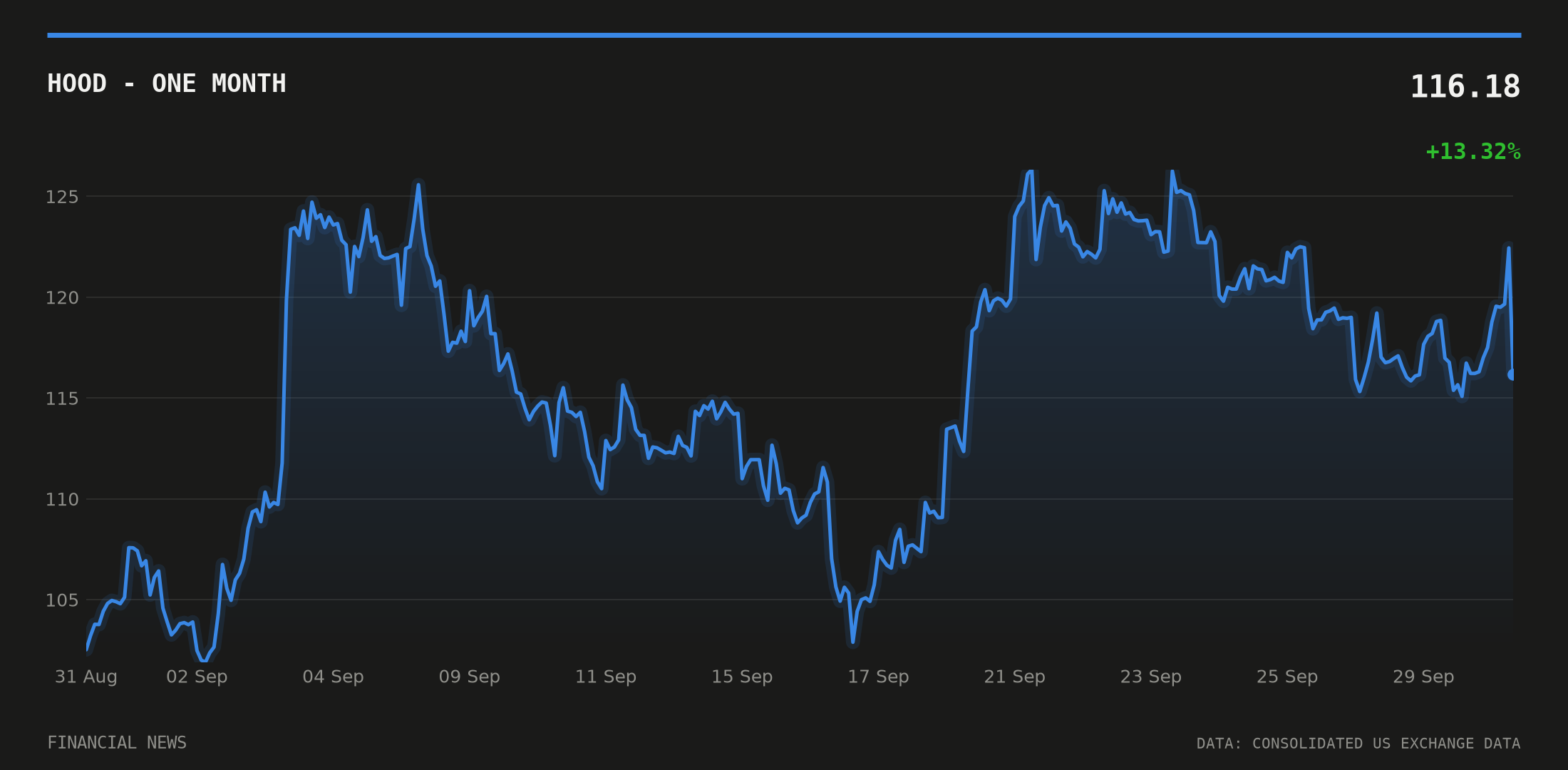
Robinhood Markets (NASDAQ: HOOD) unveiled 24/7 equities trading, AI-powered trading agents and crypto perpetual futures late on Tuesday at its HOOD Summit in Houston. By Wednesday morning, shares traded at $113.64, down 2.87% on the day and 3.85% over 20 days, according to consolidated exchange data – not the 5% jump that some headlines described.
The gap between the two numbers is the story. Robinhood’s after-hours reaction did include a pop: shares rose 1.1% immediately after the announcement, extending to 2.61% versus the prior close in subsequent overnight trading, as reported by ChainCatcher. That move had faded well before Wednesday’s session opened.
What Robinhood put on the table
The product news itself is not in dispute. Robinhood confirmed that, starting next year, customers will be able to trade certain US equities around the clock, including weekends, extending the 24/5 trading feature it launched in 2023, as reported by CNBC. The weekend extension runs on Bruce ATS, the alternative trading system that already powers Robinhood’s existing 24-hour market, according to Quartz.
Alongside the trading-hours expansion, Robinhood introduced “Robinhood Agents,” a product letting customers build AI agents that research markets, form strategies and place trades on their behalf. Users pick a model – including options from OpenAI – and open a dedicated agentic account to run it, Robinhood said in its own newsroom announcement. The company disclosed that more than 150,000 customers have opened agentic trading accounts since an earlier launch phase, with agents now used nearly 30 million times a day, as reported by CoinDesk. Robinhood also outlined plans to bring crypto perpetual futures to US customers.
The 5% figure that didn’t survive the morning
Benzinga’s report, headlined “Robinhood Stock Jumps 5% After Unveiling 24/7 Trading, AI Agents,” described a share-price reaction to the Summit news. But by the time that and similar stories published on Wednesday, the market data told a different story: HOOD had given back its overnight gain and turned negative, trading nearly 3% lower on the day.
The pattern fits a familiar shape for event-driven pops in richly-owned names: an initial after-hours rally on the news, followed by a reversal once regular trading resumes and profit-taking sets in. Trading volume on Wednesday ran at just 55% of Robinhood’s 20-day average, according to the same exchange data, suggesting the reversal was not accompanied by heavy fresh selling so much as a lack of buyers willing to chase the overnight move.
Short interest was already climbing into the announcement
FINRA’s daily short-sale data show the short-volume ratio for HOOD climbing steadily in the run-up to the Summit, from 0.466 on 17 September to 0.661 on 29 September, the day of the announcement, according to FINRA. Rising short-side activity into a scheduled catalyst can amplify moves in both directions – a short squeeze on the way up, then fresh shorting into any fade – and the sequence around the Summit is consistent with that pattern, though FINRA’s ratio does not itself explain the reversal.
The wider rates backdrop has not helped high-multiple fintech names generally. The 10-year US Treasury yield rose to 5.24% on 28 September from 5.17% previously, according to data from the Federal Reserve Bank of St Louis, a level that continues to weigh on growth-stock valuations across the sector.
The underlying business keeps growing
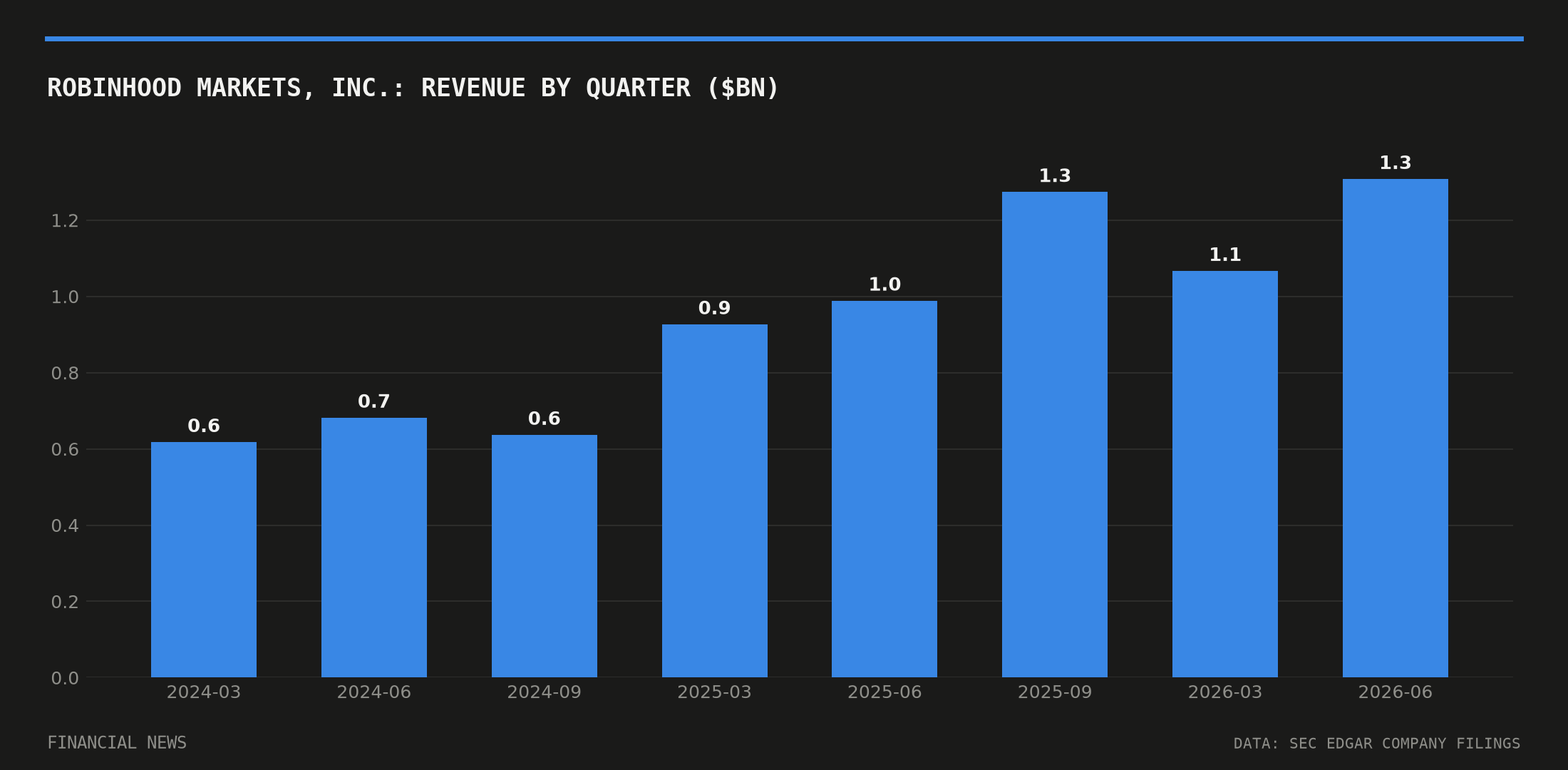
None of the share-price noise changes Robinhood’s recent earnings trajectory. Net income rose to $561m in the second quarter of 2026 from $350m in the first, on revenue that climbed from $1.067bn to $1.308bn over the same period, according to Robinhood’s quarterly filing with the SEC. Diluted earnings per share reached 62 cents in the second quarter, up from 38 cents in the first.
That growth is the backdrop against which the Summit announcements landed. Robinhood is betting that round-the-clock equities trading, AI-run agentic accounts and crypto perpetuals broaden its appeal beyond commission-free stock trading, the business that built its user base. Whether that bet moves the share price is a separate question from whether Wednesday’s reported jump actually happened – and the exchange tape, as of Wednesday lunchtime, said it hadn’t.
The 24/7 equities feature is not due until next year, giving traders a dated marker to watch for confirmation that the expanded hours, rather than a single headline, are what eventually shifts the stock.
This article is for information only and is not investment advice or a recommendation to buy or sell any asset. Markets move quickly; figures are correct as sourced at the time of writing. Always do your own research before making financial decisions.
