Microsoft Corp (MSFT) plans to more than triple its global data centre capacity by 2032, according to a Bloomberg News report published on 10 September 2026. The push follows shortages that have already forced the company to turn away some AI and cloud business, Bloomberg said, citing people familiar with the plans.
The target: capacity exceeding 38 gigawatts, up from roughly 12 gigawatts today, Reuters reported, matching Bloomberg’s figures. Techmeme, aggregating the same Bloomberg story, noted about a third of the planned 38 gigawatts would centre on AI-specific chips.
A reversal on Microsoft data centre capacity strategy

The scale of the ambition sits awkwardly against Microsoft’s own recent history. Earlier in 2026, Bloomberg reported the company had walked away from roughly 2 gigawatts of planned US and European data centre projects, citing an AI compute oversupply flagged by TD Cowen analysts. Months later, the same company is planning to more than triple total capacity.
That whiplash says as much about how fast AI demand forecasts move as it does about Microsoft’s confidence in the buildout. The company’s own finance chief, Amy Hood, said in April that Microsoft expected to remain capacity-constrained at least through 2026, a point The Register reported at the time.
The numbers behind the spend
Microsoft has the balance sheet to fund a multi-year expansion of this size. Net income for its fiscal second quarter, October to December 2025, reached $38,458m on revenue of $81,273m, filings with the SEC show. Revenue has climbed every quarter since late 2023, from $62,020m in the December 2023 quarter to $82,886m by March 2026.
That growth has funded an escalating capital programme. Microsoft’s fiscal 2026 capital expenditure and finance leases reached $175bn on an adjusted basis, including a $41bn fourth-quarter outlay, Yahoo Finance reported. A 38-gigawatt target implies that spending pace continuing, and likely accelerating, through the rest of the decade.
Financing backdrop

The buildout comes as borrowing costs stay elevated. The 10-year US Treasury yield stood at 4.83% on 9 September 2026, up from 4.80% the prior session, FRED data show, while the 2-year yield sat at 4.43%. Hyperscalers including Microsoft have increasingly leaned on debt and lease financing to fund data centre expansion, making the rate environment a live consideration for the cost of any 38-gigawatt programme.
Microsoft is not alone in the race. BloombergNEF has estimated that the four largest hyperscalers – Amazon Web Services, Google, Meta and Microsoft – together control 42% of US data centre capacity, underlining how much of the industry’s near-term power and land demand rests on a handful of balance sheets.
What the market saw
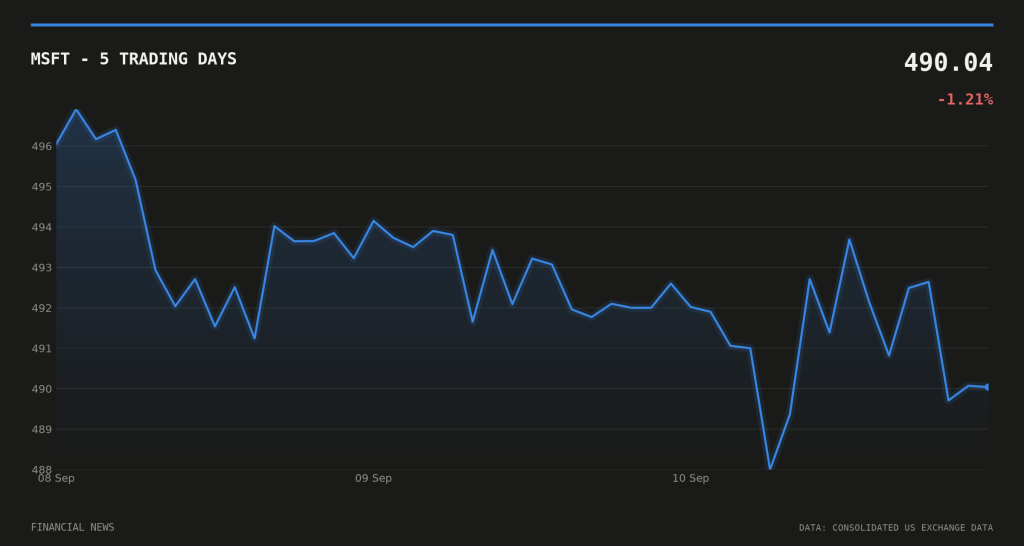
MSFT shares closed at $490.04 on 10 September 2026, down 0.74% on the day but up 1.77% over the prior 20 sessions, trading within a 20-day range of $481.33 to $516.88. Trading volume ran close to its 20-day average, at 1.05 times the norm, suggesting the report moved sentiment without triggering a rush for the exits.
None of the outlets that picked up the Bloomberg figures – Reuters, Seeking Alpha, Investing.com and PANews among them – disputed the 38-gigawatt number or the 12-gigawatt baseline. The plan itself, however, rests on people described only as familiar with Microsoft’s thinking; the company has not confirmed the target in a press release or regulatory filing. Investors watching for confirmation are likely to focus on Microsoft’s next earnings call and any updated capex guidance, where a target of this size would typically surface in commentary from Hood or chief executive Satya Nadella.
This article is for information only and is not investment advice or a recommendation to buy or sell any asset. Markets move quickly; figures are correct as sourced at the time of writing. Always do your own research before making financial decisions.