
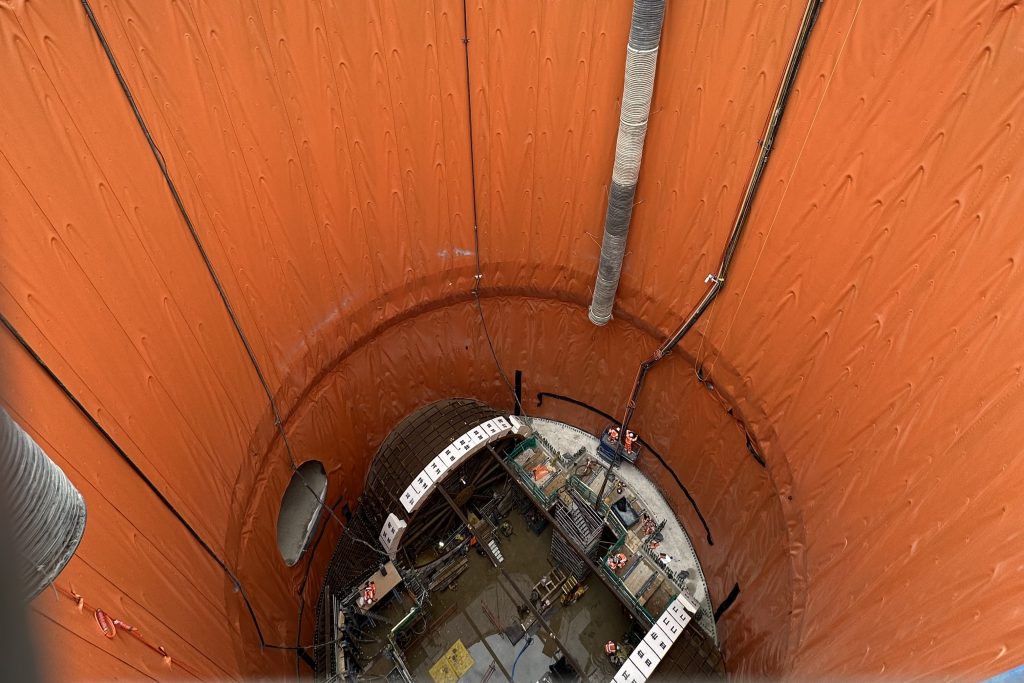

HS2 faced significant water pressure challenges during the construction of its London TBM extraction and vent shaft.
- The Skanska Costain Strabag joint venture employed a dual strategy to manage water influx at the site.
- Past uses of the Green Park Way site, including a landfill and a munitions factory, complicated the project.
- The steel can, manufactured for the project, is key to ensuring a waterproof environment for TBM extraction.
- Digital rehearsals are being used to prepare for the complex TBM extraction process expected in 2025.
High Speed 2 (HS2) encountered formidable water pressure challenges at their Green Park Way vent shaft in London. The Skanska Costain Strabag (SCS) joint venture, tasked with the project, implemented a two-part process to manage these challenges and facilitate the arrival and extraction of tunnel boring machines (TBMs).
The construction site, situated in Greenford, northwest London, is historically a complex area, having previously served as a landfill and prior to that, a munitions factory. This history raised concerns about potential unexploded ordnance, necessitating rigorous testing on-site. Moreover, the work began before the launch of the National Underground Asset Register, requiring additional testing to map out underground utilities accurately.
During initial ground investigations, significant water ingress was recorded, approximately 110 litres per second, necessitating comprehensive ground treatment measures. This involved injecting grout into water-bearing geological strata to reduce water flow around the shaft. Even after these measures, water ingress continued at 30 litres per second. To address this, a method of de-watering was employed, involving the installation of wells around and within the shaft to actively extricate water, thereby relieving water pressure in the area.
A substantial component in this effort is the installation of a purpose-built steel can, manufactured in Sheffield and transported to London. This structure aims to provide a stable, watertight reception chamber for the TBMs. The can is assembled in segments and installed within the shaft, with a hydraulic system used to seal its lid to the tunnel’s edge. Adequate sealing is essential for maintaining dry conditions as the TBMs are extracted.
The extraction process is noted for its complexity, prompting the use of 4D digital simulation technology, where the movements of TBMs, tunnels, and shafts are visualised over time. This digital rehearsal serves to anticipate and mitigate potential challenges. The TBMs are scheduled to arrive at the shaft by 2025, with each extraction demanding precision and careful coordination.
Upon completion, the site will feature a headhouse to facilitate ventilation for the HS2 tunnel. This complex engineering feat underscores significant advancements in civil engineering problem-solving.
The innovative approaches adopted for HS2’s London TBM shaft exemplify cutting-edge engineering solutions.

