

Every SME owner in Dubai knows the feeling: revenue is growing, but so is the pile of admin work that comes with it. Invoicing, scheduling, customer follow-ups, lead qualification, HR paperwork. None of it generates income directly, but all of it eats hours that could go toward growth. Agencies like WebBox are already building these systems for Dubai SMEs, handling everything from lead qualification to invoicing through custom automation rather than off the shelf tools.
Over the past two years, a quiet shift has taken place among UAE small and mid-sized businesses. Instead of hiring another admin staff member or offshoring tasks to virtual assistants, more owners are turning to AI automation, and the cost savings are hard to ignore.
Where the 40% Comes From
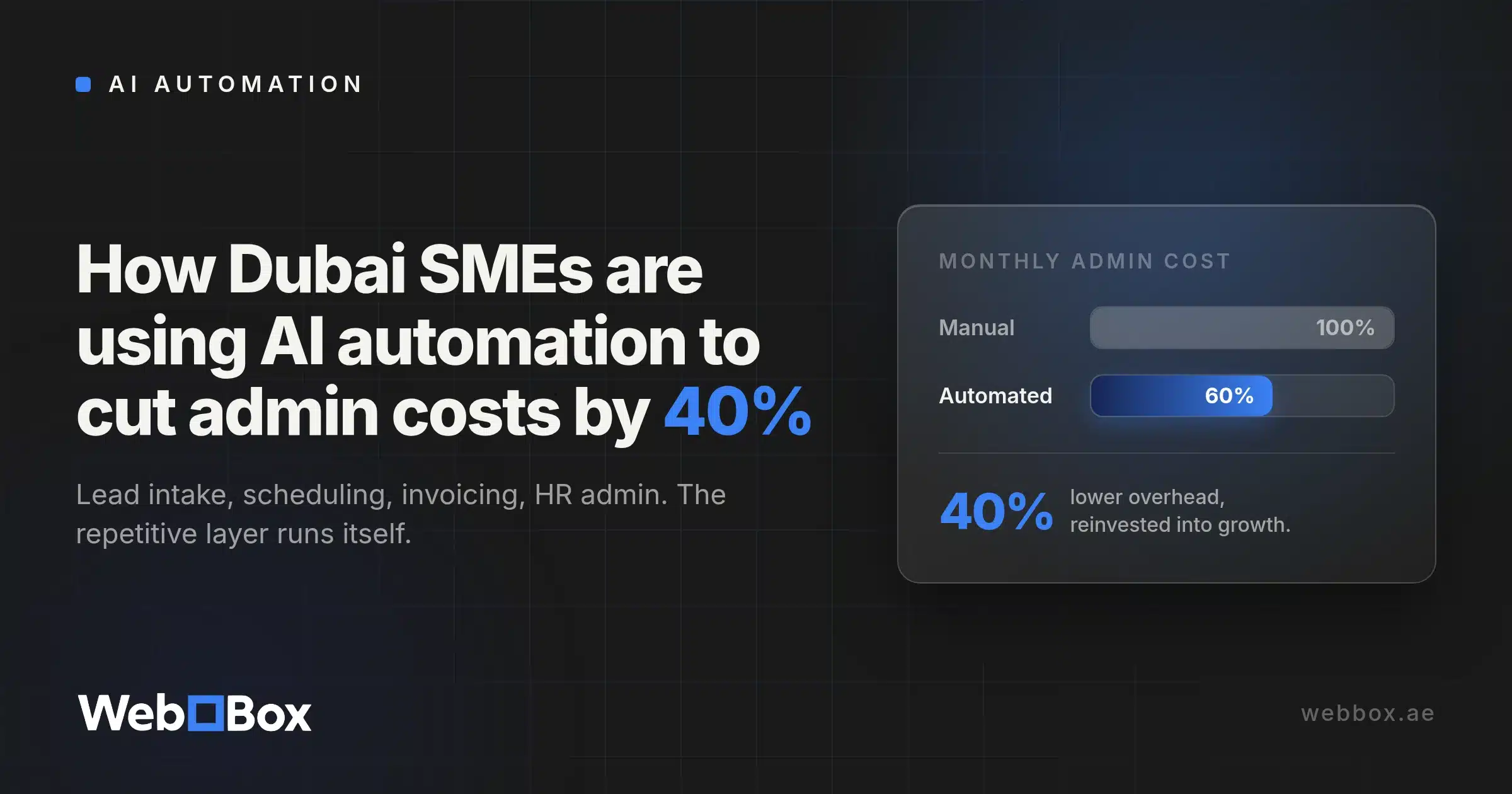
The number isn’t marketing fluff. It comes from a simple comparison: the fully loaded cost of a junior admin hire (salary, visa, insurance, office space, management time) versus the monthly cost of running automated workflows that handle the same volume of repetitive tasks.
A typical breakdown looks like this:
- Lead intake and qualification: AI agents can read incoming enquiries from WhatsApp, Instagram, and web forms, ask clarifying questions, and route only qualified leads to a human. This alone removes hours of back and forth that used to sit with a sales coordinator.
- Appointment scheduling: Instead of a receptionist juggling calls and calendar conflicts, an AI scheduling agent handles bookings, reschedules, and reminders around the clock.
- Invoicing and follow-up: Automated systems generate invoices, chase overdue payments with polite but persistent reminders, and reconcile payments against bank feeds without a finance assistant manually checking spreadsheets.
- HR and onboarding admin: Document collection, contract generation, and basic policy Q&A can run through an AI HR assistant, freeing up actual HR time for the things that need a human judgment call.
Stack these together and a business that would have needed two or three admin hires can often run with one, supported by automation handling the repetitive layer underneath.
Why This Is Happening Now, Specifically in Dubai
A few local factors are accelerating this shift:
Visa and sponsorship costs. Hiring in the UAE comes with fixed costs (visa, medical, Emirates ID, insurance) that don’t scale down even for part-time or seasonal admin needs. Automation has no visa cost.
Bilingual demand. Many Dubai SMEs serve both Arabic and English speaking customers. AI agents handle language switching instantly, something that used to require hiring specifically for language coverage.
24/7 customer expectations. Dubai’s customer base spans multiple time zones and often expects instant responses on WhatsApp regardless of the hour. Automated agents don’t need shift differentials to answer at 2am.
Rapid business scaling. UAE SMEs often need to scale fast during peak seasons (Ramadan, Q4, event season) without permanently expanding headcount. Automation scales up and down without HR overhead.
What This Actually Looks Like Day to Day
For an SME owner, the practical shift usually starts small. Maybe it’s an AI agent that handles the first response on Instagram DMs and WhatsApp, qualifying whether someone is a genuine lead before a human ever gets involved. Then it expands to appointment booking, then to basic customer support questions, then to internal reporting that used to require someone manually pulling numbers together every week.
The businesses seeing the strongest results aren’t trying to automate everything at once. They’re identifying the two or three most repetitive, most time-consuming tasks and solving those first, then expanding once the system proves itself.
The Risk of Waiting
The businesses that adopt this early aren’t necessarily more sophisticated. They’re just further ahead on a cost curve that’s only going to widen. As admin costs in Dubai continue to rise (rent, salaries, visa fees), the businesses still doing everything manually will find their margins squeezed from both sides: rising costs and slower response times compared to competitors who’ve already automated.
The 40% figure isn’t a ceiling. For businesses with high volumes of repetitive customer interaction, the savings can go higher. But even a conservative 40% reduction in admin overhead, reinvested into growth or better customer service, compounds quickly over a year.
For SME owners still running everything through spreadsheets and a single overworked admin person, the question isn’t whether AI automation makes sense. It’s which task to hand over first.
Agencies like WebBox are already building these systems for Dubai SMEs, handling everything from lead qualification to invoicing through custom automation rather than off the shelf tools.
Author bio: This piece was contributed by the team at WebBox, a Dubai based agency specializing in AI automation, SEO, GEO, and PR for growing businesses.
