

Megan Spaccarelli spent 13 years alongside Marshall, a rescue dog whose life threaded through every significant chapter of her family’s story — through a marriage, three daughters, the building of veterinary hospitals and the ordinary Tuesday afternoons that, in retrospect, turn out to be the ones you remember most.
When Marshall was gone, she wrote him a book.
Released on 2nd February, Goodnight, My Sweet Pup, is a hardcover picture book aimed at children facing what is, for many of them, their first real encounter with loss. Megan Spaccarelli, who lives in Wappingers Falls, New York, frames the story around a young girl and her dog moving through life together — from the earliest days of the friendship through to a final farewell. The philosophy at its centre is quietly insistent: pets leave homes, but not hearts.Simple. And for anyone who has been there, completely true.
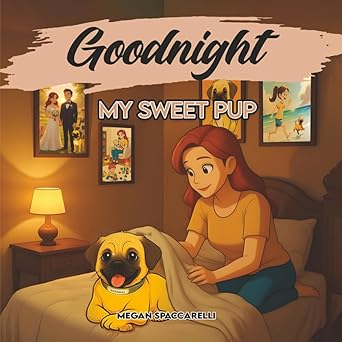
The book arrives into a children’s literature space that has long grappled with how to handle grief honestly without overwhelming young readers. Pet loss occupies a particular emotional territory — profound enough to cause genuine distress, yet sometimes minimised by adults who underestimate what the death of an animal means to a child. Megan Spaccarelli’s background gives her an unusually clear view of that gap. Alongside her husband, she helps run veterinary hospitals, placing her at the intersection of animal care and the human grief that follows when that care is no longer enough.
She has watched families say goodbye. Professionally, repeatedly, intimately.
Goodnight, My Sweet Pup suses full-colour illustrations throughout, moving from playful early scenes — a puppy in motion, the particular chaos of a young dog in a family home — to quieter moments of comfort as the companion ages. The verse is written to be read aloud, rhythmic enough to carry naturally in a parent’s voice during bedtime, accessible enough that children can follow without the language becoming a barrier to the emotion underneath it.
That read-aloud quality is not incidental. The book is built for shared experience — a parent and child working through something together, the story doing some of the heavy lifting that direct conversation sometimes cannot.
Spaccarelli has three daughters of her own. The question of how to talk to children about death — how to acknowledge the reality without stripping away the comfort — is not abstract for her. Marshall’s 13-year presence in her household means the book draws on lived experience rather than imagined grief, and that distinction tends to show on the page.
The central reassurance Goodnight, My Sweet Pup offers is that a pet’s influence does not end with its life. Loyalty, joy, the particular kind of unconditional companionship a dog provides — these persist in memory, in the habits a family forms around an animal, in the shape a house takes when a creature has lived in it long enough. For children who have lost a pet and feel the absence as something large and confusing, that framing offers something more useful than consolation. It offers continuity.
Whether the book reaches the families who need it most will depend, as it always does, on word of mouth among parents, teachers and the grief counsellors who work with young children. It is available now through Amazon, major online retailers and by order through bookstores.
Marshall got 13 years. The book he inspired has considerably longer ahead of it.
