

Roderick Warren has a specific theory about why retail traders lose money. Not wrong predictions. Wrong entries. “In practice, many losses occur not because traders are wrong in direction,” the founder of Zurich-based ChartDetector.ai argued, “but because trades are entered without sufficient validation of risk, structure, and market context.”
That observation sits at the centre of a broader shift Warren sees moving through trading culture. Across cryptocurrencies, equities, foreign exchange, and commodities, market participants now have more chart data and technical indicators than at any previous point. Yet consistent performance remains elusive for most retail traders. Warren’s argument is that the problem was never data availability. It was always decision structure.
“For decades, retail trading has emphasised forecasting where price might go next,” he said. The pursuit of the correct directional call has dominated how retail participants think about their edge. But direction, Warren contends, is only part of the question. The harder part is what happens before the trade opens.
Institutional trading desks have long understood this distinction. Professional environments operate around confirmation, predefined risk parameters, and probabilistic assessment — not instinct and isolated signals. Replicating that discipline at the individual level has historically been difficult. The gap between how retail traders and institutional traders approach the same chart has widened as algorithmic and quantitative strategies now account for a growing share of market activity, reducing the effectiveness of pattern-based guesswork.
The cross-asset environment adds further complexity. Cryptocurrencies no longer move in isolation. Macroeconomic data releases, equity market sentiment, and currency movements all now influence crypto price action in ways that make single-indicator analysis increasingly unreliable. “Retail traders often respond to isolated patterns or signals,” Warren noted. “Professional workflows tend to evaluate whether a setup aligns with broader market structure before capital is committed.”
Paradoxically, the expansion of analytical tools has made some of this harder rather than easier. More indicators create more opportunities for selective bias — finding confirmation for a decision already emotionally made rather than genuinely testing the setup. Warren sees this as a structural feature of how most retail platforms present information, not a failure of individual traders.
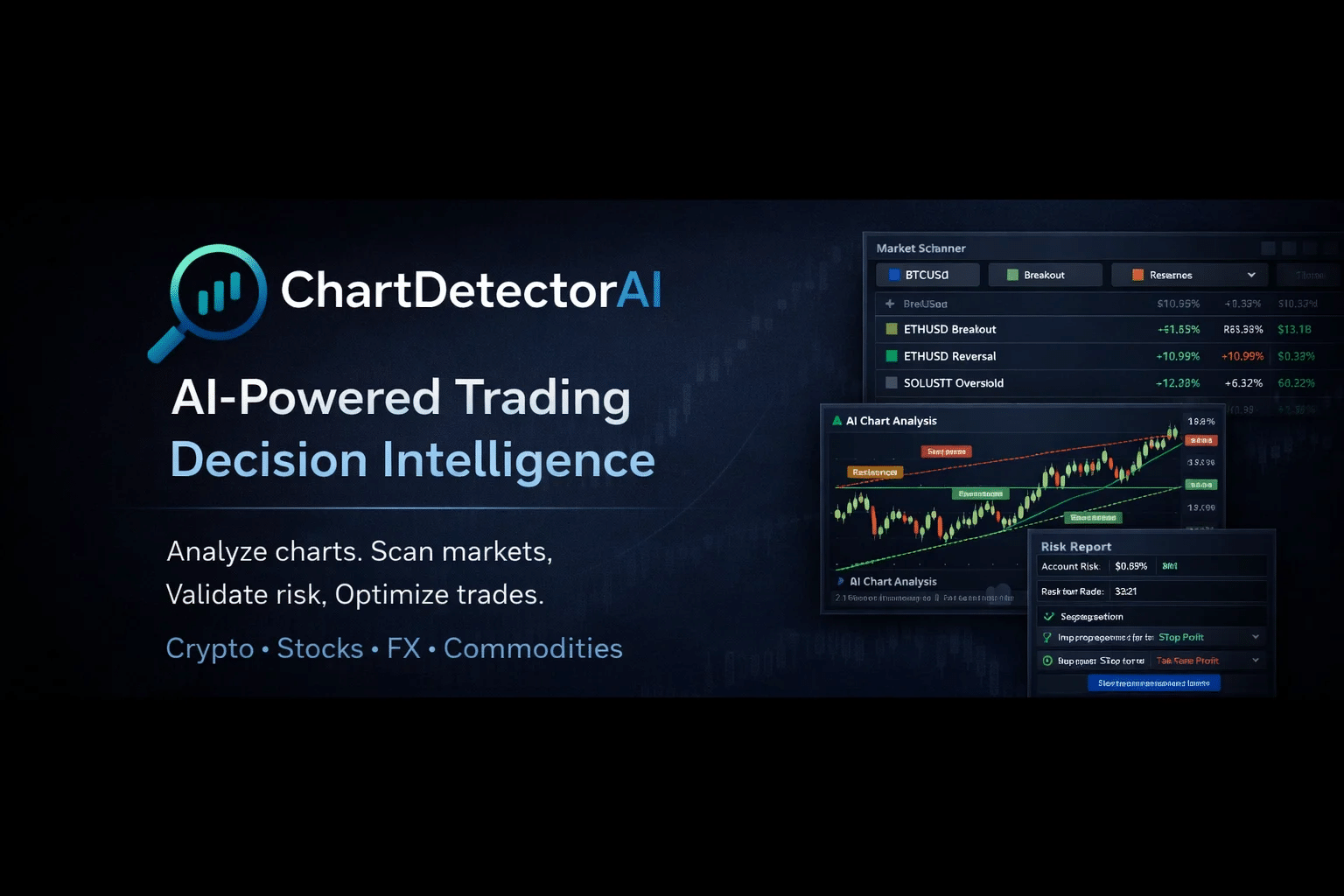
ChartDetector.ai, his Zurich-based platform, applies AI to structural chart analysis across multiple asset classes, focusing specifically on pre-trade validation and risk assessment. The platform does not generate directional forecasts. It evaluates whether conditions support the entry a trader is considering.
Warren’s third observation is the most direct. “Uncertainty is a permanent feature of financial markets,” he said. “The objective is not to eliminate it, but to engage with it more systematically.”
That framing — uncertainty as something to manage rather than solve — marks the clearest departure from how most retail trading tools position themselves. Whether traders follow is, as always, their call to make.
