

Boeing (BA) has won the US Navy’s F/A-XX fighter contract, beating Northrop Grumman (NOC) to build America’s next carrier-based stealth jet. The Department of War confirmed the award on 29 September 2026.
The contract is worth more than $20bn for the full-scale development phase, according to Aviation Week, covering the test aircraft needed for ground, airworthiness, systems and weapons integration work.
Second sixth-generation win in 18 months
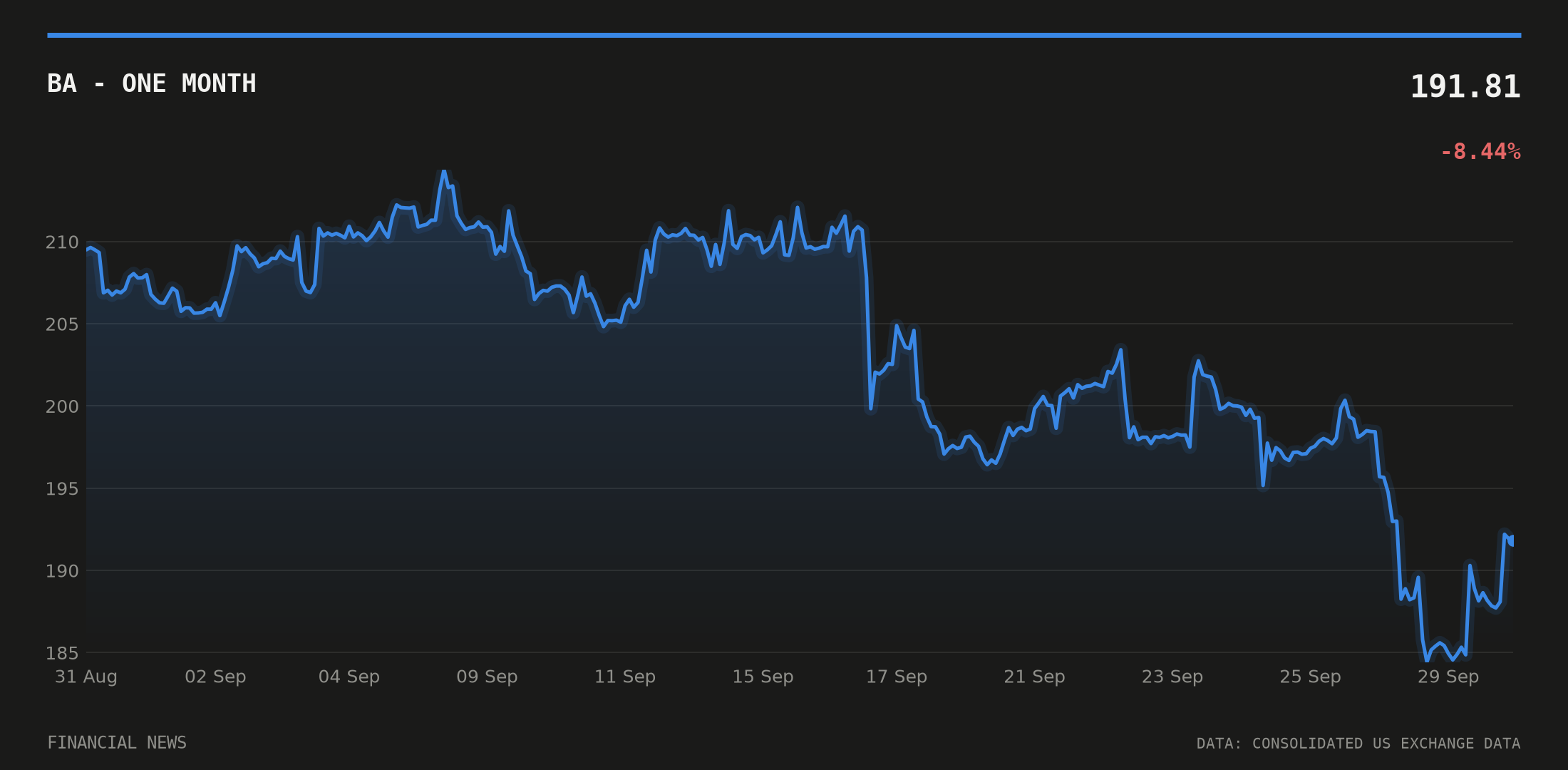
The F/A-XX award gives Boeing both of the Pentagon’s marquee sixth-generation crewed fighter programmes. It won the Air Force’s F-47 contract in March 2025, as Reuters reported, and has now added the Navy’s equivalent inside a year and a half.
Boeing Defense, Space & Security chief executive Steve Parker framed the pairing as deliberate strategy rather than a scramble to keep pace. ‘Delivering two advanced fighters in parallel was always our plan, and we invested accordingly,’ he said, according to Air Data News.
Under Secretary of War for Acquisition and Sustainment Michael Duffey called the F/A-XX platform ‘a crucial, non-negotiable investment in America’s national security and long-term air combat capabilities,’ according to The War Zone.
The jet is intended to replace the Navy’s F/A-18E/F Super Hornet and EA-18G Growler, flying alongside the F-35C and unmanned Collaborative Combat Aircraft in future carrier air wings, per Air Data News. The award follows a period in which the Pentagon reportedly weighed shelving the programme altogether over doubts that Boeing’s industrial base could run the F-47 and F/A-XX lines at once – concerns that were ultimately resolved in the company’s favour, Reuters reported via a syndicated wire report carried by 93.3 The Drive.
A win against a backdrop of losses
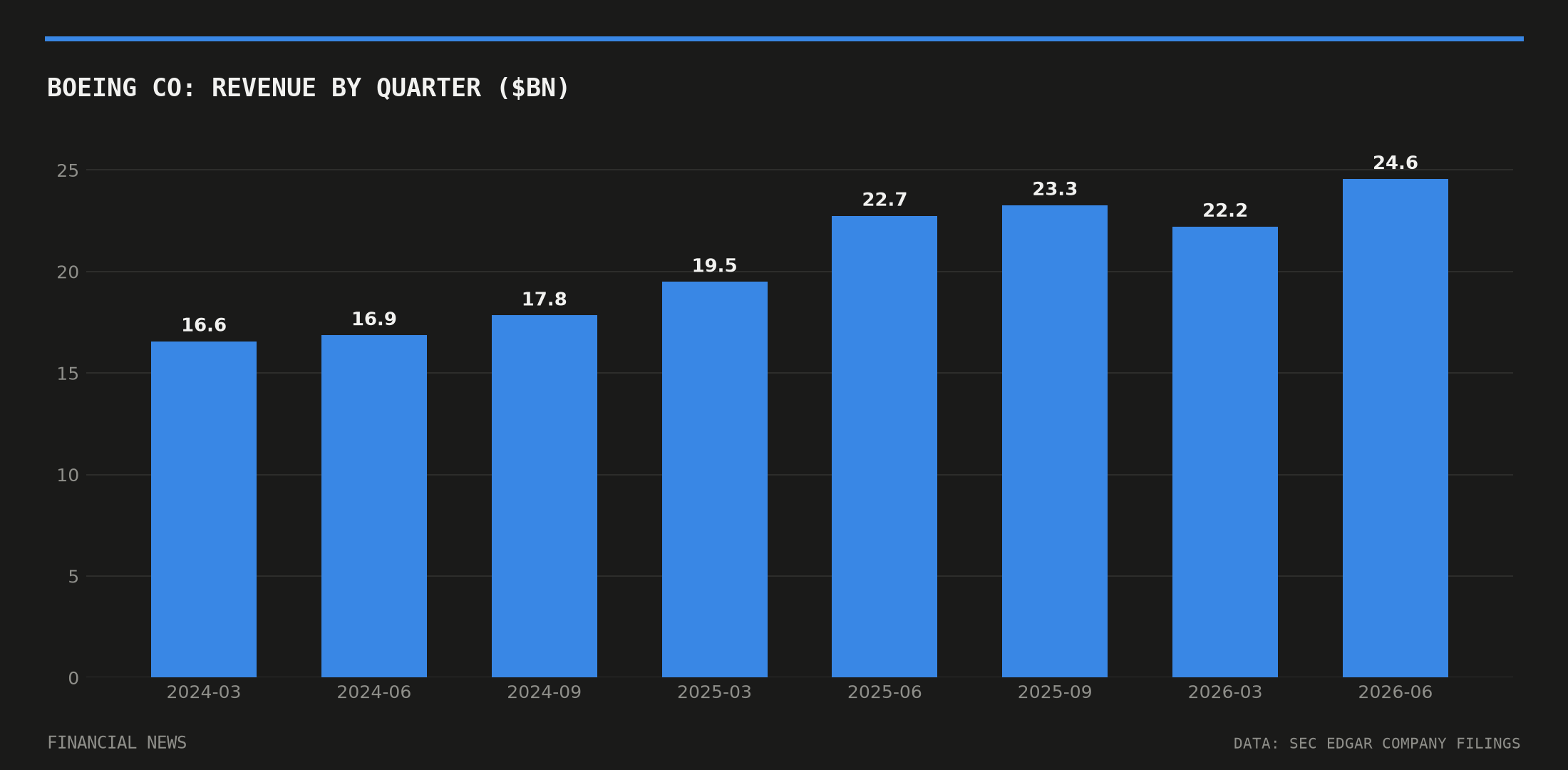
The contract lands while Boeing continues to report recurring GAAP losses. The company posted a net loss of $5.337bn in the third quarter of 2025 and a further $444m loss in the second quarter of 2026, according to its 10-Q filings with the SEC. Quarterly revenue has nonetheless climbed steadily, reaching $24.56bn in the three months to June 2026 from $16.57bn in the first quarter of 2024.
That trajectory – rising top line, persistent bottom-line red ink – is the context in which a multi-billion-dollar defence award carries weight beyond the headline figure. Defence contracts of this scale run over years and typically carry firmer margins than Boeing’s troubled commercial programmes, giving the F/A-XX deal disproportionate significance for a balance sheet still working through the costs of prior overruns.
Rates backdrop
The award also arrives with US borrowing costs elevated. The 10-year Treasury yield stood at 5.24% as of 28 September 2026, up from 5.17% the prior session, according to data from the Federal Reserve Bank of St Louis. Higher long-term yields raise the discount rate applied to future cashflows from multi-year contracts such as F/A-XX, a factor investors typically weigh alongside the headline contract value.
Missouri lawmakers Wesley Bell and Eric Schmitt welcomed the award as reinforcing St Louis’s position as a centre of US fighter-jet manufacturing, building on the earlier F-47 win, according to Fox2Now. Boeing’s own investor relations statement confirmed the Navy’s selection, framing it as a multi-billion-dollar award to produce the F/A-XX aircraft.
Attention now turns to how quickly the Navy moves from the development contract toward production milestones, and whether Boeing’s defence unit can convert the F-47 and F/A-XX pipeline into the kind of margin that has eluded its commercial aircraft business in recent quarters.
This article is for information only and is not investment advice or a recommendation to buy or sell any asset. Markets move quickly; figures are correct as sourced at the time of writing. Always do your own research before making financial decisions.
