

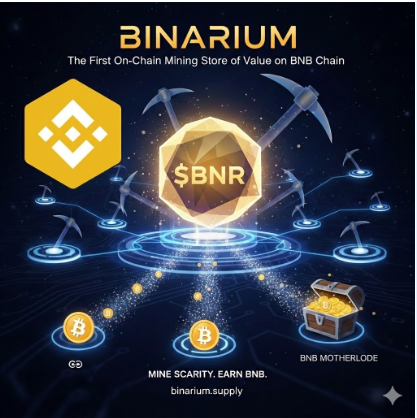
$BNR brings ORE supply-style mining mechanics and MACARON-inspired rewards to Binance BNB Chain
BOSTON, Mass., January 21, 2026 — Binarium has launched on BNB Chain, delivering the first on-chain mining store of value token built exclusively for the Binance ecosystem.
Every major blockchain has its native store of value. Solana has ORE and MACARON protocols. Now the BNB Chain has a Binarium. For users searching for an ORE supply for BNB or MACARON for BNB alternative, Binarium fills that gap—combining the best elements of both projects while leveraging BNB Chain’s lower fees, faster transactions, and massive user base.
On-Chain Mining Meets BNB
Binarium brings on-chain mining to BNB Chain without requiring expensive hardware. Users connect their wallet and mine directly from the browser, earning rewards through active participation. The protocol functions as an ORE supply for BNB—accessible, engaging, and rewarding.
Unlike traditional crypto mining, Binarium’s system delivers triple reward mining:
- $BNR Distribution — Earn scarce Binarium tokens through mining participation
- Native BNB Rewards — Receive BNB directly while mining
- BNB Motherlode — Compete for massive BNB jackpots in special events
Mine once, earn multiple rewards—including both the native chain currency and a scarce store of value tokens.
Tokenomics Built for Scarcity
$BNR features a permanently fixed supply of 56 million tokens with zero inflation. The Binarium store of value is designed to appreciate over time through built-in scarcity mechanics:
- 95% Mining Rewards — 53.2 million $BNR available exclusively through on-chain mining
- 5% Initial Liquidity — Paired with BNB on PancakeSwap
- Fair Launch — No team allocation, no presale, no VC tokens
The Buyback & Bury mechanism uses 6.5% of mining activity to purchase and permanently remove $BNR from circulation, creating continuous deflationary pressure.
Why Binarium
While ORE protocol pioneered on-chain mining and macaron brought gamified store of value mechanics to Solana, BNB Chain users have lacked a native equivalent. Binarium is the MACARON for BNB that the ecosystem needs—purpose-built for Binance Smart Chain, not a bridge or fork.
The BNB store of value is live now. Mine scarcity. Earn BNB. Own the Binance store of value.
About Binarium
Binarium ($BNR) is the definitive store of value on the BNB Chain. Scarce, mineable, and built natively for Binance Smart Chain with on-chain mining.
Website: binarium.supply
Network: BNB Chain
Kyle Parker

