
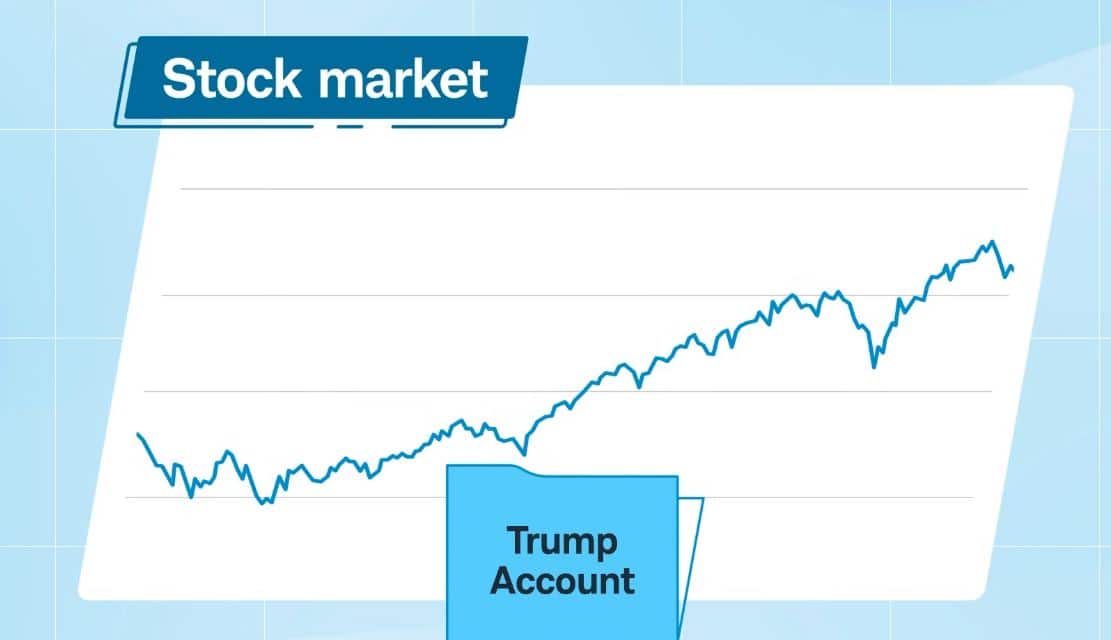

President Trump rang the New York Stock Exchange’s opening bell from the Oval Office early on July 4, 2026. A president sitting behind the Resolute Desk, introducing what the administration is calling a generational savings program for American children, was an eye-catching image. There was something theatrical about the ceremony. A genuinely intriguing financial question, however, was emerging behind the pageantry: are Trump Accounts truly a wise investment?
The fundamental structure is fairly simple. Any child under the age of eighteen who has a Social Security number is eligible. Up to $5,000 can be donated annually by friends, family, employers, and even nonprofits. The funds are invested in a low-cost index fund that tracks a variety of U.S. stocks. The account compounds tax-deferred until the child turns eighteen, at which point it becomes a traditional IRA. The $1,000 federal seed contribution available to infants born between 2025 and 2028 is the main attraction, at least for the time being. The free money is a real and instantaneous part.
Before the accounts even went live, an estimated six million families had registered. That figure may seem impressive until you take into account the number of eligible children in the nation and the number of families who may have enrolled purely for the $1,000. It’s difficult not to question if the excitement stems from a sincere faith in the program or simply a logical reaction to the term “free.”
This is where things become more complex. Based on past S&P 500 returns, the $1,000 could theoretically increase to about $6,000 by the time a child turns 18. The administration says the initial deposit alone could reach $243,000 if you extend that to age 55 with an average annual return of 10%. Technically, that projection is feasible. Additionally, a best-case market scenario is assumed. A more cautious estimate, such as 6.7% annual growth, places the figure closer to $40,000 during the same time frame. Taxes and inflation would erode it even more. When making financial plans for an 18-year-old, the difference between those two numbers is very important.
Financial experts criticize the tax treatment more than the concept. Investing after-tax money into a Trump Account eventually results in the gains being taxed at ordinary income rates, which currently range from 10% to 37%, according to Adam Michel of the Cato Institute. In contrast, long-term capital gains in a typical brokerage account are normally taxed at 0%, 15%, or 20%, depending on income. A 529 savings plan goes one step further: withdrawals for eligible educational costs are tax-free, and growth is tax-free. For many families, Trump Accounts fall somewhere between those two options when it comes to pure tax calculations.
The problem of access is another. Money deposited during childhood cannot be taken out until the beneficiary turns 18, and even then, touching it before the age of 59½ results in a 10% penalty unless the money is used for emergency expenses, education, or the purchase of a first home. Concerns have been expressed by experts that lower-income families, who may actually require that money at the age of 18 to pay for living expenses or rent, may be penalized at the exact moment when the account was meant to be most helpful to them. It’s important to recognize that as a design flaw.
However, completely rejecting the accounts would be unjust. Trump Accounts provide an additional layer of long-term investment for families who already have 529 plans and their own retirement savings in order to give their child a head start in the stock market. Belite Capital’s Gerson Gibbs summed up a sensible compromise: if you can afford it, use both. The likelihood that a child will have some financial stability as an adult increases with the number of savings tools used by the family.
The $1,000 subsidy may be the program’s most valuable component, with everything else serving as window dressing. The account will probably grow slightly over the course of eighteen years for a newborn whose family claims the federal contribution and then does nothing else. It will then sit there as a retirement vehicle that the young adult may not fully comprehend. It could be a helpful supplemental account for a family with disposable income, sound financial planning, and tax-savvy advisors. Who this program will ultimately benefit most can be inferred from the difference between those two results. The free money is genuine. Accept it. However, combine it with better choices.
