Analog Devices (NASDAQ: ADI) reported record results for its fiscal fourth quarter and full year on 24 November 2026. Fourth-quarter revenue came in at $4.37bn, taking fiscal 2026 revenue to $15.2bn, up 38% on the year, according to the company’s annual filing with the SEC.
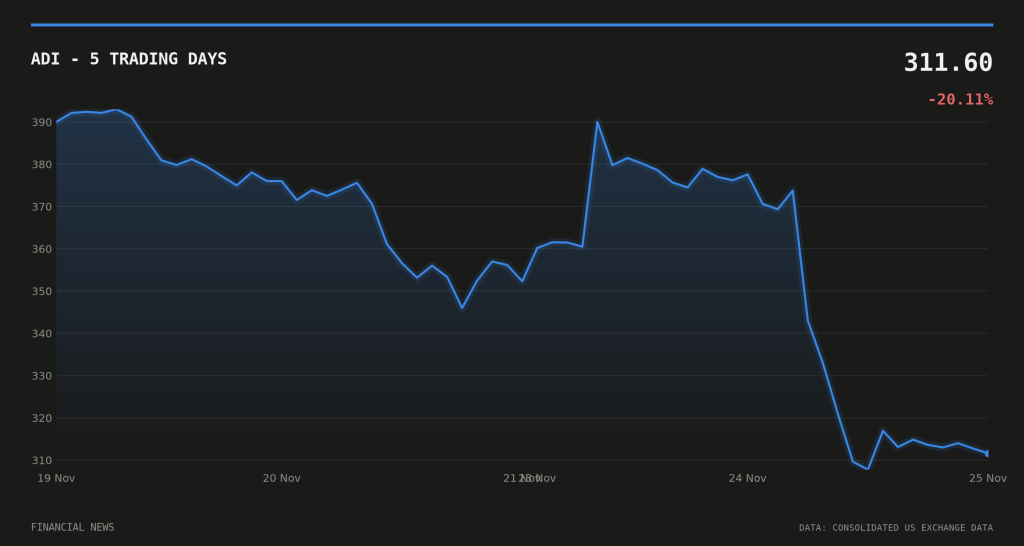
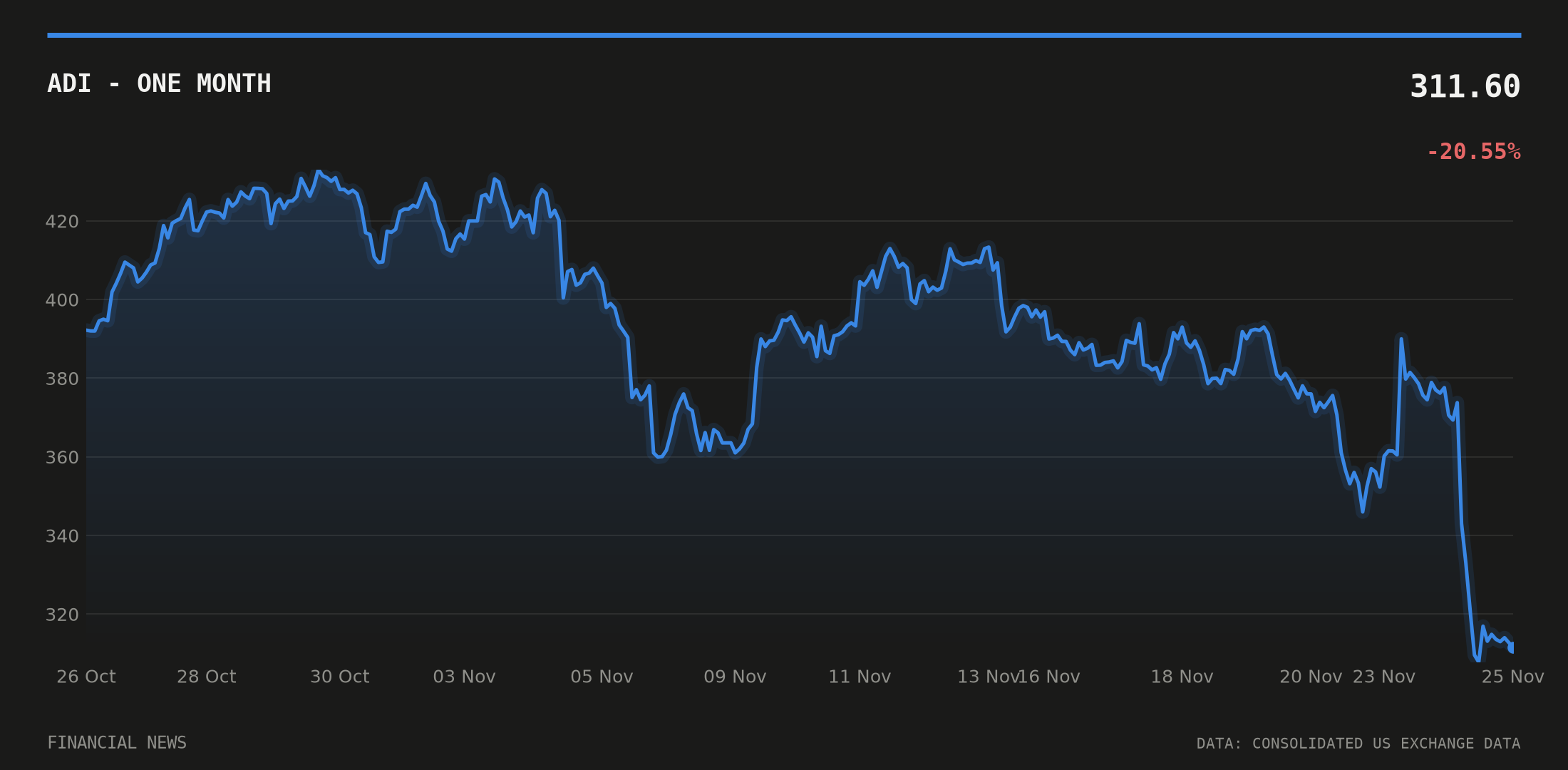
Despite the record numbers, shares have fallen roughly 27% over the past 20 trading days, from a high of $427.95 to a low of $307.77, and last changed hands at $311.60, down 1.68% on the day. The stock had tumbled as much as 16% intraday on the day of the results, as first reported by Crypto Briefing.
A genuinely record year
The fourth-quarter print beat estimates on both revenue and profit. Adjusted earnings per share of $4.06 topped the roughly $3.89-$3.90 analyst consensus, while GAAP diluted earnings per share came in at $3.40, according to a GuruFocus earnings flash of the filing.
Full-year revenue of $15.179bn compared with $11.020bn in fiscal 2025, a $4.16bn increase confirmed in the company’s 10-K. Operating cash flow reached $6.2bn and free cash flow $5.5bn, equal to 41% and 36% of revenue respectively, per the earnings exhibit filed alongside the results. ADI returned $5.4bn to shareholders through dividends and buybacks during the year, Crypto Briefing reported.
Growth was broad rather than confined to artificial-intelligence demand. Chief executive Vincent Roche said in the earnings release that ‘more than two-thirds of our growth in fiscal 2026 came from non-AI-centric market opportunities,’ according to the SEC filing. Full-year end-market growth included industrial revenue up 51%, communications up 74%, automotive up 12% and consumer up 15%, with data-centre revenue more than doubling year-on-year, according to a transcript of the earnings call carried by Benzinga.
Guidance, not the quarter, drove the selloff
The slide traces to forward guidance rather than the numbers just reported. ADI guided fiscal first-quarter 2027 adjusted earnings per share to $3.82 on revenue of around $4.4bn, below what the market had been pricing in, according to Yahoo Finance.
The reaction was sharpened by positioning into the print. Shares had rallied more than 10% the session before earnings on price-target increases from Cantor Fitzgerald and Evercore ISI, Yahoo Finance reported, leaving the stock exposed to a reversal once guidance disappointed. Analyst sentiment had stayed firmly bullish beforehand: 30 buy ratings against four holds, with an average price target of $463.76, according to MarketBeat – a gap of more than $140 to where the stock has traded since.
Short interest climbed into the print
Positioning data point to heavier short-side activity around the release. FINRA’s daily short-sale ratio for ADI rose to 0.473 on 24 November, up from 0.356 the previous session, indicating elevated short-side participation heading into the numbers, according to FINRA data.
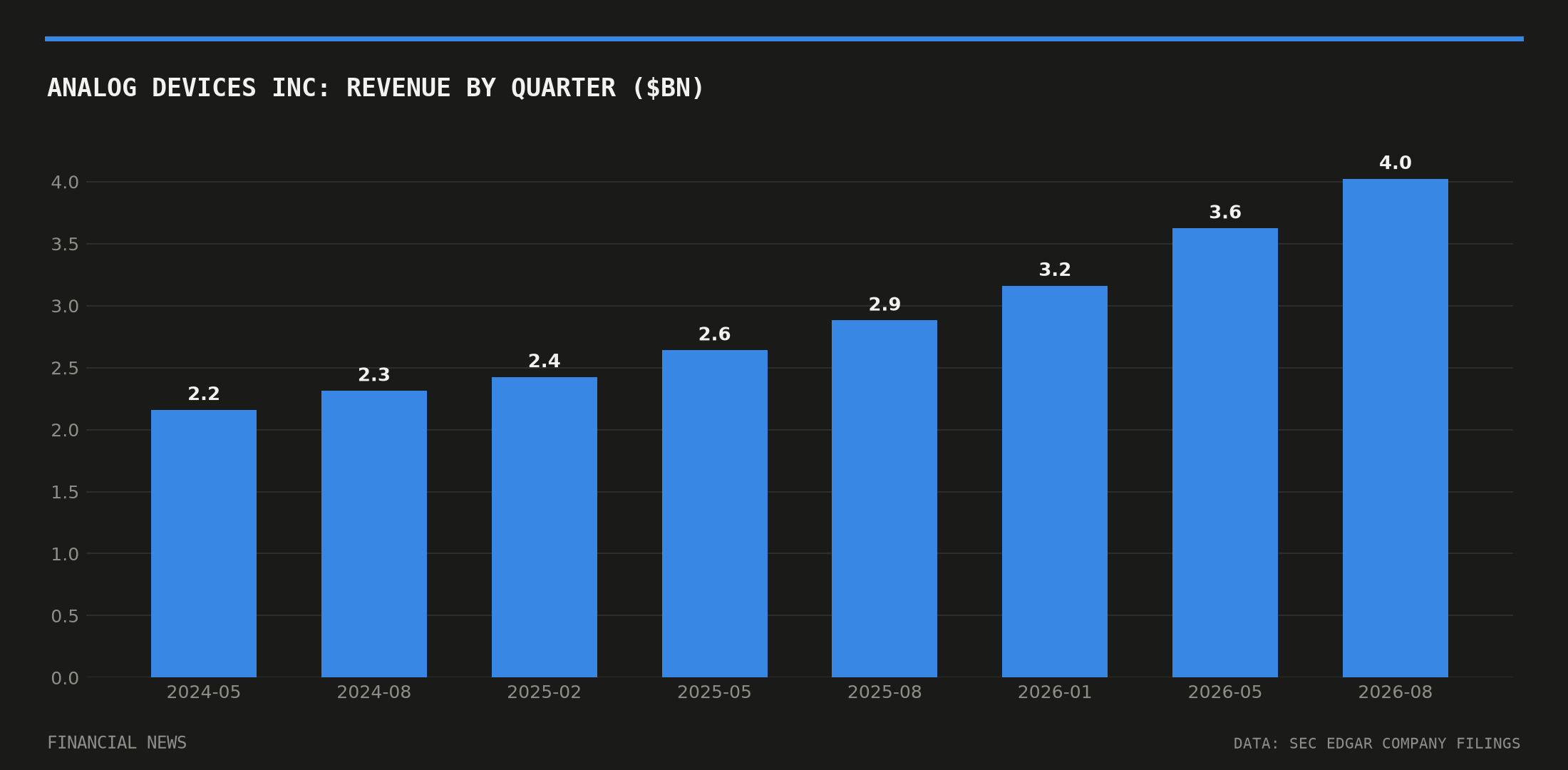
The quarter extends a run of sequential gains that has defined ADI’s fiscal 2026. Revenue rose from $3.16bn in the first quarter to $3.62bn in the second and $4.02bn in the third, before the fourth quarter’s $4.37bn, according to the company’s own quarterly filings. That trajectory underlines how much of the current share-price weakness is forward-looking rather than a reassessment of the year just closed.
Attention now turns to whether the first-quarter guidance proves conservative, a pattern management has leaned on before, or whether it signals a genuine slowdown in the order momentum that carried the stock through 2026. The next scheduled update comes with ADI’s fiscal first-quarter 2027 results.
This article is for information only and is not investment advice or a recommendation to buy or sell any asset. Markets move quickly; figures are correct as sourced at the time of writing. Always do your own research before making financial decisions.