

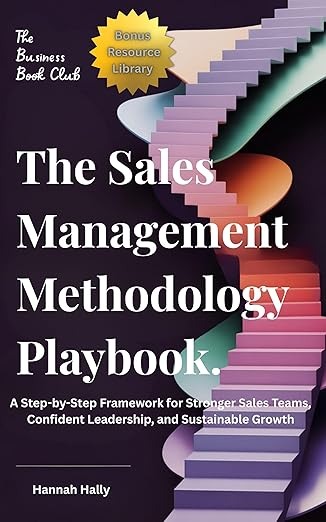
Most sales teams already own the methodology. SPIN for discovery. MEDDICC for qualification. Challenger for the commercial conversation. The frameworks are there, the training happened, the laminated cards went up somewhere near the whiteboard — and the forecast is still wrong on Friday.
Hannah Hally noticed.
Seventeen years in UK tech sales leadership will do that to a person. You watch enough pipeline reviews collapse under the weight of deals that qualified beautifully on paper and then stalled, enough coaching conversations that produced enthusiasm on Tuesday and no behaviour change by Thursday, enough end-of-quarter scrambles from teams that genuinely believed their number was solid. The problem, Hally concluded, was never the individual frameworks. It was that nobody had shown sales leaders how to connect them.
That is the book she wrote.
The Sales Management Methodology Playbook — aimed squarely at Sales Directors, frontline managers and revenue leaders — does not arrive with a new proprietary framework demanding that teams unlearn everything they know. Smarter than that. Instead, Hally takes SPIN, MEDDICC, Challenger and consultative selling and builds a single operating system around them, showing exactly how each one fits into a unified model rather than competing with the others for airtime in the weekly team meeting. The result, she argues, is something most sales organisations have never actually had: a repeatable process that produces consistent outcomes regardless of which manager is running the call review.
Bold claim. The tools she provides are what make it credible.
This is not a book that diagnoses problems and then retreats into principle. Readers get templates, scorecards, scripts and structured meeting frameworks — built for immediate use, not gradual adaptation. The kind of material that works in Monday’s 9am pipeline review, not six months from now after a consultant has finished customising it. Hally’s chapters on discovery and qualification discipline, pipeline quality and forecast accuracy are practical in the way that only 17 years of senior field experience can produce — grounded in the specific, recurring failures that sales leaders actually face rather than the theoretical ones that look good in a business school case study.
And then there is the AI chapter.
Most sales leadership writing on artificial intelligence currently falls into one of two failure modes: breathless enthusiasm that treats AI as a complete replacement for human judgement, or defensive scepticism that dismisses it as a distraction. Hally takes neither position. Her treatment focuses on where AI genuinely supports productivity and decision-making — and where pulling human judgement out of the process makes complex B2B selling worse, not better. It is a harder balance to strike than it sounds, and the 17-year backdrop gives it weight that consultant commentary typically lacks.
The timing matters here. UK technology sales teams have navigated compressing deal cycles, more cautious buyers and mounting forecast pressure through 2024 and into 2025. MEDDICC has become near-universal in enterprise SaaS qualification — yet teams running it rigorously still produce inconsistent forecast accuracy, because qualification discipline alone cannot fix coaching quality or discovery depth. Those are the gaps the playbook targets simultaneously rather than sequentially.
Alongside the book, Hally runs The Business Book Club — a podcast platform built around leadership development that professionals can actually fit into a working day. Three series sit within it: 5-Minute Summaries, Icons of Influence and Leadership Unpacked. The same philosophy runs through both projects. Insight without application has limited shelf life. Learning needs to be delivered in forms that work between calls, not only in the training room.
Seventeen years of watching the frameworks fail. One book explaining what to do instead.
For sales leaders tired of diagnosing the same problems in the same pipeline meetings — the scorecard on page one might be worth the price of the book alone.
