

Teradyne (NASDAQ: TER) said on 5 October 2026 it has made a strategic investment in Bright Machines, pairing its robotics and test technology with the private manufacturing-software firm’s platform to build out AI infrastructure production lines.
Neither company put a figure on the Bright Machines investment, leaving investors to measure it against Teradyne’s past minority stakes – including the $12.0m it put into manufacturing-software group MachineMetrics in 2021, according to a Teradyne 10-Q filing.
What the Bright Machines investment covers
The companies describe the tie-up as both capital and collaboration. Teradyne’s robotics arm and its test-technology division will work with Bright Machines’ software-defined manufacturing platform, which the two firms say has supported more than 130 microfactory deployments across ten-plus countries, per the joint announcement.
Shantnu Sharma, Teradyne’s chief development officer, said: “Physical AI is changing what is possible on the factory floor.” James Davidson, the company’s chief AI officer, framed the rationale around automation’s current ceiling, saying “what limits automation today is not what a robot can physically do.”
Bright Machines is not a start-up without backers. It raised $126m in a Series C round in June 2024 with participation from BlackRock, Nvidia and Microsoft, according to a PR Newswire release at the time – giving the Bright Machines investment a credible counterparty, even without a disclosed size.
No filing yet describes the deal
The only Teradyne filing in the window around the announcement is a routine Form 4 covering a director’s periodic share sale, unconnected to Bright Machines, filed with the SEC on 2 October 2026. No 8-K describing the transaction has appeared in the public record.
That is not necessarily telling. Teradyne’s 2021 MachineMetrics stake surfaced only in a later 10-Q, while its larger 2023 Technoprobe agreement was material enough to require its own 8-K disclosure. The absence of a filing this time points either to a smaller cheque or simply to a disclosure still working its way through the pipeline.
A company with cash to spend
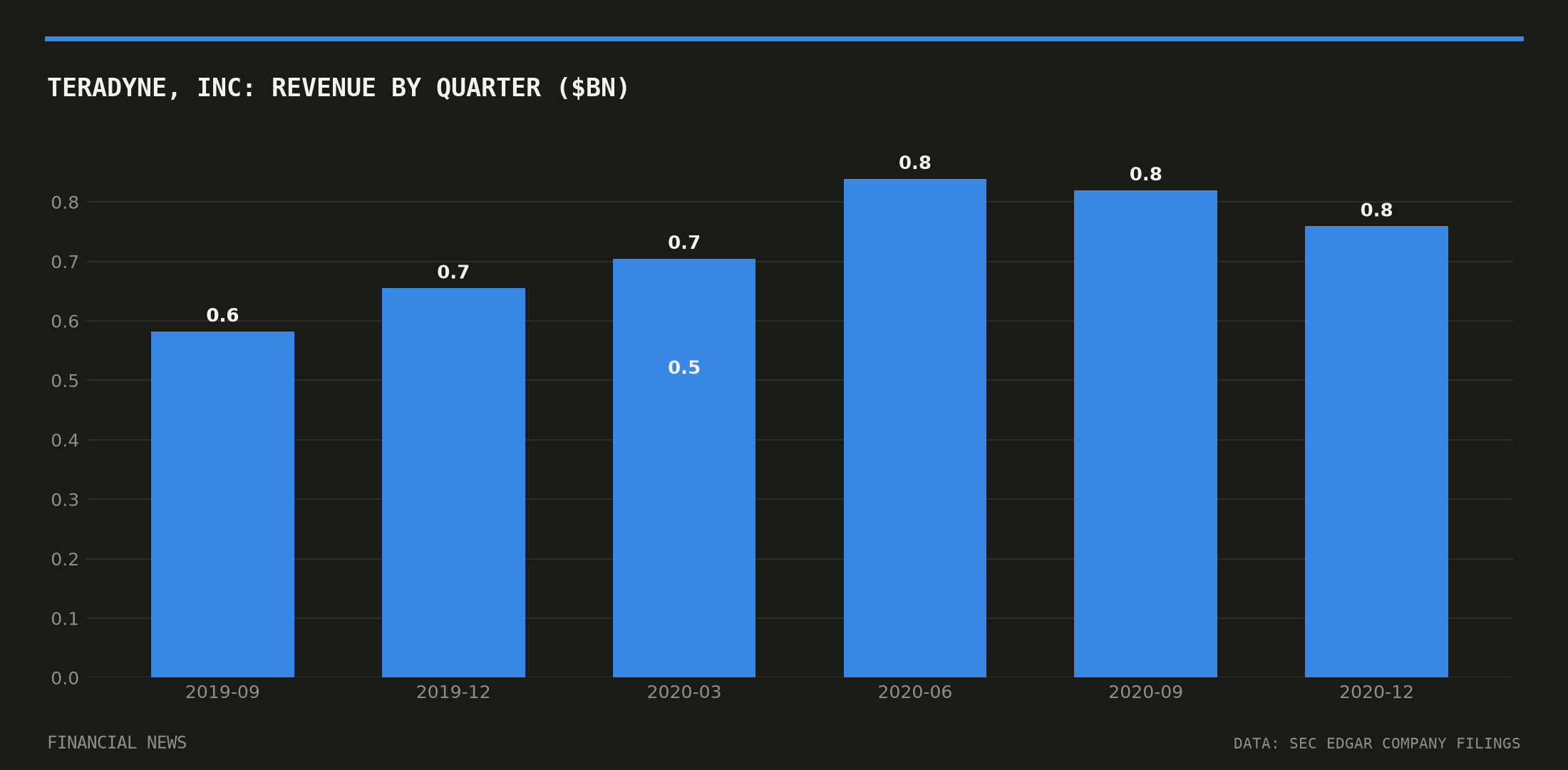
Whatever the size, Teradyne has the balance sheet for it. Net income reached $398.9m in the first quarter of 2026, up from $98.9m a year earlier, and $374.5m in the second quarter, according to its 10-Q filings. Diluted earnings per share rose to $2.53 in the first quarter from $0.61 a year before.
That surge sits against a market that has already priced in a great deal of AI-driven growth. Teradyne shares last traded at $435.98, down 3% on the day but up 29.61% over the prior 20 sessions, having ranged between $326.97 and $450.56 in that stretch, according to consolidated exchange data. Seeking Alpha analysis has flagged the stock trading at roughly 55 times trailing earnings and 14 times trailing sales despite revenue growth of 104% year-on-year in the second quarter of 2026.
The macro backdrop adds another layer. The 10-year US Treasury yield stood at 5.24% as of 1 October 2026, down slightly from 5.29% prior, according to Federal Reserve data – a rate environment that keeps pressure on high-multiple names making new capital commitments.
What’s missing from the record
For now, the Bright Machines investment stands as a confirmed partnership with an unconfirmed price. Teradyne has not said whether the stake is a token position akin to MachineMetrics or something closer in scale to Technoprobe, where disclosure obligations kicked in. Until a filing or further statement specifies the terms, investors sizing the deal are working from precedent rather than paperwork.
This article is for information only and is not investment advice or a recommendation to buy or sell any asset. Markets move quickly; figures are correct as sourced at the time of writing. Always do your own research before making financial decisions.
