

The Federal Reserve is drafting a plan to raise the asset thresholds that trigger stricter oversight of big banks, Reuters reported on 25 September 2026, citing four sources familiar with the discussions.
The current rules impose tougher requirements once a bank passes $100bn in assets, with further steps at $250bn and $700bn. Three of the four sources told Reuters they expect the Fed to formally propose changes to those bank oversight thresholds later this year.
Who actually benefits
Raising the tiers would let some lenders escape costly capital, liquidity and stress-testing requirements, and could encourage consolidation among midsize regional banks, according to Reuters. The thresholds have not moved since 2019, when the Fed set them following Congress’s 2018 softening of Dodd-Frank supervisory rules.
That timing matters for who gains. Bank Policy Institute and the American Bankers Association have argued for years that the framework’s dollar lines have not kept pace with inflation or industry growth. Trade groups have been pressing the case since at least last year, and bankers were already anticipating a move on the $100bn line after Fed Vice Chair for Supervision Michelle Bowman’s June 2026 remarks on category thresholds, as American Banker reported at the time.
The lenders best placed to benefit sit just above or below the $100bn and $250bn marks – regional banks that could shed Category III or IV supervisory burdens if the lines shift upward. Bank of America (NYSE: BAC), Citigroup (NYSE: C) and BNY (NYSE: BNY) are not among them. All three already sit well above the top $700bn tier and face the Fed’s most stringent enhanced prudential standards regardless of where the lower boundaries are redrawn. Citizens Financial Group (NYSE: CFG), closer to the $250bn band, has more at stake in the outcome.
Shares tell a different story
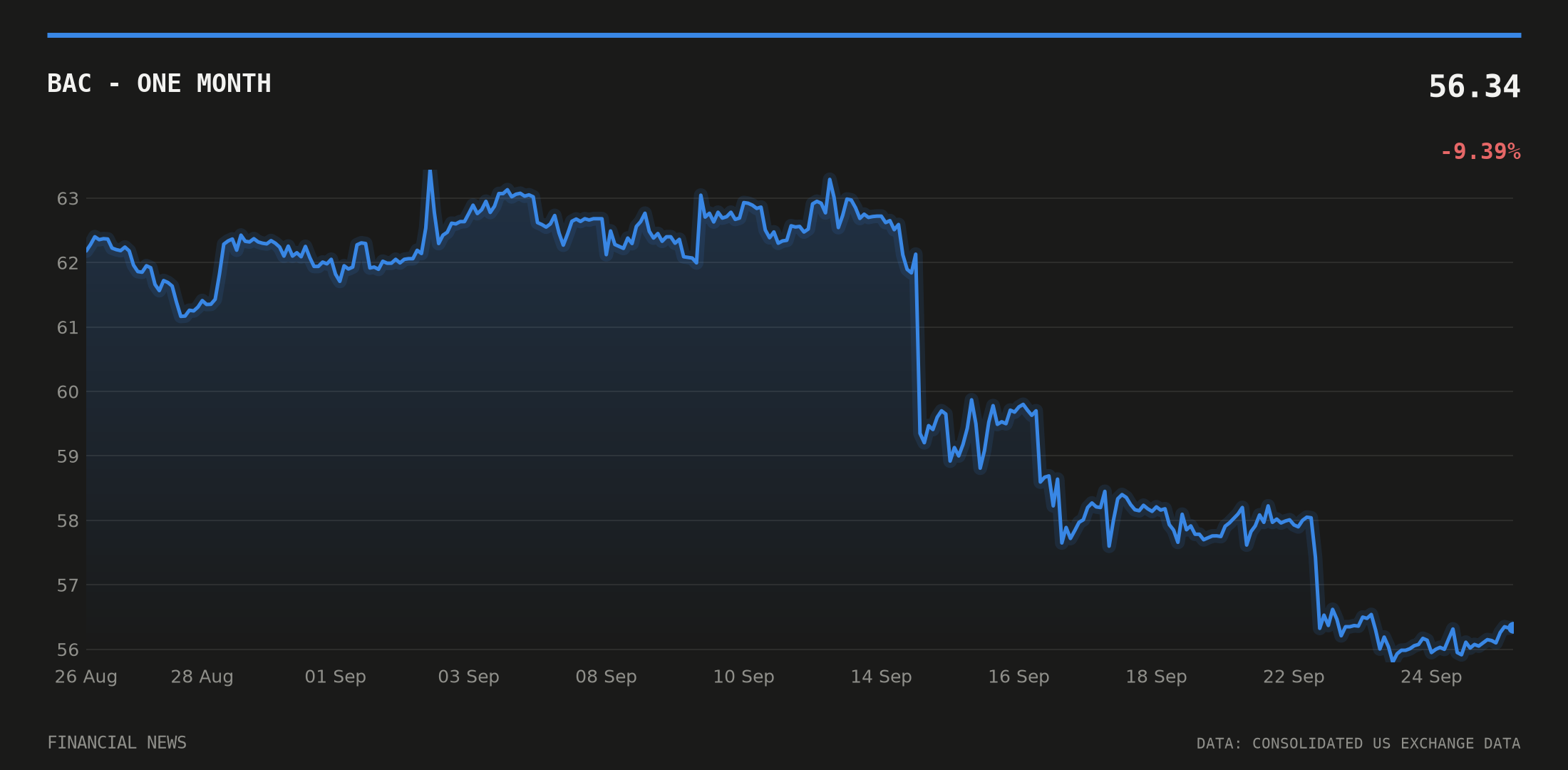
Markets have not treated the report as a clear win for the largest lenders. BAC shares traded at $56.34 as of 25 September, down 9.8% over the prior 20 days, against a 20-day high of $63.29.
Short-selling activity picked up over the same stretch. BAC’s FINRA short-volume ratio rose to 0.496 on 24 September, up from 0.275 on 21 September, suggesting some investors were positioning against the stock even as the Fed report circulated. Trading volume over the period ran at 44% of the 20-day average, pointing to a quiet market rather than a rush of buyers chasing a deregulation headline.
The regulatory-tailoring push is not confined to this one report. In March 2026 the Fed proposed indexing Category I and II capital thresholds and the GSIB surcharge to inflation, and the FDIC floated a parallel inflation-linked adjustment to agency asset thresholds in mid-2025, arguing they had not been raised “in decades.” Comments on the joint FDIC-Fed-OCC capital-threshold proposal closed on 18 June 2026, according to an FDIC financial institution letter.
Fundamentals keep climbing regardless
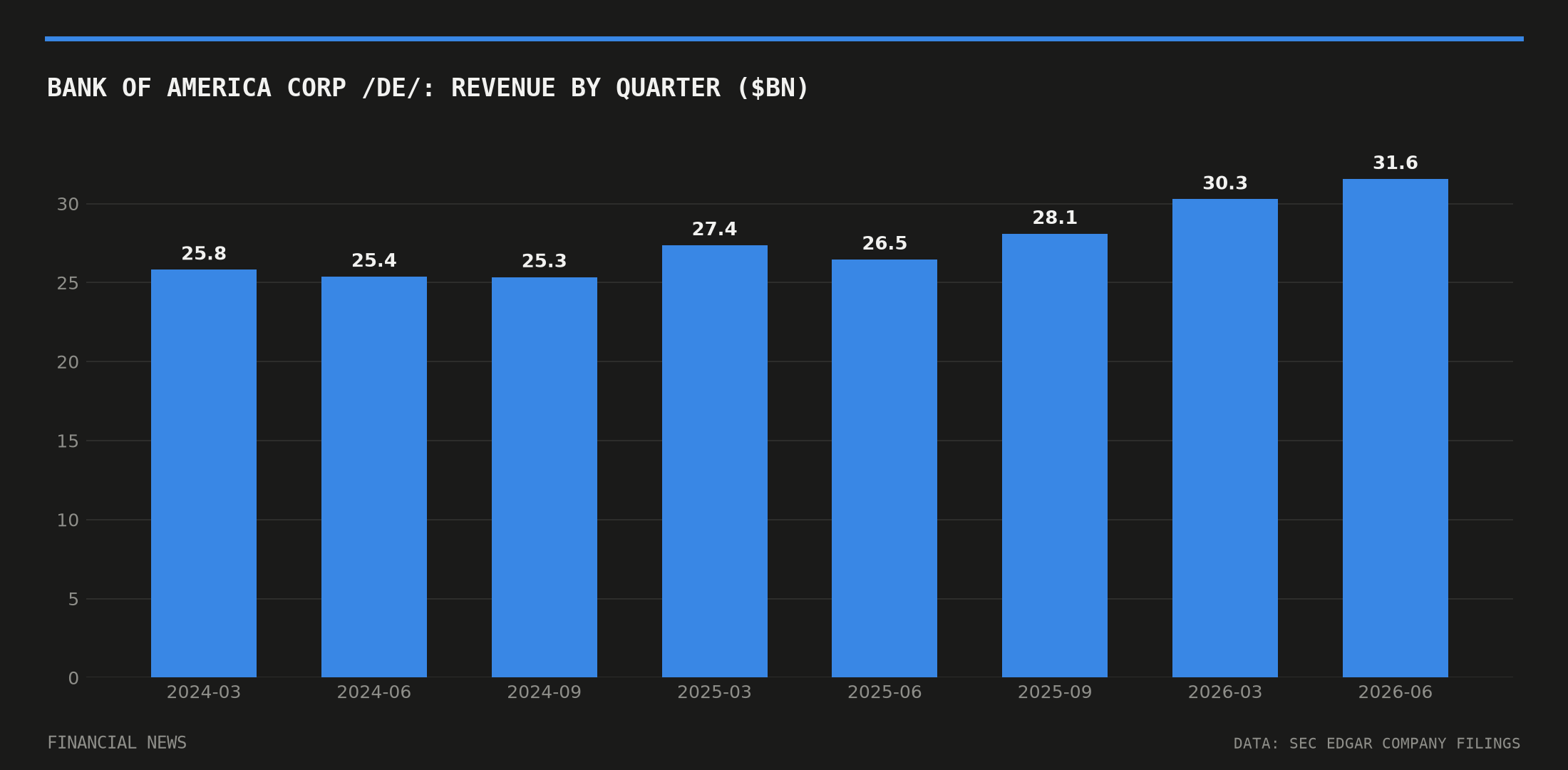
Whatever the Fed decides on thresholds, Bank of America’s underlying numbers have kept rising. Quarterly net income climbed from $6.674bn in the first quarter of 2024 to $9.074bn in the second quarter of 2026, according to the bank’s 10-Q filings with the SEC. Diluted earnings per share rose from $0.76 to $1.21 over the same run of quarters, and revenue grew from $25.8bn to $31.6bn.
None of that growth trajectory depends on where the Fed sets its $100bn or $250bn lines – BAC cleared those thresholds long ago and would remain under enhanced prudential standards under any plausible redraw. The bank’s size, which once made it a poster child for post-crisis oversight, now puts it outside the group of lenders with anything obvious to gain from this particular reform.
Treasury yields have moved higher in the same window, with the 10-year at 5.11% on 23 September against 4.96% previously, a backdrop that weighs on bank funding costs independent of any regulatory shift, according to Federal Reserve data.
The Fed has not confirmed a timetable for a formal proposal. Bank Policy Institute and the American Bankers Association are likely to keep pressing for the change in public comment letters, while regional lenders closer to the $100bn and $250bn lines stand to find out first whether the reform reaches them.
This article is for information only and is not investment advice or a recommendation to buy or sell any asset. Markets move quickly; figures are correct as sourced at the time of writing. Always do your own research before making financial decisions.
