

Warren Buffett is stepping down as chairman of Berkshire Hathaway (NYSE: BRK-A), the company said on 18 September 2026, becoming chairman emeritus after 56 years in the role.
His son Howard Buffett, a Berkshire director since 1993, becomes the new chairman, according to NPR, citing the Associated Press. Warren Buffett, 96, remains a director on the board.
Buffett steps down as chairman after 56 years
Buffett had chaired Berkshire since 1970 and stepped down as chief executive in late 2025, succeeded by Greg Abel, according to AP reporting carried by KIRO 7. Susan Decker continues as lead independent director, CNBC reported.
In his letter to shareholders, Buffett wrote: ‘Father Time always wins,’ adding ‘He has, however, been generous with me,’ according to CNBC. The phrase echoes a near-identical line Buffett used in a Thanksgiving 2024 philanthropy letter posted on Berkshire’s own site, making the callback in this transition letter a deliberate one.
Buffett described the succession arrangement plainly: ‘Greg runs the company; Howard will guard its culture and values,’ he said, according to the AP wire carried by KIRO 7. Abel said of his longtime boss: ‘Warren’s impact on Berkshire and its owners is without parallel in the history of American business,’ and that ‘Howard will be their guardian’ of the firm’s culture, according to an NPR affiliate carrying the same AP wire copy.
Stock lags the market as cash pile swells
The handover lands at an awkward moment for Berkshire’s shares. The stock is up just 1% in 2026, against a gain of more than 11% for the S&P 500, CNBC reported, raising the stakes for Abel as he takes full command.
Berkshire is sitting on $365.5bn in cash, and Abel lifted share buybacks to $4.5bn in the second quarter, per CNBC’s reporting. The market has watched the cash pile grow for several years now, and Buffett’s exit as chairman sharpens the question of how quickly Abel will put it to work.
Buffett’s own stake in Berkshire stock was worth more than $140bn as of July 2026, according to the AP wire report carried by KIRO 7.
The numbers behind the succession
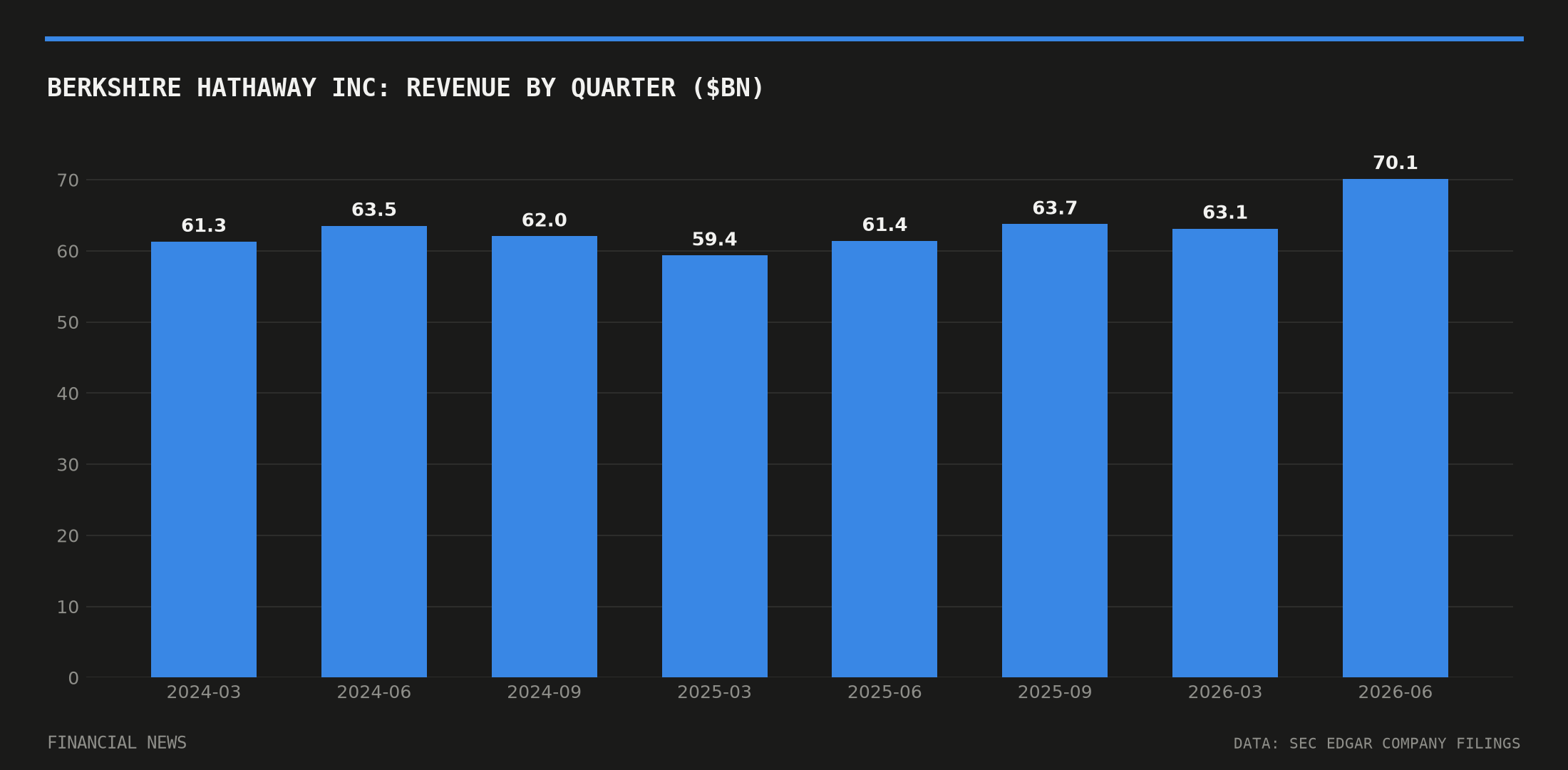
Berkshire’s underlying business has kept growing through the leadership handover. Net income for the quarter ended 30 June 2026 came to $25.667bn, on revenue of $70.115bn, according to the company’s 10-Q filing with the SEC. That revenue figure is the highest of any quarter in the past two and a half years, ahead of the $63.747bn booked in the third quarter of 2025 and the $63.519bn reported in the second quarter of 2024.
Quarterly profit has swung sharply across recent periods, reflecting the mark-to-market treatment of Berkshire’s vast equity portfolio rather than any deterioration in its operating businesses. Net income ran from $4.603bn in the first quarter of 2025 to $30.796bn in the third quarter of the same year, before easing to $10.106bn in the opening quarter of 2026 and then rebounding to the $25.667bn reported for the second quarter, filings show.
The transition also lands against a rates backdrop that shapes how Berkshire’s insurance float and bond holdings behave. The 10-year US Treasury yield stood at 5.01% on 16 September 2026, against 4.74% on the two-year note, according to data from the Federal Reserve Bank of St Louis. The 10-year/2-year spread held at 0.27 percentage points, little changed from the prior session, separate FRED data show, leaving the yield curve’s modest positive slope largely intact as the leadership change takes effect.
What comes next
Berkshire’s next scheduled disclosure of note is its third-quarter results, which would offer the first full look at how Abel is deploying capital under Howard Buffett’s chairmanship rather than Warren Buffett’s. Investors have flagged the size of the buyback programme and the pace of any acquisitions as the clearest early signals of the new leadership’s approach, building on the $4.5bn spent on repurchases in the second quarter.
This article is for information only and is not investment advice or a recommendation to buy or sell any asset. Markets move quickly; figures are correct as sourced at the time of writing. Always do your own research before making financial decisions.
