
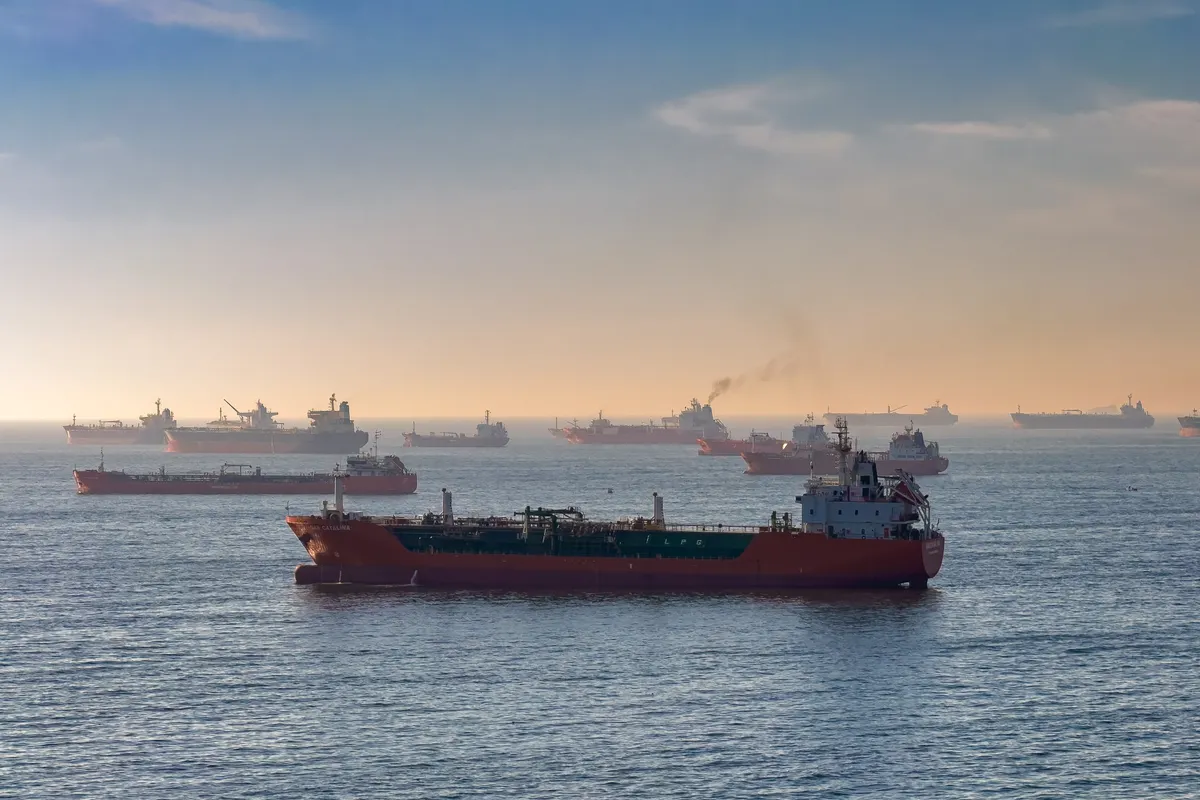

The London Stock Exchange‘s FTSE 100 fell on Tuesday as Donald Trump’s Hormuz toll threat and a fresh round of U.S. military strikes on Iran pushed oil prices sharply higher and rattled equity markets. The index was down 0.5% in afternoon trade, with around 75% of its constituents in negative territory.
The Hormuz Toll Announcement and What It Said
Trump posted on Truth Social that ships transiting the Strait of Hormuz would face a levy ‘at the rate of 20% on all cargo shipped,’ according to CNBC. He did not specify whether the charge would apply to the value of cargo, shipping costs, or another measure, leaving the mechanism undefined.
U.S. Central Command said the blockade of Iranian ports near the strait was set to resume at 4 p.m. ET on Tuesday. The announcement followed U.S. strikes on Iran on Sunday evening, in which U.S. Central Command said it had hit ‘dozens of targets at multiple locations with precision munitions to degrade Iran’s ability to continue attacking international shipping flowing through the Strait of Hormuz.’
The International Maritime Organization pushed back directly. The IMO ‘stands firmly against charging fees for passage through straits used for international navigation’ and said there is ‘no legal basis through which to introduce mandatory tolls simply to transit through a strait,’ CNBC reported, quoting an IMO statement.
The White House had been building formal pressure on Tehran since at least February 2026, when a presidential action titled ‘Addressing Threats to the United States by the Government of Iran’ extended the national emergency first declared under Executive Order 12957 in March 1995.
FTSE 100 Hormuz Toll Fears Pull Down Three-Quarters of the Index
Housebuilders and consumer-facing stocks bore the brunt of Tuesday’s selling. Persimmon and Barratt each lost around 2%, weighed by the prospect of higher energy costs filtering through to the broader economy. InterContinental Hotels fell 3.8%, hit by the risk of disrupted travel routes and weaker consumer confidence. Pearson and Melrose dropped between 2% and 3%.
BP and Shell, along with other commodity names, provided partial support. It was not enough to keep the index in positive territory.
Susannah Streeter, Chief Investment Strategist at Wealth Club, said markets had effectively stalled. ‘Stasis has taken over markets as investors wait for the latest twist in the Iran conflict and brace for higher energy prices to filter through to economies,’ she said. ‘The Strait of Hormuz is once again a dangerous flashpoint and fast becoming a highly expensive one.’
Streeter added: ‘President Trump has called for a 20% reimbursement on cargoes transiting the waterway, although he did not specify whether this would be based on the value of the cargo, shipping costs or another measure, leaving big questions over how such a levy could be implemented.’
On the oil price conflict: the snippet reported Brent crude trading above $86 a barrel, up 4% on the day, while WTI rose 3% to above $80. Trading Economics showed Brent closer to $84 a barrel as diplomatic contacts emerged, with Iran’s Foreign Minister holding separate talks with his Saudi and Omani counterparts and Oman proposing a joint regional mechanism to manage the strait. The snippet figure of above $86 reflects the intraday high; the $84 reading from Trading Economics appears to capture a later retracement as diplomacy developed.
Oil Market Fundamentals Tighten the Squeeze
The price moves come against a taut supply backdrop. U.S. crude inventories fell 1.7 million barrels for the week ending 10 July, leaving commercial stockpiles at 409.7 million barrels, which is 6% below the five-year seasonal average, OilPrice.com reported, citing U.S. Energy Information Administration data.
The supply picture in the Middle East is equally constrained. The EIA’s Short-Term Energy Outlook shows Middle East crude production shut-ins averaged 8.3 million barrels per day in June, down from a peak of 11.2 million b/d in May. The EIA still forecasts an average of 1.4 million b/d of supply remaining shut-in across the fourth quarter of 2026.
With inventories lean and a meaningful share of regional production already offline, any further escalation in the strait has limited buffer in the physical market. The next move hinges on whether Oman’s proposed regional mechanism for managing the strait gains traction before U.S. and Iranian forces exchange another round of fire.
