
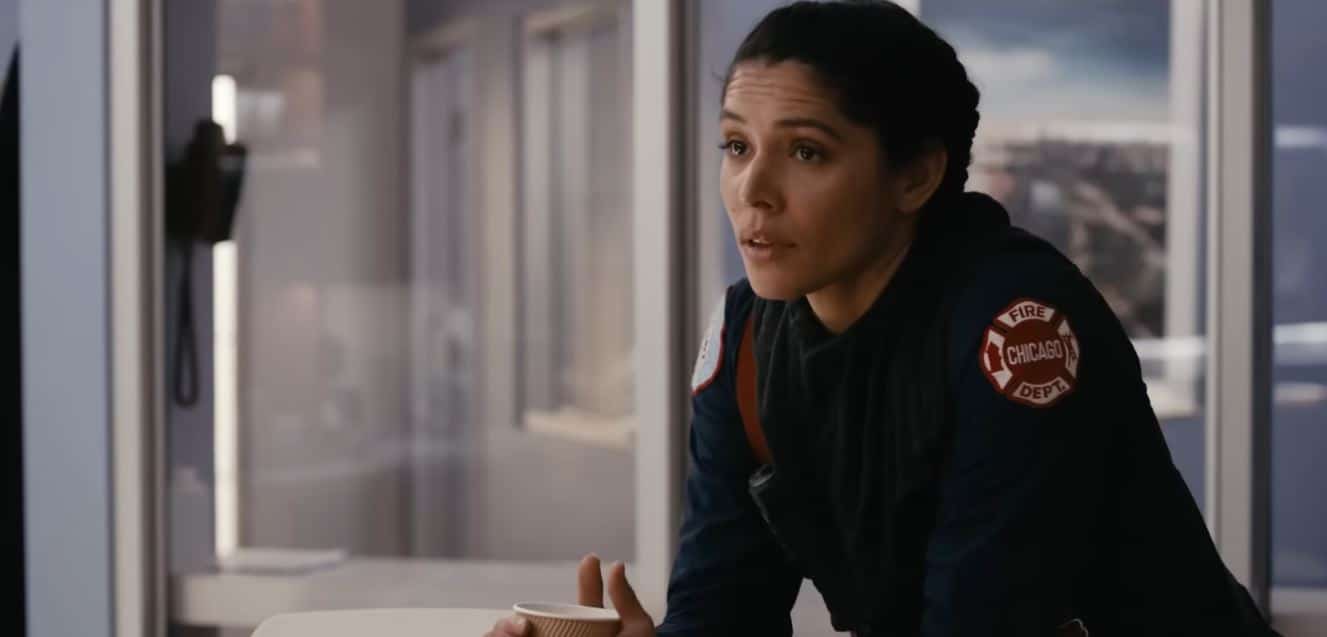

When viewed through the perspective of a television drama, Chicago’s streets take on a different appearance. The city itself feels alive as firefighters dash into danger, sirens reverberate between tall brick buildings, and emergency lights bounce off wet asphalt. For years, Chicago Fire has built its reputation on moments like that—moments where heroism and tragedy collide in ways that feel uncomfortably real. Throughout the show, a few characters move silently. Others make a lasting impression long after the credits have rolled.
One of those characters was Macy Vasquez. Macy had a certain unadulterated resolve that seemed plausible when viewers first encountered her on Chicago Fire. She wasn’t presented as an experienced hero or a self-assured firefighter. Rather, she came to prominence through Stella Kidd’s “Girls on Fire” program, a narrative intended to encourage young women to seek careers in firefighting. It was encouraging to watch her train, falter, and ultimately complete the program.
| Category | Details |
|---|---|
| TV Series | Chicago Fire |
| Character | Macy Vasquez |
| Portrayed By | Carlita Tucker |
| Occupation in Series | Firefighter / EMT Candidate |
| Affiliation | Chicago Fire Department – Firehouse 87 |
| Program | “Girls on Fire” Training Initiative |
| First Appearance | Chicago Fire Season 10 |
| Final Storyline | One Chicago crossover event (“Reckoning”) |
| Cause of Death (Storyline) | Chemical exposure during emergency rescue |
| Official Show Page | https://www.nbc.com/chicago-fire |
Characters that develop in front of the audience have a certain allure. Macy was a symbol of a new generation joining the Chicago Fire Department. She put in a lot of effort, picked things up fast, and gradually gained respect from the firefighters who had spent years fighting fires and natural disasters. Her presence brought a degree of vulnerability to a show full of seasoned veterans.
Perhaps that vulnerability served a purpose. Characters like Macy are frequently introduced by television writers to illustrate a profession’s future. Like many organizations, firehouses depend on new hires to maintain their traditions. Macy’s story was shaped by the “Girls on Fire” program, which represented the shift from mentorship to practical responsibility.
It was subtly satisfying to watch her assume the role of firefighter. However, Chicago Fire has always benefited from unpredictability. Every now and then, the show serves as a reminder to viewers that fighting fires is risky in ways that television narratives are unable to mitigate. Emergencies happen fast, and not all rescues have the desired outcome.
During the massive “One Chicago” crossover event called “Reckoning,” that tension collapsed.
A terrifying emergency call opens the plot. Emergency personnel are immediately alarmed when a passenger plane lands after losing contact with air traffic control. The scene inside the aircraft is nearly unbelievable when firefighters arrive: hundreds of passengers have already perished as a result of an unexplained chemical exposure.
At times like that, Chicago Fire seems less like entertainment and more like a fictionalized reflection of actual tragedies.
Along with other firefighters, Macy boards the aircraft to look for survivors. She stays in the contaminated environment for longer than anyone initially realizes due to the chaos of the situation. At the time, it appears to be a typical act of bravery—the kind of risk that firefighters take on a daily basis.
However, there is a problem. Several responders start exhibiting symptoms from the chemical agent as the crossover plot develops between Chicago Fire, Chicago Med, and Chicago P.D. After being taken to the hospital, Macy’s condition rapidly worsens. As her breathing deteriorates, doctors try emergency procedures in a hurry.
It’s tense, almost uncomfortable, to watch the scene develop. The emotional weight of the situation is difficult to ignore. Macy had only recently proven herself as a firefighter. She had made it through the academy, won her team’s trust, and started advancing her career in the Chicago Fire Department.
The future abruptly vanishes. According to the show, Macy passes away as a result of complications brought on by the chemical exposure. Rather than being a dramatic spectacle, the announcement is delivered with a quiet finality. She is battling for her life in the hospital one moment, and then the narrative turns to the aftermath.
Deaths on television are occasionally overdone for shock value. It felt different this time.
Stella Kidd’s relationship with Macy contributes to the emotional impact. Kidd saw recruits like Macy as practically protégés because she was the mentor behind the “Girls on Fire” program. As a result, the loss becomes extremely personal, making her face the dangers of encouraging young people to pursue such a risky career.
The story takes on a new level as you watch that dynamic develop. It’s easy to understand why fans reacted so strongly. Although Macy was never the show’s main character, her journey stood for hope—hope that more firefighters would come forward to defend their communities.
That optimism is abruptly interrupted by her death in a way that seems intentional. It seems as though the authors wanted Macy’s story to speak to a broader issue regarding firefighting in general. Real firefighters are aware that there is always risk and uncertainty, regardless of how well a rescue is portrayed on television.
Viewers are reminded of that reality by Macy’s character. Her legacy lives on in the world of the show even after her plot concludes. The “Girls on Fire” program is still in place, mentoring upcoming recruits and celebrating the notion that bravery can motivate others to follow.
And maybe that’s the story’s subliminal message. Sometimes the most powerful moments in a show full of dramatic rescues and burning buildings occur after the sirens have faded.
