

Rows of corn stretch like green walls toward the horizon on a warm Iowa July morning. For generations, farmers have listened to the gentle rustle of leaves in the wind as they speculate about the potential appearance of the harvest. Crop yield prediction for the majority of agricultural history relied on a combination of memory, instinct, and cautious optimism. Explore the fields, look at the dirt, and look up at the sky. Next, hope.
These days, algorithms are another thing that sits next to that instinct. Months before combines ever hit the fields, farmers in the Midwest of the United States and elsewhere are quietly testing artificial intelligence systems that predict crop yields. The technology collects data from weather stations, satellites, and small sensors embedded in the ground, then processes the information to produce predictions that can occasionally seem uncanny in their accuracy.
| Category | Details |
|---|---|
| Topic | AI-Driven Crop Yield Prediction |
| Industry | U.S. Agriculture & Precision Farming |
| Key Technologies | Machine Learning, Satellite Imaging, IoT Soil Sensors |
| Primary Applications | Yield forecasting, crop monitoring, precision irrigation |
| Major Data Sources | Weather data, soil health metrics, historical yield records |
| Market Trend | Rapid growth of AI in agriculture analytics |
| Reference Website | https://www.usda.gov |
That’s the promise, anyway. Drones hovering over fields and antennas affixed to barns are now common sights when driving past contemporary farms. These devices do more than just capture images. They are gathering layers of data, such as soil moisture levels, plant health indicators, and subtle color changes in crops that can indicate stress long before the human eye detects any problems.
Farmers have long wondered how much this field will actually produce, and machine learning models use all of that data to try and answer that question.
Although the procedure seems intricate, the reasoning behind it is surprisingly straightforward. AI systems compare decades’ worth of historical farming data with current conditions, such as temperature, rainfall, and soil nutrients. The software gradually improves its ability to predict what yields might look like weeks or even months from now as it learns patterns.
Under stable conditions, some systems claim prediction accuracy of nearly 90%. Farmers are still wary, though.
Agricultural behavior is rarely tidy. Every year, the task of forecasting becomes more difficult due to climate change, erratic storms, and changing pest patterns. Months of meticulous preparation can be undone by a sudden downpour or a week of unanticipated heat. It is evident why farmers are hesitant to fully trust any forecast when they observe a field following a severe summer storm, with mud pooling between rows and leaves flattened.
However, the technology continues to proliferate. It’s partly due to basic economics. Crop yield forecasts affect almost every decision made on a farm, including when to sell grain, how to store it, and how much fertilizer to use. A farmer may be able to lock in favorable market prices earlier in the season if they have even a rough idea that yields will be high.
Investors in agricultural technology firms appear to think that farming economics will change as a result of this data-driven strategy.
For years, precision agriculture has been heading in that direction. Tractors with GPS guidance can plant seeds in almost exact lines and automatically adjust the depth according to the composition of the soil. Rather than dispersing chemicals evenly over entire fields, variable-rate fertilizer systems provide nutrients precisely where crops need them.
On top of that, artificial intelligence expands. AI platforms can identify areas of farmland that need additional irrigation or early pest treatment by instantly analyzing sensor data and satellite imagery. Farmers can take early action rather than waiting for damage to become apparent, sometimes stopping yield losses before they start.
The concept has a subtle elegance. For example, on an Illinois soybean farm, a tiny group of sensors may monitor soil moisture content, temperature, and nitrogen levels every few minutes. A cloud-based platform receives the data and uses algorithms to search for minute patterns. The system can suggest targeted irrigation if moisture levels start to drop more quickly than anticipated.
In certain cases, the technology can even detect illnesses before farmers do. Small changes in leaf color brought on by specific plant diseases are imperceptible from the ground up. Farmers can treat impacted areas early thanks to the ability of multispectral cameras installed on drones or satellites to detect those changes. According to researchers, in certain crops, these early warnings can increase yields by up to 20%.
Many rural communities still rely heavily on knowledge that has been passed down through the ages. Despite their speed, algorithms aren’t able to walk the fields or feel the soil with their fingers. Machines can help, but they shouldn’t take the place of a person who has been farming the same land for thirty years.
When artificial intelligence is introduced, every industry eventually faces the same dilemma: how much faith should humans have in the machine?
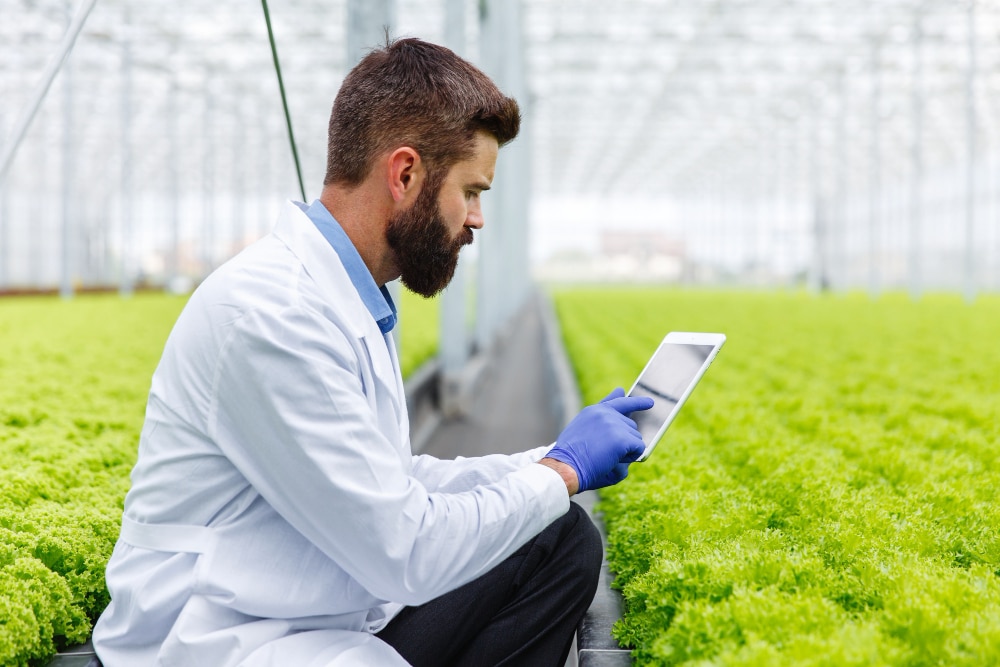
It’s difficult to ignore the balance developing when you watch a farmer stand next to a dusty pickup truck and look at a tablet. Color-coded maps of crop health over hundreds of acres are displayed on the screen. In the meantime, the farmer gets on his knees and manually examines the roots of a plant by pulling it from the ground.
Crop forecasts may be more accurate thanks to artificial intelligence, but agriculture is still heavily influenced by factors that no algorithm can fully comprehend, such as weather patterns that change overnight, insects that show up out of the blue, and soil that behaves differently after decades of cultivation.
Even the most advanced artificial intelligence still uses probability. However, it’s evident that farming is evolving when you stand at the edge of a Midwestern field in late summer, with sensors blinking close to irrigation pipes and drones buzzing softly overhead. Not too loudly. Not all at once.
Millions of data points are subtly forecasting the harvest’s future somewhere in those rows of corn and soybeans.
