
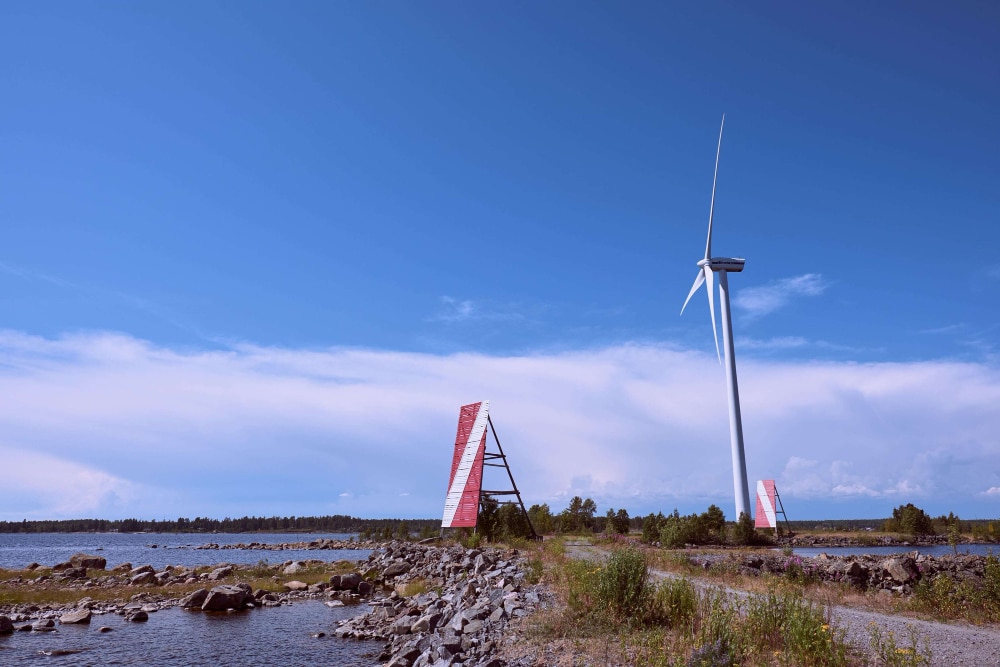

In winter, standing on the chilly Yorkshire coast, the turbines seem almost unreal. Their scale is hard to understand until a maintenance vessel passes beneath them and they appear to be toys. Their white blades turn slowly against a grey sky, silent from a distance. Piece by piece, steel by steel, and more recently, pound by pound, this is where Britain’s energy future is being put together.
Energy companies in the UK have announced significant new investments in offshore wind expansion, investing hundreds of millions in supply chains, manufacturing hubs, and construction projects located along the coast. The wind itself, pushing relentlessly across the North Sea, is the real story, despite the impressive numbers of £1.2 million here and £300 million there.
| Category | Details |
|---|---|
| Industry | Offshore Wind Energy |
| Key Companies | Great British Energy, Ørsted |
| Major Investment Example | £300 million offshore wind supply chain investment |
| UK Offshore Wind Capacity | 16.6 GW currently, target 43 GW by 2030 |
| Major Locations | North Sea, Scotland coast, East Anglia |
| Government Support Mechanism | Contracts for Difference scheme |
| Strategic Importance | Offshore wind provides ~17% of UK electricity |
| Reference | https://www.bbc.com/news |
Britain may have concluded that it has no other option.
About 17% of the nation’s electricity is currently generated by offshore wind, a percentage that would have seemed extremely optimistic twenty years ago. According to new government targets, offshore capacity must nearly triple to 43 gigawatts by 2030. Even though the math still seems off, investors seem to think that this expansion is not only economically necessary but also environmentally necessary.
Workers are welding steel sections that will be used to create turbine towers taller than skyscrapers in fabrication yards along the northeast coast and shipyards in Scotland. Machinery that didn’t exist ten years ago is illuminated by flashing sparks in dim industrial buildings. With the support of both public and private funding, these facilities are currently growing and creating jobs that feel both contemporary and strangely traditional.
Here, heavy industry never truly vanished. It simply took on a new form.
The North Sea itself is going through a crisis of identity. Previously dominated by oil rigs, wind turbines are gradually taking over, forming a new industrial skyline that can be seen from ferries and fishing boats. Some residents embrace the return of investment and jobs to areas that have historically been characterized by decline.
Offshore wind is perceived as carrying promises that might not materialize as quickly as promised. Despite years of growth in renewable energy, energy bills haven’t decreased significantly yet. Critics contend that supply chain bottlenecks, high construction costs, and growing interest rates could postpone the benefits for average households. They might not be wholly incorrect.
Although massive projects like Dogger Bank South and Berwick Bank have the capacity to power millions of homes, connecting them to the grid is still difficult. Regulatory approvals are rarely expedited, landfalls must be negotiated, and transmission cables must traverse seabeds.
It is only half the fight to build turbines.
In light of the recent gas price shocks brought on by geopolitical crises, government officials maintain that offshore wind will eventually stabilize electricity prices. The national conversation was altered by the overnight spike in gas prices, which made energy independence seem more pressing and less hypothetical.
Decisions tend to be accelerated by fear. Even the energy companies seem cautiously optimistic. New manufacturing facility investments convey both necessity and confidence. If Britain wishes to avoid depending entirely on foreign components, supply chains must be constructed domestically. This is a topic that policymakers are now discussing more urgently.
The trend of industrial independence is back. Uncertainty nevertheless persists in subtle ways.
Everyone was reminded of how flimsy these plans can be when Hornsea 4, a major project, was put on hold after costs soared beyond projections. The cost of steel varies. Conditions for financing get tighter. Because of its inherent unpredictability, even the wind itself cannot promise steady returns.
Nature doesn’t make agreements. But the turbines continue to rise. Maintenance workers ascend ladders inside hollow towers while standing offshore, emerging hundreds of feet above the water. The horizon is endless: spinning blades, grey sky, and grey sea. It’s difficult to ignore how tiny humans seem in contrast.
How aspirational, too. In addition to being technological, the UK’s offshore wind push is also psychological. It represents a national endeavor to restructure a formerly fossil fuel-dependent economy. Although its complete success is still up in the air, the dedication is evident in the cranes, cables, and ships that are silently operating beyond the horizon.
The wind continues to blow for the time being. Britain is wagering that it will always do so.
