
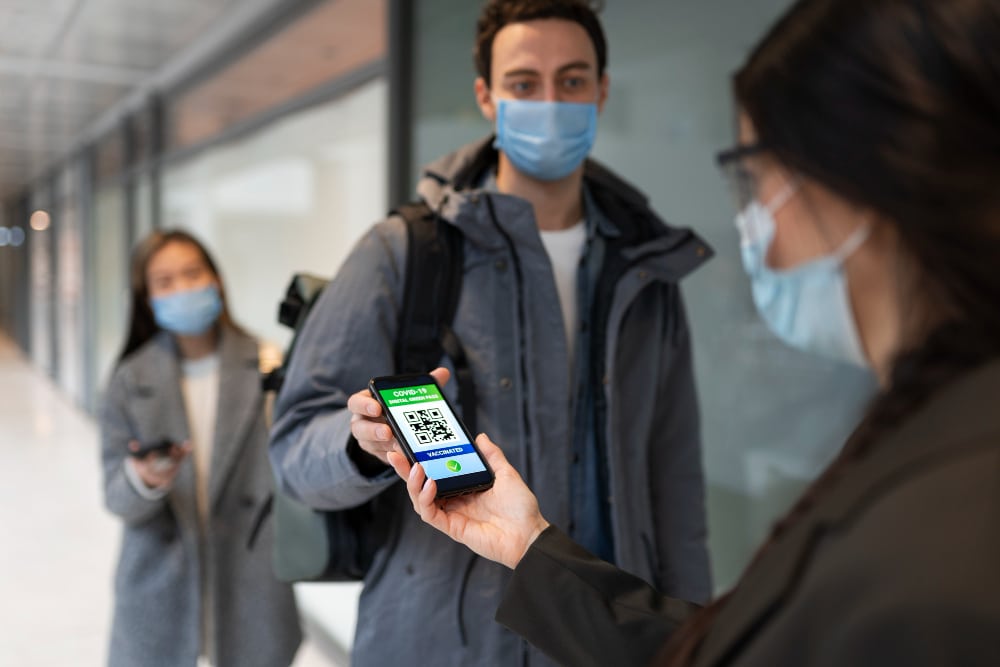

The TSA PreCheck line moved quickly on a busy morning at Hartsfield-Jackson in Atlanta. There were no IDs displayed. No tickets were scanned. Faces are silently captured by a camera and compared to records that have been stored. Green lights blinked, gates opened, and passengers passed through a few seconds later. Some saw it as a step forward. Others found it to be a source of unanswered questions.
Once a specialized tool tested at trade shows, facial recognition technology is now a standard feature of American airports. The TSA claims that it is quick, accurate, and optional. But according to critics, it has evolved into something completely different: a covert change in airport security with significant ramifications for civil liberties and privacy.
| Category | Details |
|---|---|
| Technology in Question | Facial Recognition Technology (FRT) used by TSA at airport checkpoints |
| Current Usage | Active in over 80 U.S. airports, with plans to expand to 400+ locations |
| TSA’s Position | Claims it’s optional, efficient, and improves security |
| Privacy Concerns | Civil liberties groups cite bias, data vulnerability, unclear consent |
| Proposed Legislation | Traveler Privacy Protection Act (S.1691) |
| Industry Opposition | Airlines argue rollback would reduce efficiency and overwhelm staffing |
| DHS Oversight | Inspector General launched privacy audit in 2026 |
| Public Choice | Passengers may opt out, but awareness and execution remain inconsistent |
More than 80 airports currently use the agency’s biometric program, and that number is expected to rise. There are plans to roll out the program nationwide, encompassing over 400 terminals. TSA says that travelers can still choose to have their IDs checked manually without incurring any fees or delays. However, a number of reports indicate otherwise.
When trying to opt out, some travelers have reported feeling perplexed or disheartened. Some claim they were never informed of their options. Others remember staff members giving the impression that refusing the scan would cause them to postpone their trip or require additional screening. The opt-out system appears to be applied inconsistently in practice.
The Traveler Privacy Protection Act, which was introduced by Senators Jeff Merkley and Ed Markey, is at the heart of this national discussion. Making facial recognition opt-in by default, limiting data storage, and clearly informing passengers of their rights are the bill’s limited but significant reforms. It establishes clear limits but does not completely outlaw the technology.
The bill has repeatedly stalled despite bipartisan support due to pressure from travel lobbyists and industry associations. Just before a busy travel season in July 2025, it was removed from the Senate Commerce Committee’s agenda. Limiting biometrics, according to airlines, would severely impair efficiency at major events like the 2026 World Cup. TSA supported that stance by pointing to labor shortages and expected bottlenecks.
Efficiency is unquestionably at the heart of their case. According to the TSA, facial recognition improves checkpoint throughput by almost a third and reduces wait times by up to 60%. Those gains are significant in the post-pandemic era, where air travel has increased beyond pre-2020 levels and staffing shortages are still being felt. This technology is essential to creating what TSA Acting Administrator Ha Nguyen McNeill called a “golden age” of safe, easy travel.
Critics, however, draw attention to the dangers of sacrificing convenience for power. EPIC and the ACLU have issued warnings about the gradual normalization of biometric surveillance. Although current TSA policy prohibits storing facial data for more than 24 hours, no federal law ensures this. Furthermore, once biometric systems are established, it is not only feasible but also likely that they will be expanded beyond identity verification.
In response to claims that Immigration and Customs Enforcement (ICE) had employed facial recognition technology to monitor people outside of transportation contexts, the inspector general of the Department of Homeland Security initiated an audit into biometric data practices in February 2026. Although the audit is still in progress, preliminary findings point to a worrisome oversight gap.
Another issue that keeps coming up is technical accuracy. Independent studies consistently show that facial recognition algorithms perform poorly on women, older adults, and people of color, despite TSA’s impressively low false match rates. Sometimes subtle, sometimes deeply ingrained, this bias can result in unfair outcomes like delays, secondary screening, or worse.
The Privacy and Civil Liberties Oversight Board’s 2026 report states that when implemented widely, even well-functioning systems can perpetuate inequality. The board stressed that success can be measured in ways other than accuracy. Equally important are consent, openness, and equitable design. Stronger federal regulations, more transparent public disclosures, and required bias auditing across agencies were all recommended by their findings.
There is still a lot of opposition from the industry. According to airline associations, the TSA would have to drastically increase hiring, take money away from automation, and ultimately increase passenger costs if facial recognition were removed from checkpoints. In contrast to the long-term cost of increasing the number of manual screening employees, they have presented the current model as being both incredibly effective and surprisingly inexpensive.
The National Airspace System is already at a breaking point, according to a recent testimony by Nicholas Calio, CEO of Airlines for America. He cautioned that reversing technological advancements now would jeopardize desperately needed improvements to airport infrastructure and air traffic control.
However, even in government, there is a growing understanding that innovation needs to be accompanied by rights. Local restrictions on the use of biometrics have been imposed in California, Maine, and several other states as a result of the debate over facial recognition. However, the legal system is still glaringly undeveloped at the federal level.
Last fall, while waiting in a TSA line, I saw an elderly couple struggle to comprehend why a machine was asking them to pose. “Just smile—it’s faster,” a young agent whispered, leaning over. In part because it felt so commonplace, and in part because of how easily something optional can turn into a necessity, that moment has stuck with me.
According to the TSA, its current procedures are both lawful and civil liberties-protective. It cites the Aviation and Transportation Security Act’s Section 109(a)(7), which permits biometric systems “to prevent a person who might pose a danger” from boarding. The question of whether that language permits a broad, uniform facial scan protocol is currently up for debate, particularly as the Supreme Court gets ready to review Chevron deference later this year.
The TSA’s biometric rollout may encounter additional difficulties if courts choose to restrict agency interpretation of federal statutes. If nothing else, it might force Congress to intervene and establish unambiguous legal boundaries, something civil liberties organizations have been demanding since 2020.
The agency’s “PreCheck Touchless ID” program is still growing and will soon be implemented in 65 additional airports. Through a simple facial match, the system enables registered passengers to board flights without ever presenting identification. It is considered a breakthrough by officials. It is referred to by critics as a gateway to unfettered surveillance.
The argument over whether or not facial recognition should be prohibited at American airports is no longer hypothetical. It is an ongoing discussion about what constitutes consent, privacy, and safety in public areas. The long-term cost of normalizing biometric tracking is also much harder to reverse, even though it may be alluring to accept the speed of a shorter line.
