

There’s a certain level of annoyance that appears around the $70 mark when you stand at a gas station in Phoenix on a Tuesday morning and watch the digital numbers move upward as the pump runs. A few weeks ago, the national average price per gallon surpassed $4. Some stations in California are charging $6. Everyone is curious about the same thing: when will this end? When do prices start to decline? Frustratingly, the answer is both not really and shortly.
The April 7 cease-fire with Iran ought to be beneficial. Analysts monitoring geopolitical risk premiums and crude oil futures generally agree. After weeks of increased tensions, the Strait of Hormuz, which transports about a fifth of the world’s oil, reopened. Almost instantly, as traders recalculated supply risk, oil prices decreased by a few dollars per barrel. That should theoretically result in cheaper gas prices. In reality, the translation is not quite as spectacular as the rise that led us here, and it is sluggish and inconsistent.
| Gas Price Overview | Details |
|---|---|
| National Average (April 6, 2026) | Over $4.00 per gallon |
| California Average | Approaching $6.00 per gallon |
| Key Event | April 7, 2026 ceasefire with Iran |
| Strait of Hormuz Status | Reopened following ceasefire agreement |
| Expected Price Drop Timeline | 48 hours to 2 weeks for initial declines |
| Industry Price Behavior | “Rocket up, feather down” effect |
| Crude Oil Impact | WTI crude prices easing post-ceasefire |
| Summer Fuel Switch | Premium “summer-blend” fuel keeping costs elevated |
| Long-term Outlook | Prices unlikely to return to pre-conflict levels soon |
| Regional Variance | West Coast prices expected to remain highest |
Gas prices rise like a rocket and fall like a feather, according to industry observers. When you’re filling up a tank, it feels like a conspiracy, but it’s not. The mechanics are simple. Refiners and distributors rapidly pass costs forward to safeguard margins when crude prices spike. These same players take their time modifying pump pricing as oil prices decline, acting cautiously to prevent losing money if the decline reverses. Asymmetry is the outcome. Within days, there is a $10 increase in oil at the pump. It can take weeks or even months for a $10 reduction to fully manifest.
Looking at the timing, the dispute with Iran began to intensify in late February. In just one month, oil prices shot up from the mid-$70s to the low $90s. By early April, gas prices had risen from about $3.20 nationwide to more than $4. Crude returned to the mid-$80s following the ceasefire on April 7, a significant decline but not a collapse. According to analysts, once supply chains stabilize, gas prices may begin to decline within 48 to 2 weeks, losing a few cents per gallon per day. But in that sentence, “normalizing” is doing a lot of effort. It takes time for refineries to increase output. Distribution networks must get rid of current inventory that was purchased at a premium. No one who is forced to spend $4.50 a gallon wants to hear that the entire system operates more slowly.
Complicating matters further is the summer-blend fuel transition. Refineries switch from winter gasoline compositions to summer mixes, which are more expensive to produce but burn cleaner, every spring. In order to lessen smog during the summer months, the Environmental Protection Agency requires this in some areas. The changeover is already in place, so even if crude prices continue to decline, the more costly summer fuel will keep pump prices higher than they would otherwise be. It is a systemic regulatory expense that arises at the exact moment when demand usually increases when more people begin driving for long weekends and vacations.
The national average is virtually meaningless due to regional variations. California’s $6-per-gallon costs are a result of state-specific circumstances, such as harsher environmental rules, higher fuel taxes, and supply-limiting refinery restrictions. California may only decrease to $5.50, even if the national average falls to $3.80. Due to their proximity to refining hubs, Texas and the Gulf Coast will get relief more quickly. The Midwest will lag behind. The West Coast will be further behind. Geographical factors are important, but not in the ways that most customers consider while attempting to pay for their journey.
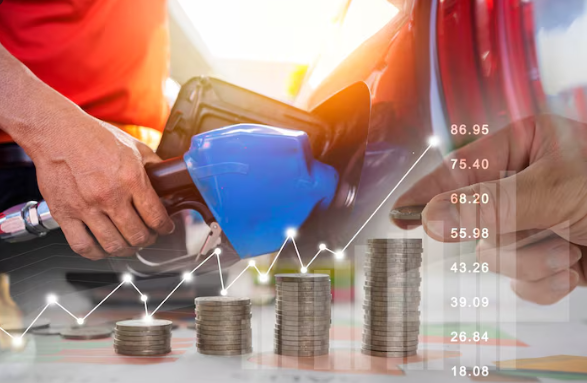
In Houston, where the skyline and economy are dominated by refineries, the atmosphere is cautiously positive. Crude is declining. Processing margins continue to be strong. There isn’t a pressing emergency requiring supply interruptions or shutdowns. However, refinery owners are not in a rush to supply the market with more affordable gas. Why would they do that? There is no elastic demand. Regardless of cost, people must drive. There is little reason to drastically cut prices merely because oil is slightly less expensive than it was two weeks ago as long as consumers continue to pay $4 or $5 per gallon.
Significant relief, or a steady decline of 20 to 30 cents per gallon, may take months rather than weeks, according to analysts. Although it is helpful, the ceasefire is not a panacea. Tensions in the Middle East may reappear. OPEC might reduce output. Refineries along the Gulf Coast could be affected by a hurricane. Prices would rise before they had completed down due to any of those factors. At best, this means cautious optimism and at worst, hedged bets because the market is pricing in unpredictability. Nobody wants to forecast a significant decline only to have it reverse the following month.
Customers feel as though they are trapped in an unwinable waiting game. These days, prices are exorbitant. In June, they’ll likely be a little lower. They will remain higher than they were in 2024. Geopolitical risk, refining capacity, regulatory costs, and supply chain fragility are structural variables that have not changed significantly. One variable in a complicated equation is addressed by the Iran ceasefire. It doesn’t address OPEC strategy, summer demand, or the fact that, despite rising consumption, U.S. refining capacity hasn’t significantly increased in years.
Driving an extra mile to save five cents per gallon, checking apps that track the cheapest stations, and monitoring real-time gas prices are all now considered cultural rituals. Everybody has a plan. Some people fill up on Tuesdays because they believe midweek costs are the lowest. Others bide their time in the hopes that prices would drop tomorrow. Most likely, both groups are incorrect. At the daily level, gas prices don’t exhibit consistent trends. It tracks regional supply-demand imbalances, refining margins, and patterns in crude oil that change more quickly than any consumer can.
In all honesty, the question of “when will gas prices go down” has already begun, even though you may not have noticed. It adds up gradually—two cents today, three more the following week, and possibly five the week after. If nothing else goes wrong, the national average might return to less than $4 by late May or early June. $5.50 could be seen in California. Technically, that is progress. It’s another matter completely whether it feels like progress when you’re still paying twice as much as you were two years ago. There will be relief soon. However, don’t anticipate a sense of relief.
