
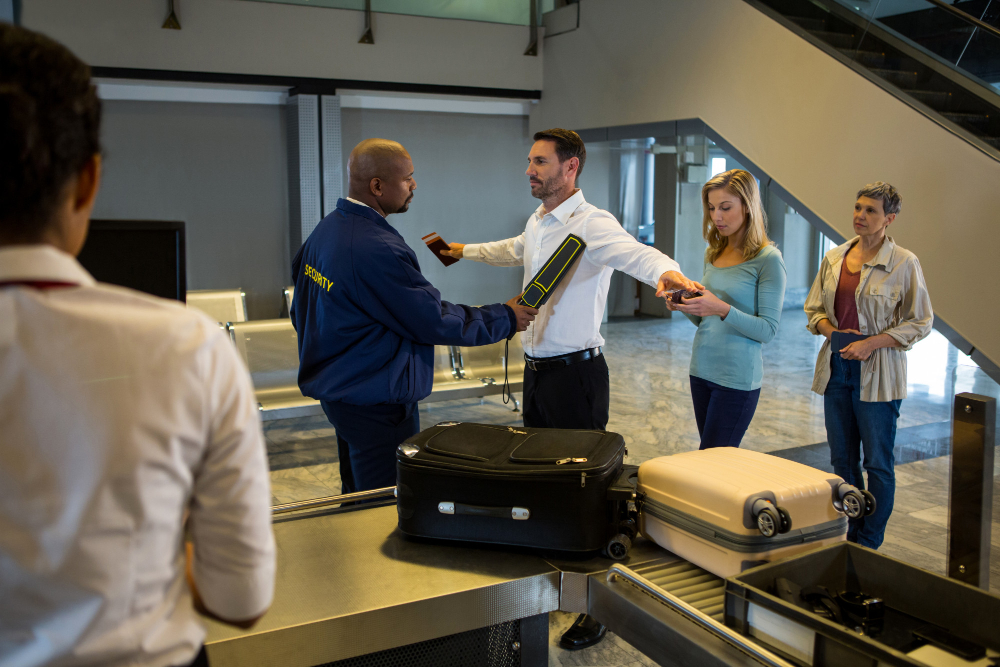

Passing through security at major UK airports may feel very different by next summer—not just faster, but also noticeably calmer. Travelers will experience streamlined lanes directed by algorithms operating silently in the background, as opposed to lengthy lines and shouted instructions about taking laptops out.
This isn’t some far-off idea; it’s already taking place.
The CT scanners at London Luton Airport are now fully operational, enabling travelers to store electronics and liquids in their luggage. It’s a minor adjustment that results in noticeably quicker checkpoint navigation. More significantly, by feeding data into AI systems that are constantly learning from patterns, the scans help identify threats more consistently and with a remarkably lower number of false alarms.
| Detail | Information |
|---|---|
| Initiative | AI-powered security screening in major UK airports |
| Launch Timeline | Full implementation by Summer 2026 |
| Major Airports Involved | Heathrow, Gatwick, Luton, Birmingham, Aberdeen, Glasgow, Southampton |
| Core Technology | AI-led baggage screening, CT scanners, predictive passenger analytics |
| Expected Benefits | Shorter wait times, better threat detection, fewer human errors |
| Regulatory Oversight | Civil Aviation Authority AI roadmap in progress |
| Notable Projects | Project DARTMOUTH, Birmingham AI dashboards, Luton CT scanner upgrades |
| External Link | www.caa.co.uk/ai |
Future plans are more ambitious.
In order to shift from reactive to predictive operations, airports such as Heathrow, Gatwick, and Birmingham are combining cutting-edge AI with real-time data feeds, including baggage images and passenger counts. Consider air travel to be the autonomous equivalent of a car: constantly scanning, learning, and adapting. The system anticipates queues rather than just reacting when they arise.
This change is being spearheaded by Project DARTMOUTH, which was introduced at the airports in Aberdeen, Glasgow, and Southampton. The project employs AI for crowd control and baggage screening, tracking foot traffic and identifying security trends before they interfere with operations. It’s incredibly efficient at improving security personnel’s situational awareness in addition to streamlining logistics.
Birmingham Airport’s operations coordinator showed me their new AI-powered dashboard during our recent conversation. It continuously monitors queue lengths and scanner uptime. “We now get ahead of problems instead of chasing them,” she remarked. AI is most noticeable when people adopt a proactive rather than reactive mindset.
Airports can take quick decisions by using these insights. An unexpected surge of travelers from a postponed flight? Staff redeployment is automatically triggered by the system. Is a scanner beginning to perform poorly? Before lines even form, alerts are sent. Resilience is more important than efficiency.
Several airports in the UK are now utilizing AI not only for scanning but also for journey optimization through strategic partnerships. This includes lane balancing, predictive scheduling, and even using dynamic signage to direct travelers through the terminal’s less crowded areas. Thus far, the outcomes have been especially creative, with average wait times during peak hours being reduced by as much as 30%.
To keep up, the UK’s Civil Aviation Authority is developing a regulatory framework. The goal is to make sure that systems are incredibly dependable and managed ethically, not to impede innovation. This includes cybersecurity procedures that are strong enough to withstand actual threats, oversight of automated decision-making, and protections against data misuse.
Additionally, security isn’t the only application of AI in airport operations. To assist air traffic controllers, model pilot training environments, and improve aircraft ground handling, new tools are being created. However, this change will be most noticeable at the security checkpoint, where passengers experience the pressure the most.
Crucially, employees are being refocused rather than replaced. They are now interpreting AI insights and handling edge cases that machines are still unable to fully resolve, rather than inspecting every bottle of shampoo. This hybrid model, which combines machine consistency and human intuition, is especially advantageous.
I can recall the last time I took a flight from Glasgow and neglected to take a tablet out of my carry-on. That error would have cost me five minutes and a reprimand in the past. However, the device was immediately flagged by the new system and cleared without a manual inspection. It felt like a glimpse of better travel—that quiet confidence, that feeling of being watched over rather than scrutinized.
The experience of airport security will continue to change over the coming months as these systems become commonplace, going from something you have to put up with to something that just happens. Adoption of AI is so potent because of this passive improvement. It changes expectations without requiring attention.
Strict electronics protocols and the 100ml liquid rule were long seen as reminders of antiquated methods. They are now disappearing—quietly, effectively, and with the least amount of resistance. The complexity hidden beneath the simplicity might go unnoticed by passengers. That’s the point, though.
Traveler feedback has significantly improved since these upgrades began, with faster throughput and fewer complaints at each test site. Additionally, the systems themselves are constantly learning and adjusting to weather-related disruptions, special events, and seasonal traffic.
This AI-first strategy may serve as a model in the years to come as other European countries watch the UK’s implementation. That means more than just shorter lines for the British aviation industry. It entails setting a good example in an area where safety, technology, and human experience come together with remarkable clarity.
And by the summer of 2026, that understated effectiveness will make a big impression.

