
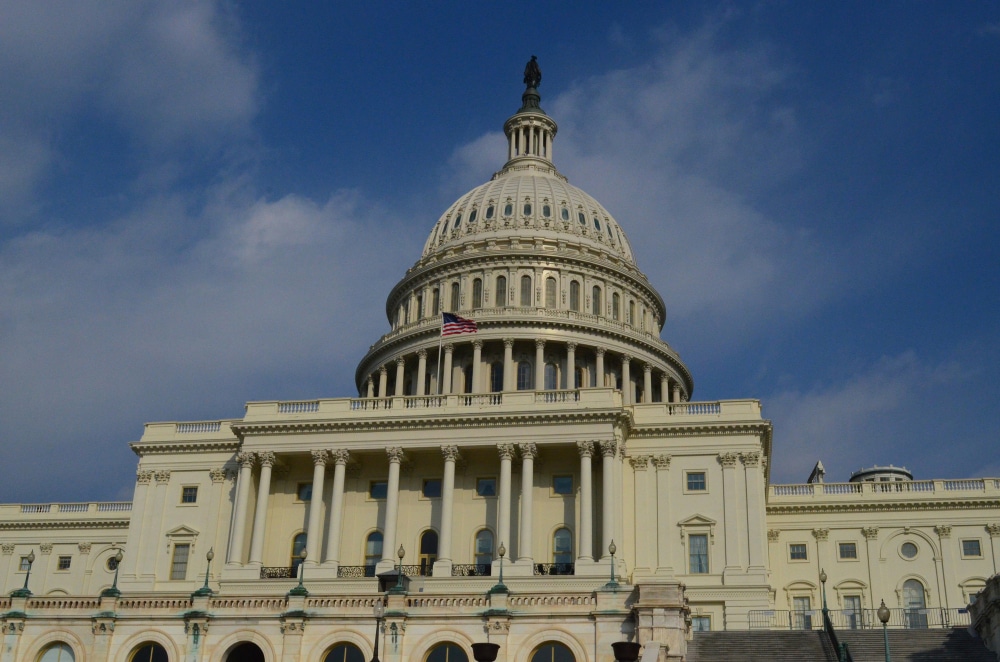

The Hart Senate Office Building’s hearing room was unusually tense on a gray February morning. Over laptops with draft language glowing on the screens, staff members whispered about “materially deceptive synthetic media.” Outside, visitors walked past marble columns and stopped to take pictures under the Capitol dome. Senators debated whether artificial intelligence should be required to identify itself when it speaks in advertisements, a topic far less picturesque but far more contentious.
What some lawmakers are referring to as a historic push for AI transparency in advertising is currently being discussed in the US Senate. Legislation that would mandate disclaimers when political advertisements use artificial intelligence (AI)-generated or significantly altered audio, video, or imagery is at the heart of the controversy. Labeling the fake sounds easy, but nothing in Washington is ever that easy. Senators seem to recognize the urgency, particularly in light of the year-long spread of deepfake videos that went viral before anyone could refute them.
| Bio Data / Important Information | Details |
|---|---|
| Legislative Body | United States Senate |
| Key Sponsor | Amy Klobuchar |
| Bipartisan Co-Sponsor | Lisa Murkowski |
| Related Bill | Copyright Labeling and Ethical AI Reporting Act (CLEAR Act) |
| Federal Reference | Official legislative text and updates: https://www.congress.gov |
| Context | 2026 bipartisan effort to mandate disclosure and curb deceptive AI-generated political ads |
One plan, supported by Lisa Murkowski and Amy Klobuchar, would require explicit disclaimers on political ads that use artificial intelligence. Klobuchar cautioned during committee hearings that content produced by AI could “jaundice or even totally discredit our election systems.” It was difficult to ignore the rarity of that harmony as senators from opposing parties nodded in grudging agreement. Strangely enough, AI is doing what few problems can: bringing uneasy allies together in one space.
However, fault lines are revealed by the debate. Concerned about free speech, some lawmakers bring up issues with parody and satire. Would a legal disclaimer be necessary for a late-night comedy sketch? If broadcasters showed a dubious advertisement, would they be held accountable? Congress might veer into constitutional quagmire in its attempt to preserve democracy. There has always been a thin line separating protected expression from deceit. AI merely facilitates blurring.
Transparency was not first pushed in Washington. California took the lead by enacting the Transparency in Frontier Artificial Intelligence Act in late 2025, which required major AI developers to reveal risk assessments and publish safety frameworks. New York followed suit with regulations mandating that “synthetic performers” be disclosed in advertisements. Last fall, tech lobbyists were silently calculating compliance costs in the corridors outside committee rooms in Sacramento. The stakes feel national—and much higher—now that federal legislation is imminent.
The Copyright Labeling and Ethical AI Reporting Act, or CLEAR Act, was introduced by Senators Adam Schiff and John Curtis and is currently being considered by the Senate. According to that bill, AI firms would have to reveal whether generative model training involved the use of copyrighted works. The measure has received public support from creators’ organizations, including the Recording Industry Association of America and SAG-AFTRA.
They consistently convey the message that while innovation is valued, secrecy is not. Clearer regulations may actually stabilize the AI market and lower the risk of litigation, according to investors. Executives at some tech companies, however, privately contend that excessive disclosure might slow development or reveal confidential information.
The issue of enforcement is another. The question of who is accountable when a misleading AI advertisement circulates has been debated during Senate Rules Committee hearings. Was it a result of the campaign? The site on which it was hosted? The network that carried it? Lawmakers seem wary because they know that punishing distributors might stifle free expression. Whether the final bill will cast a wider net or concentrate only on creators is still up in the air. The legislation’s ability to withstand the inevitable court challenges may depend on that distinction.
Election officials are keeping a close eye on things in the meantime. After a gubernatorial candidate in Massachusetts circulated an AI-assisted parody ad that mimicked his opponent’s voice, the state recently passed a bill addressing AI-generated campaign materials. The advertisement blurred humor and manipulation and quickly went viral on the internet. At first, the incident seemed insignificant. However, the anxiety becomes understandable when you multiply that scenario over fifty states during a presidential cycle.
The wider cultural change is evident outside the Capitol. AI-generated graphics are becoming more and more common in Super Bowl ads. Synthetic influencers who never age, make mistakes, or sleep are all over social media feeds. As this develops, there is a sense that public trust—the underlying problem—may not be resolved by disclosure alone. Although labels can provide information, they cannot ensure that viewers will take the time to read them.
The bill is presented by some senators as a simple first step that would alert voters when a political message has been digitally manufactured. Some refer to it as a defensive tactic in an arms race for technology. Both could be correct. The more profound conflict is between promoting AI innovation and guarding against its abuse. It has frequently been difficult for Washington to regulate technology without stifling it or coming too late. Lawmakers appear intent on avoiding being caught off guard this time.
But there is still uncertainty. In an attempt to foreshadow some state-level initiatives, the White House has expressed interest in creating a single national AI policy. Legal challenges are practically a given, especially when it comes to First Amendment rights. Furthermore, because technology is developing so quickly, it rarely waits for legislative clarification.
There is a sense of something more than ordinary politics in the Capitol corridors as senators leave hearings with aides holding thick binders of amendments. AI is no longer a futuristic concept. It is influencing corporate branding, campaign advertisements, and even a candidate’s voice. The Senate’s discussion of advertising transparency may not address all the risks, but it does mark a change: legislators are finally realizing that when machines can speak for people, people should be able to tell who—or what—is speaking.

