
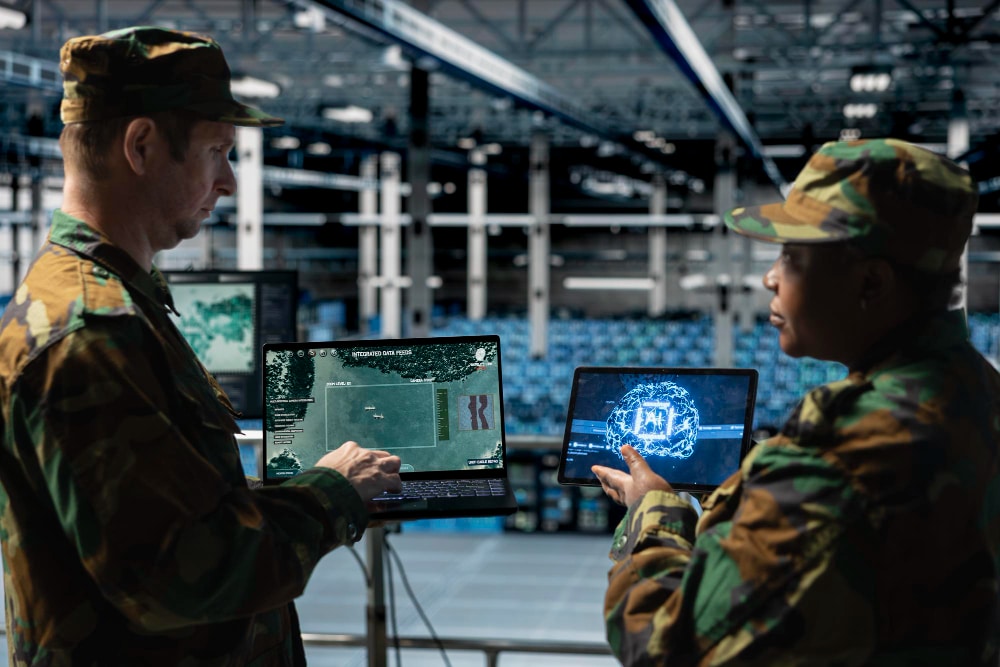

The Pentagon’s enormous parking lot outside of Washington, D.C., starts to fill up before dawn. Engineers, analysts, and consultants with laptops and access badges attached to their jackets are among the contractors who arrive early. Many of them were specialists in logistics or aerospace a few years ago. Data scientists now make up a startling percentage.
The change provides insight into the direction of US defense strategy. Artificial intelligence is quietly moving from research labs into everyday military planning, and the money following that transition has been staggering. Defense contracts tied to AI systems have surged over the past year as the U.S. Department of Defense pushes to integrate advanced algorithms into intelligence, surveillance, logistics, and battlefield support.
| Category | Information |
|---|---|
| Government Agency | U.S. Department of Defense (DoD) |
| Key Initiative | AI Acceleration Strategy |
| Estimated Defense Budget (2026) | ~$839 billion |
| AI-related Spending | Billions allocated across defense branches |
| Major Technology Areas | AI decision support, drone systems, satellite intelligence |
| Key Contractors | Defense tech firms, AI companies, drone manufacturers |
| Strategic Focus | Intelligence analysis, battlefield simulations, predictive defense systems |
| Reference Website | https://www.defense.gov |
A defense budget of almost $839 billion was recently approved by Congress, with billions going toward autonomous systems and AI-related technologies. For defense contractors and technology firms, the numbers are hard to ignore. Investors have noticed too.
Something more significant than a typical procurement cycle seems to be taking place. Analysts now discuss “defense AI” in Silicon Valley boardrooms and New York trading floors in a manner similar to that of cloud computing. The sector has quietly become one of the fastest-growing segments of the global defense market, with projections suggesting it could exceed $20 billion within a few years.
Yet the technology itself still feels strangely invisible. Unlike fighter jets or missile systems, AI tools often exist inside software dashboards—lines of code scanning satellite images, flagging suspicious movement patterns, or analyzing intercepted communications faster than human analysts could manage alone.
The change was recently summed up by a Pentagon official as follows: modern warfare produces too much data for people to process on their own. Once stated, that observation seems clear. These days, military intelligence gathers data from surveillance sensors dispersed throughout continents, satellites, drones, and cyber networks. The problem is not collecting the information. It’s analyzing it fast enough to be significant.
AI systems have started to play a role in this. Large language models and machine learning systems have reportedly helped analysts find patterns in massive intelligence datasets in some operations. These tools are capable of scanning satellite imagery, identifying anomalous vehicle movement, or highlighting possible targets concealed within vast amounts of data.
At least not yet. The machines don’t make final decisions. The output must still be interpreted by human officers.
However, the impact of AI is growing. Defense startups and traditional contractors alike have begun building systems designed to help military commanders simulate battle scenarios before they unfold. These systems can predict how conflicts might change under various circumstances by executing thousands of variations in a matter of minutes.
Sometimes it feels more like high-speed strategy gaming than traditional warfare to watch these tools in action.
That comparison may not be entirely accidental. Many AI developers who are now working in the defense industry have previously created systems for video game simulation, finance, and logistics optimization. Their models are currently being modified to forecast missile trajectories, drone swarms, and battlefield logistics.
Many of these initiatives have been coordinated by the Pentagon’s Chief Digital and Artificial Intelligence Office, which has awarded contracts to tech firms that can conduct quick experiments.
The guiding principle seems to be speed. In internal policy documents, defense officials have warned that the United States risks falling behind rivals such as China if AI adoption moves too slowly. The result has been a procurement environment encouraging rapid testing and deployment.
Not everyone is comfortable with that pace. Some researchers argue that current AI models still produce unreliable outputs under certain conditions. Even minor mistakes can have far-reaching effects in high-stakes situations like military planning.
Artificial intelligence policy researcher Heidy Khlaaf recently voiced doubts about the systems’ operational deployment readiness. She pointed out that AI models occasionally produce erroneous answers, a phenomenon that developers refer to as “hallucination.”
A defective algorithm could result in a small annoyance in the majority of industries. The stakes are obviously higher in military situations.
However, there is an increasing need for AI-assisted tools. Funding for machine learning initiatives aimed at improving everything from battlefield intelligence to predictive maintenance has been increased by the Army, Navy, and Air Force. The increase in spending has also been largely attributed to drone systems.
Modern conflict zones now heavily rely on small autonomous aircraft that can conduct electronic surveillance, mapping, or reconnaissance. Compared to previous systems, AI systems enable those drones to identify objects, track vehicles, or analyze terrain much more quickly.
As militaries look for ways to identify and neutralize hostile unmanned aircraft, the market for counter-drones alone is predicted to grow significantly over the next ten years.
One thing sticks out when you walk through defense industry conferences these days. Companies showcasing AI software platforms now occupy the booths that were formerly dominated by missile manufacturers. Dashboards that track satellites, drones, and logistics systems in real time are displayed on screens, with streams of data representing the entire battlefield.
It’s hard not to notice how different the atmosphere feels. Hardware, such as aircraft carriers, tanks, and nuclear submarines, was used to gauge military advantage for a large portion of the 20th century. These days, the topics of algorithms, data pipelines, and processing power are discussed more and more.
An unsettling question is raised by that transformation. In the event that artificial intelligence plays a bigger role in warfare, who will ultimately make decisions—human commanders or the systems that advise them?
Officials maintain that AI will only be used as a support tool going forward. But watching the surge in contracts and investment, there’s a feeling that the boundary between assistance and autonomy may eventually become harder to define.
Additionally, the next generation of battlefield software is already being developed somewhere in the Pentagon’s labyrinthine hallways.

