
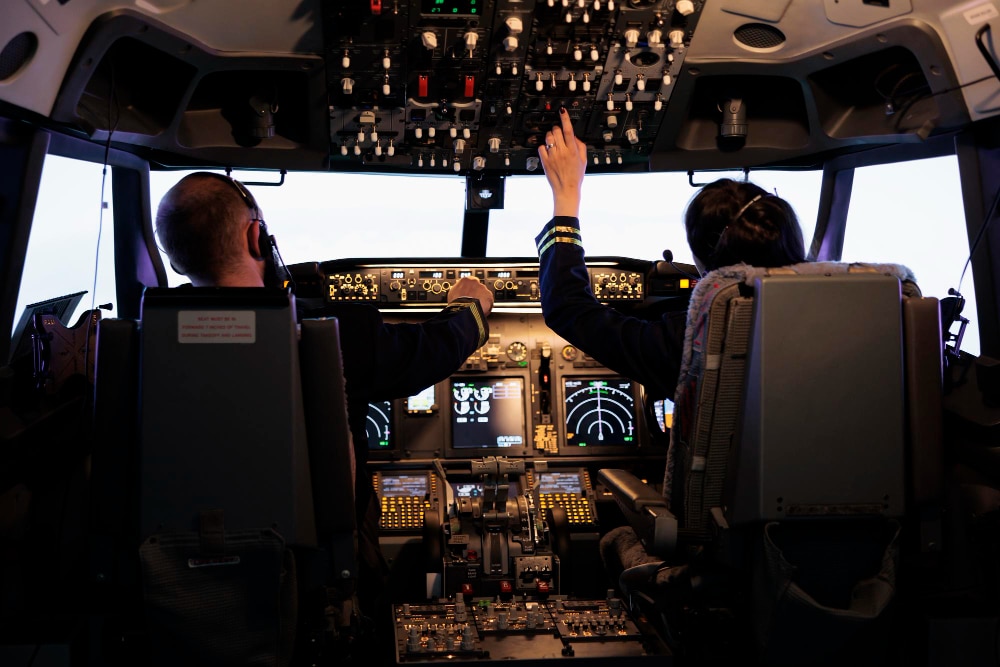

A contemporary commercial jet’s cockpit may have the feel of a tiny command center rather than a machine. The instrument panel’s screens glow in layers. In the background, alerts blink softly. As pilots navigate digital checklists on tablet screens, a faint hum of avionics permeates the room. Automation has been gradually integrating into this environment for decades. However, systems that provide guidance have recently started to show up on those screens.
Not exactly orders. More like recommendations. And a lot of pilots don’t feel totally at ease with that.
New AI decision-support systems are starting to go through testing stages at a number of US airlines. After analyzing massive streams of flight data, such as weather, aircraft performance, and traffic patterns, these tools advise pilots on what to do. Theoretically, the software lessens workload in challenging circumstances. In reality, some pilots are concerned that it could subtly change who makes decisions in the cockpit.
| Category | Details |
|---|---|
| Topic | AI Decision-Support Systems in Aviation |
| Industry | Commercial Aviation |
| Key Authority | Federal Aviation Administration (FAA) |
| Research Area | AI-assisted pilot decision-making |
| Notable Test Program | Stanford & U.S. Air Force AI Copilot Flight Tests |
| Industry Concern | Human oversight vs. automation in safety-critical systems |
| Reference Website | https://www.faa.gov |
Automation has always been adopted by the aviation industry, albeit cautiously. For many years, autopilot systems have managed standard flight operations while pilots kept an eye on the aircraft. Nevertheless, despite all of the technology in contemporary aircraft, the human crew members occupying the two front seats still hold the final say.
At a recent pilot safety forum, a seasoned captain bluntly described the tension. He claimed that technology is useful—until it starts to convince. A guidance-giving tool is one thing. Another is a system that encourages a choice, particularly in an emergency.
Pilots don’t seem to be completely opposing artificial intelligence, based on the debate. In fact, a lot of people embrace it. AI can identify patterns in thousands of past flights and process data more quickly than any human crew. In a matter of seconds, certain experimental systems are able to scan entire aircraft manuals and generate pertinent procedures.
Scientists studying these systems have made an effort to maintain human control. In one project, Stanford University worked with test pilots from the U.S. Air Force to test an AI assistant that would sit silently next to the pilot and assist with searching manuals and identifying potential failure scenarios.
In controlled settings, the idea performed surprisingly well. When warning lights came on during simulator sessions, the assistant could almost immediately retrieve pertinent checklists. Pilots could see potential answers in a matter of seconds rather than having to turn pages or scroll through lengthy documents. When alarms start going off, it’s easy to see how that could ease tension.
Some pilots are still dubious, though. Experience is a contributing factor in the worry. Uncomfortable lessons about an over-reliance on automation can be learned from aviation history. Over the past 20 years, crews have struggled to understand automated systems in a number of high-profile accidents involving unusual circumstances. Pilots are concerned that incorporating AI recommendations into that mix might make matters more complicated.
particularly when under duress. Making decisions in the cockpit during an emergency is rarely straightforward or peaceful. It is possible for several alarms to sound at once. The weather might be getting worse. Using headsets, air traffic controllers are speaking quickly. Pilots mainly rely on instinct and training in that setting.
Algorithms lack intuition. This distinction is more significant than many proponents of technology realize. Pattern recognition is an area in which artificial intelligence shines, as it can simultaneously analyze thousands of variables. However, incomplete information is frequently involved in aviation emergencies, such as conflicting warnings, sensor errors, or unprecedented mechanical issues.
Judgment becomes less mathematical in those situations. In private, some pilots are concerned that AI suggestions could come across as overconfident. After all, even in cases of uncertainty, modern language models have a tendency to provide answers with certainty. That could be bothersome in a software program or financial report. It might be hazardous in a thirty-thousand-foot cockpit. The resistance also has a cultural component.
To obtain command authority, airline pilots must complete years of training. There is a clear responsibility for the cockpit hierarchy. Pilots question who will be ultimately responsible if an AI system starts to indirectly influence decisions.
Regarding the software developer? The airline? The captain? It’s still unclear. For their part, airlines are taking a cautious approach to the technology. The majority of systems in development are intended only as advisory instruments. They give information fast, but they let the pilot make the final decision. Before authorizing their widespread use, regulators such as the Federal Aviation Administration are expected to carefully examine such technologies.
It will probably take years to complete that process. In the meantime, advancements in aviation technology keep coming. AI-driven assistance has enormous potential, according to software companies and aircraft manufacturers, from real-time hazard detection to fuel optimization and predictive maintenance. Investors appear to be certain that machine intelligence will play a significant role in the next generation of aviation systems. Pilots don’t always disagree.
However, a lot of people insist on setting a limit. It feels strangely familiar to watch the industry navigate this moment. Decades ago, when autopilot systems were first made standard, similar discussions took place. Some pilots were concerned that they would lose important flying abilities. Others were concerned that they might eventually be completely replaced by machines.
Neither of the predictions was entirely accurate. Undoubtedly, automation altered aviation. However, there was always a human presence in the cockpit. Pilots now have more oversight and judgment and less manual control, if anything. Artificial intelligence might take a similar course.
It’s difficult to ignore how much faith aviation already has in technology when you stand in a quiet cockpit before takeoff and watch pilots perform pre-flight checks while digital systems scroll information across displays. However, it’s equally evident that trust has its boundaries.
The line pilots are attempting to safeguard an area that lies somewhere between authority and assistance. They appear committed to keeping it there, at least for the time being.

