
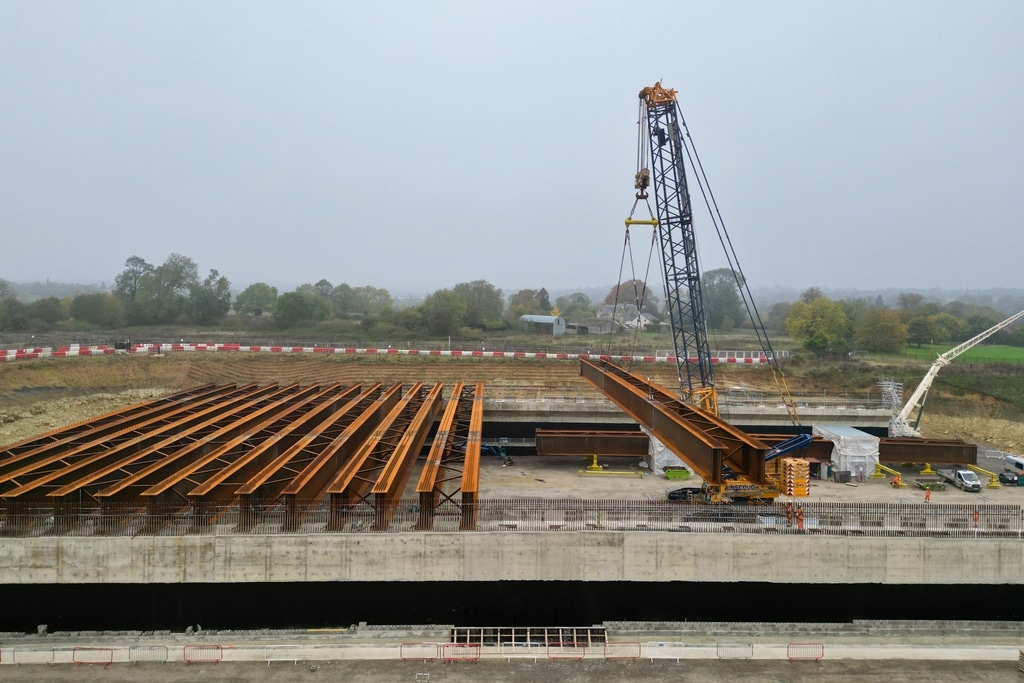

The development of the Turweston wildlife bridge marks a new phase in HS2’s construction initiative, promising enhanced connectivity for local fauna.
- Situated on the edge of Buckinghamshire and West Northants, the ‘green bridge’ aims to facilitate safe passage for small animals and insects.
- Designed by the EKFB contracting team, the bridge is part of a series of non-structural, eco-friendly crossings, contributing to increased project costs.
- The structure will span 5,940 square metres, incorporating hedgerows and vegetation to aid in noise reduction and biodiversity protection.
- Efficient engineering led to cost-saving measures, opting for shallow foundations thanks to favourable ground conditions.
The Turweston wildlife bridge is a significant component of the HS2 project, aimed at enhancing ecological connectivity across the high-speed railway. Located near Brackley on the boundary of Buckinghamshire and West Northants, this ‘green bridge’ serves as an eco-friendly crossing. Designed to aid small animals and insects, it helps maintain biodiversity along one of the railway’s deepest cuttings, highlighting its ecological significance.
This 5,940 square metre structure is one of sixteen similar bridges designated for the project. Although not essential from a structural standpoint, these bridges represent a commitment to environmental stewardship. Such priorities have, however, been criticised for inflating project expenses, leading to the cancellation of similar initiatives north of Birmingham. The Turweston site exemplifies the complex balance between environmental responsibility and fiscal prudence.
The construction process involves impressive engineering feats, with the installation of 36 steel beams by a 600-tonne crawler crane. These steel elements support a broad concrete deck that will carry 2,700 cubic metres of earth, blending functionality with environmental preservation. This project showcases innovative techniques in large-scale construction, with beams manufactured and assembled on-site, presenting an awe-inspiring aspect of modern engineering.
Insights from project leaders emphasise the role of such infrastructure in connecting communities while safeguarding local wildlife. Cameron Thompson of HS2 Ltd. described the bridge as vital not only for wildlife integration but also for maintaining existing community pathways. He expressed anticipation over the bridge’s prospective impact on the region’s ecological dynamics.
Despite being seen as luxurious, these structures have seen some budgetary efficiencies. Improved ground conditions enabled the engineers to forgo 102 deep piles, opting instead for shallow foundations. According to EKFB’s structures project manager, Luis Prieto, these adjustments optimised the design, reducing the project’s scope and allowing for smoother progress. This demonstrates an agile response to engineering challenges, aligning environmental goals with economic considerations.
The Turweston wildlife bridge not only reinforces ecological corridors but also exemplifies the fusion of innovative engineering with environmental consciousness.

