
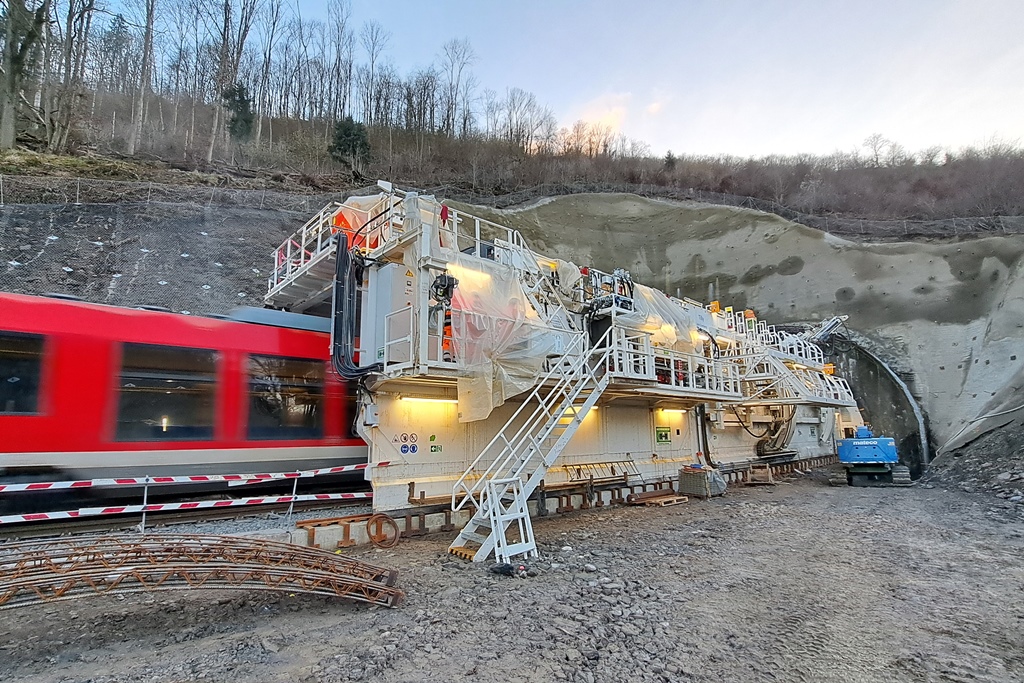

The innovative Tunnel Enlargement System (TES) revolutionises railway upgrades, allowing tunnelling work without disrupting train services.
- German Railways have implemented the TES, developed by Herrenknecht, to upgrade 19th-century tunnels while maintaining train operations.
- The TES is currently in use for renovating two historic tunnels on the Lahn Valley Railway, which connects Koblenz and Wetzlar.
- By maintaining train services during construction, TES facilitates faster upgrades and reduces the impact on rail schedules.
- This system ensures existing rail infrastructures can be modernised to accommodate electrification and future rail demands.
The Tunnel Enlargement System (TES) is a cutting-edge innovation by Herrenknecht that permits the renovation and widening of railway tunnels without halting train operations. Since January 2024, German Railways have employed this system to update 160-year-old tunnels near Limburg an der Lahn. By widening tunnels, the TES enables electrification and accommodation of larger train gauges.
The TES’s current operations focus on the Fachingen and Cramberg tunnels, part of the Lahn Valley Railway network. These tunnels are critical links between Koblenz and Wetzlar, and their renovation is necessary to support faster trains and modern electrification standards. The unique capability of the TES to allow continuous train transit during such extensive work makes it invaluable.
The TES approach begins with dismantling existing tracks and installing a central rail in the tunnel’s existing profile. This enables traffic to continue while the TES advances, excavating and widening the tunnel section by section. Notably, the TES also acts as a protective barrier, ensuring the safety of ongoing train services.
Herrenknecht’s equipment, notably a 46-metre long, 270-tonne TES machine, employs conventional excavation methods, including chiselling and blasting, to expand tunnel dimensions. Once the old masonry walls are removed, excavation progresses, with material efficiently extracted and processed. Following excavation, temporary support structures, including shotcrete and reinforcement mesh, are installed for stability.
The TES infrastructure is divided into three functional parts: the front section provides pre-excavation protection, the middle section houses essential tunnelling equipment, and the rear section contains operational systems such as hydraulic and electrical controls. This systematic design draws upon successful implementations in locations like the Basque Pyrenees, showcasing the TES’s adaptability and efficiency.
TES exemplifies a forward-thinking approach to railway modernisation, ensuring infrastructure improvements align with ongoing service demands.

