

The Sonoran Desert gives way to something unexpected in a section of northern Phoenix: a campus that appears to have been lifted from Hsinchu and dropped onto a patch of scrubland in Arizona. office buildings with glass walls. A silicon wafer-shaped fountain. During lunch, lines of people wearing hard hats and transparent backpacks went through security checks. It appears to be progress at first glance. When Washington gave TSMC $6.6 billion and declared to the world that the United States was returning to the chip industry, it appears to be precisely what it had promised.
Inside that perimeter fence, things have been much messier. In May 2020, as the world began to realize how dangerously dependent it had become on a small island in the Taiwan Strait, TSMC declared its aspirations for Arizona. Vulnerabilities in nearly every sector’s supply chains were revealed by the pandemic. On factory lots, cars were left unfinished. Control boards were not included in the shipment of refrigerators. Startled, American lawmakers united behind the CHIPS and Science Act, a comprehensive initiative to reshore semiconductor production. The key component of that strategy was TSMC, which produces about 90% of the most sophisticated chips in the world. The facility in Arizona was meant to serve as evidence of its viability.
| TSMC — Key Information | |
|---|---|
| Full Name | Taiwan Semiconductor Manufacturing Company |
| Founded | 1987, by Morris Chang |
| Headquarters | Hsinchu, Taiwan |
| Arizona Project Location | North Phoenix, Arizona, USA |
| Total U.S. Investment Committed | $65 billion |
| U.S. Government Grant (CHIPS Act) | $6.6 billion |
| Arizona Employees (as of 2024) | ~2,200 (roughly half relocated from Taiwan) |
| Original Production Start Date | 2024 |
| Revised Production Start Date | First half of 2025 |
| U.S. Share of Global Chip Production | ~10% |
| TSMC’s Share of Advanced Chips Globally | ~90% |
| Key Clients | Apple, Nvidia, Qualcomm, AMD |
| Further Reference | CHIPS Act & U.S. Semiconductor Policy — Commerce Dept. |
The factory had yet to ship a single chip for sale after four years. Production was postponed from 2024 to 2025. There was more to the delay than just technical issues. It was a human. A former American engineer, who wished to remain anonymous due to a confidentiality agreement, said as he left the plant one afternoon that he felt as though he had enrolled in a military school without thoroughly reading the contract. He had joined with the intention of advancing semiconductor technology. He discovered a management culture that believed 12-hour workdays were the standard, a strict hierarchy, and lengthy meetings.
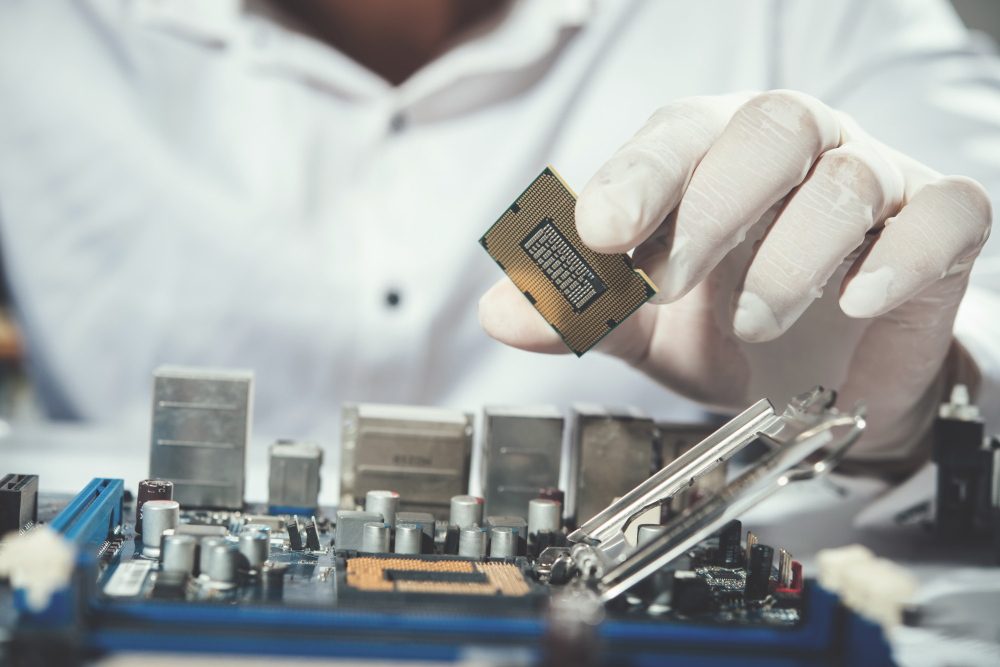
By all accounts, TSMC is the world’s most significant manufacturing corporation. At the Taiwanese government’s invitation, Morris Chang built it from the ground up in 1987. Over the course of several decades, he created not just a business but an entire ecosystem, a complex network of suppliers, engineers, and government support that enables the etching of microscopic pathways into silicon with a precision that no one else can consistently match. Intel and Samsung are still pursuing. The model was successful because it was ingrained in Taiwanese workplace culture. Engineers stayed up late. At two in the morning, they took calls. They took personal responsibility for the uptime of the fab. Phoenix was not a good destination for that culture.
Over the past two years, American employees who spoke with journalists described a truly foreign workplace. The meetings lasted three hours. During shift handoffs, American workers found lengthy oral briefings to be ineffective and even punishing, but seasoned TSMC engineers in Taiwan saw them as crucial. Some people give up completely. Others either transferred internally or just put up with it, developing a subtle bitterness that was difficult to ignore. “The work culture in Taiwan is really different from the U.S. TSMC will have to change to an eight-hour work day five days a week,” a Glassdoor post from an equipment engineer at TSMC Arizona went viral.” That’s a big request. It cuts close to the bone for a business whose competitive advantage is partially based on unrelenting human availability.
Frustration ran the other way on the Taiwanese side. Veterans who had moved their families to Arizona, uprooting their lives, enrolling their kids in new schools, and learning how to navigate American grocery stores and traffic patterns, found themselves working with coworkers who, in their opinion, lacked the fundamental commitment the job required. According to semiconductor analyst G. Dan Hutcheson, “They tried to make Arizona Taiwanese,” he told one publication. “And it’s just not going to work.” Despite its bluntness, that observation captures something genuine. There is no personal character failure on either side of the conflict. It’s a collision between two completely different presumptions about how much work should cost.
The cultural issues are compounded by structural issues. Taiwan will likely continue to produce TSMC’s most cutting-edge chips for years to come. These chips are made using 3-nanometer and eventually 2-nanometer processes, which companies like Apple and Nvidia genuinely want. By the time it opens, the Arizona fabrication plant is anticipated to begin using 4-nanometer technology, which is already a generation behind. According to experts, Taiwan will have advanced even further by the time the Phoenix facility reaches 2-nanometer production. That is a frustrating treadmill for a nation looking to lessen its reliance on foreign chips. The U.S. Commerce Department reports that 92% of America’s cutting-edge chips are purchased from Taiwan. No matter how many ribbon-cutting ceremonies are held in the desert, that number won’t change overnight.
After the Arizona operation is fully staffed and operational, it’s possible that the gap will eventually close and it will establish its own rhythm. More than 400 American engineers have been trained in Taiwan by TSMC. The company maintains that its reputation for working long hours is driven by emergencies rather than marathons and that it values work-life balance. Software interfaces are being updated, and shift protocols are being reevaluated, among other changes that are already taking place covertly. Little things, but significant ones. It seems as though both parties are gradually and a little awkwardly learning to read one another.
The more difficult question, though, is whether any degree of cultural adaptation can replicate in Arizona what took Taiwan thirty years to develop. The suppliers, technical labor pool, and institutional memory ingrained in all organizational levels that make up TSMC’s ecosystem don’t change on a political timeline. In terms of ambition and financial commitment, America’s chip renaissance is genuine. Whether it’s true in the cleanrooms, on the factory floor, or at three in the morning when something breaks and needs to be fixed is still an open and genuinely uncertain question.
