

A recent train derailment in Manchester has highlighted critical issues related to rail maintenance and safety inspection procedures.
- The Rail Accident Investigation Branch (RAIB) has advised reviewing maintenance practices following a freight train accident on 6th September 2024.
- The derailment at Audenshaw resulted in significant damage, though no injuries were reported.
- Initial investigations suggest gauge spread and inadequate detection of baseplate chair screw failures as contributing factors.
- The incident underscores the importance of using high-tensile strength materials to prevent future failures.
In the wake of a significant freight train derailment in Manchester last month, the Rail Accident Investigation Branch (RAIB) has issued urgent guidance to railway contractors. The incident has prompted a reassessment of existing inspection and maintenance regimes, especially in detecting the failure of baseplate chair screws, crucial components for lateral track support in longitudinal timber systems.
The freight train involved, comprising two class 66 locomotives and 24 wagons carrying aggregate, derailed on 6th September 2024 as it traversed a bridge in Audenshaw. While the leading locomotives and ten wagons crossed the bridge unscathed, the subsequent nine wagons came off the rails, with the final wagon halting on the bridge itself. The accident, although non-injurious, caused extensive damage to both the railway infrastructure and the derailed wagons.
RAIB’s preliminary findings indicate that the derailment was initiated by a gauge spread issue within the first half of the bridge. This was exacerbated by the transition from ballasted to longitudinal timber track systems, with a track curvature of approximately 480 metres and an installed cant of around 40 mm. Critical to this was the failure of baseplate chair screws, which were responsible for holding the rails on PAN M6 baseplates onto the timber.
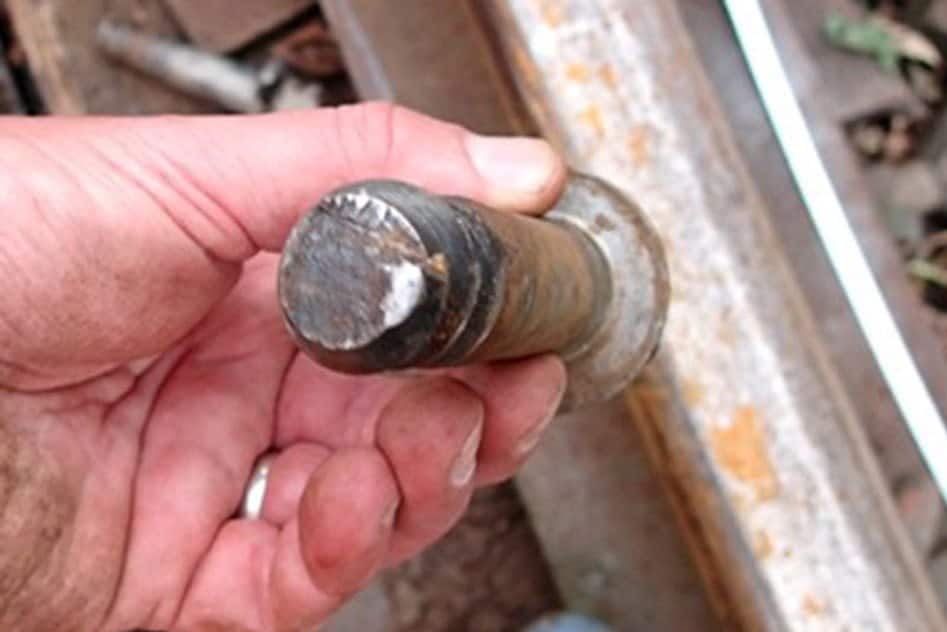
Upon inspection, investigators recovered 13 failed LSA chair screws from the low-side rail’s baseplates, none of which bore the ‘HT’ marking indicative of high-tensile strength material. Metallurgical analysis disclosed signs of both low-cycle and high-cycle fatigue failures in bending, with many screws also displaying a small area of unfatigued material that ultimately fractured by overload. This kind of failure, often just below the timber’s top level, evaded detection through visual inspection.
RAIB’s observations echo findings from a previous freight train derailment at Sheffield station in November 2020. It was noted that a broken screw’s upper portion might still resist rotation or manual removal, thus making it challenging to identify imminent failures through gauge widening alone. This underscores the critical need for improved detection methods and the employment of materials with sufficient tensile strength.
The Manchester derailment serves as a crucial reminder of the need for rigorous rail maintenance practices and the use of appropriate materials.

