
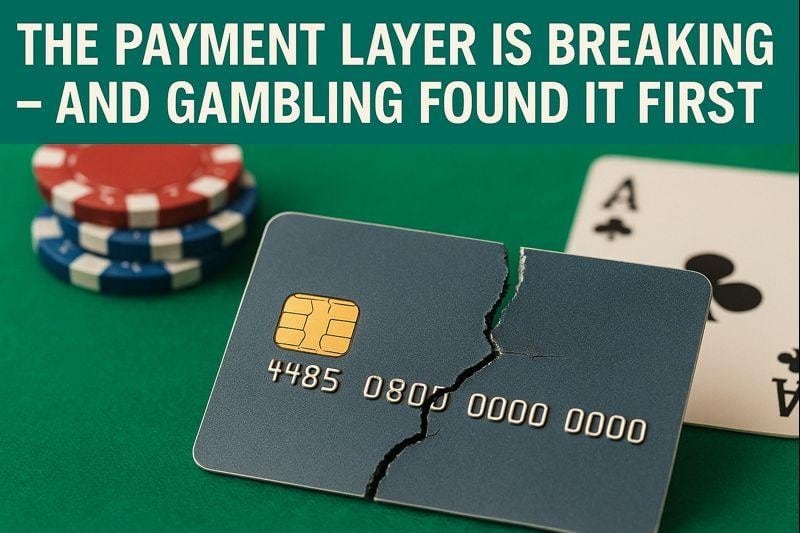

Most discussions about online gambling focus on regulation or player behaviour. Very few start where the real bottleneck lives: the payment layer itself.
From a systems perspective, online gambling is a real-time application. Games resolve instantly, balances update in milliseconds, and user interfaces assume immediate feedback. When money enters that loop and behaves asynchronously, the mismatch becomes obvious. That mismatch is not a bug. It’s a design consequence.
Banks were built for safety and oversight. Crypto networks were built for settlement. When those two models collide, friction is inevitable.
Diagnosis: Where Traditional Banking Starts to Crack
Banking infrastructure is layered by design. A single transaction may pass through card schemes, issuing banks, acquiring banks, fraud engines, compliance filters, and settlement queues.
Each layer adds logic. Each layer adds latency.
For UK users, this increasingly shows up as deposits declined without clear reasoning, withdrawals delayed by manual review, inconsistent processing times between banks, and additional affordability or source-of-funds checks.
From a financial-risk perspective, this behaviour is expected. From a real-time systems perspective, it is inefficient. The platform may be instant, but the payment rail is not.
Explanation: How Crypto Payments Rewire the Flow
Crypto payments replace discretionary approval chains with protocol rules. Transactions are broadcast, validated by network consensus, and written to a shared ledger. If the rules are met, the transaction settles. If not, it fails cleanly.
This architecture introduces three properties that traditional banking struggles to provide simultaneously: deterministic settlement, explicit finality, and continuous availability.
That design fits naturally into environments with frequent balance changes and constant transaction flow, which is why many platforms that rely on rapid settlement, including crypto casinos have gravitated toward blockchain-based payments without relying on bank-led approval cycles.
Determinism Beats Discretion in High-Frequency Systems
One of the clearest architectural differences between banks and blockchains is how uncertainty is handled.
Banking systems are discretionary. Transactions can be paused, flagged, reversed, or escalated. Humans and policy engines intervene regularly.
Blockchain systems are deterministic. A transaction either satisfies protocol conditions or it does not. Once confirmed, the state is final.
In distributed systems, determinism reduces edge cases. Fewer edge cases mean fewer reconciliation errors, fewer unresolved balances, and fewer user-facing inconsistencies. That’s a major advantage in high-throughput environments.
Why Gambling Exposes Payment Weaknesses First
Online gambling stress-tests payment rails more aggressively than most industries. It combines high transaction frequency with rapid balance updates, real-time feedback loops, and immediate settlement expectations. All at once.
Payment systems that perform adequately for ecommerce can feel unreliable under this load. Latency becomes visible. Inconsistency becomes frustrating.
Crypto payments behave more like direct value transfer than mediated settlement, which is why they surface here earlier than elsewhere.
Risk Didn’t Disappear. It Moved.
From a technical standpoint, crypto payments don’t remove risk; they relocate it.
Banks centralise risk and distribute inconvenience. Crypto systems remove intermediaries and shift responsibility to the edge. That means no chargebacks, no reversals, limited dispute resolution, and permanent state once written.
From a data-model perspective, blockchain resembles an append-only log rather than a mutable database. Once committed, entries persist.
That is powerful. And unforgiving.
Regulatory Reality Still Applies
Efficiency does not override consumer protection.
The UK Financial Conduct Authority has repeatedly warned that cryptoassets fall outside traditional protection frameworks and carry elevated risk, including volatility and lack of recourse. This applies regardless of use case.
Faster settlement does not imply safer outcomes.
Reframe: This Isn’t a Gambling Shift. It’s a Payments Shift.
Gambling didn’t create this pressure. It revealed it.
Across UK finance, similar dynamics are visible in instant transfers, open banking infrastructure, and fintech-led settlement models. Consumers increasingly expect predictable, near-instant money movement, even as regulators tighten oversight.
Crypto payments sit at the uncomfortable intersection of speed, autonomy, and reduced intermediaries. That tension is structural, not temporary.
The Questions a Technical Reader Should Ask
A more useful checklist than hype looks like this. Is settlement deterministic or discretionary? Who can modify state after confirmation? What happens when a transaction fails? Where does responsibility sit at failure points? And what protections vanish when intermediaries disappear?
These questions apply far beyond gambling.
When the Rails Matter More Than the Game
Crypto payments are reshaping online gambling faster than banks for one simple reason: the payment layer finally matches the speed of the application layer.
Banks optimise for control. Blockchains optimise for finality. Modern platforms optimise for immediacy.
When those assumptions collide, something has to give. And in this case, gambling was simply where the mismatch became visible first.

