
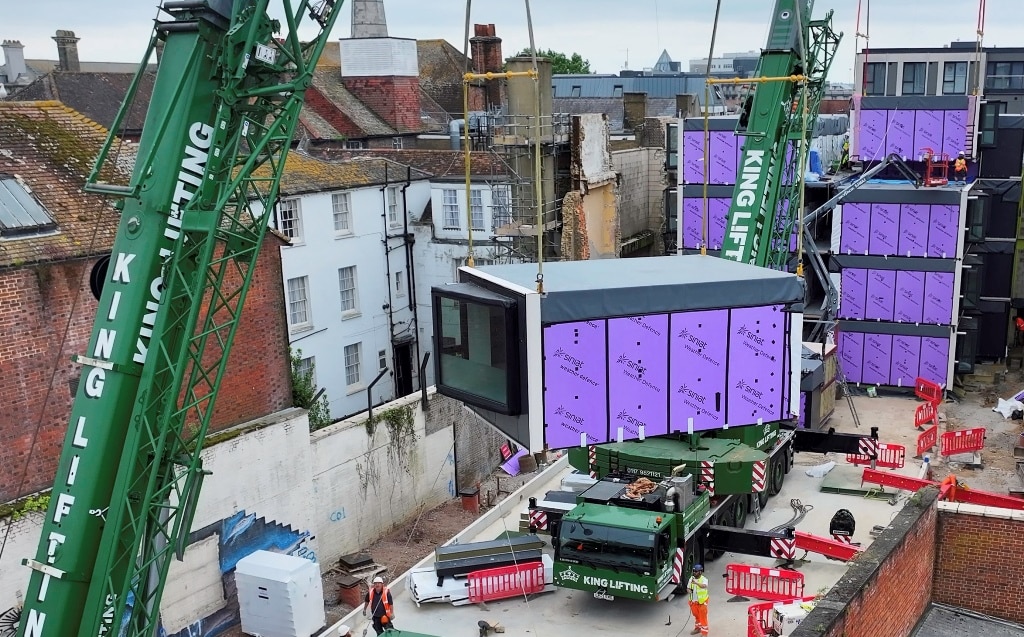

The use of modular construction has brought a fresh lease of life to a long-abandoned site in Southampton, marking a significant achievement in urban regeneration.
- A 230-tonne crane was used to install 121 modular studio apartments on the site of a former Bank of England building.
- The modular units were manufactured in Winchester and transported to Southampton, reducing on-site construction time by about 50%.
- The project restores key architectural features of the historic building while introducing modern, self-contained studio apartments operated by Unilife Student Living.
- This endeavour exemplifies the potential of modular construction, particularly for challenging and constrained sites.
In a prominent step towards revitalising Southampton’s city centre, 121 modular studio apartments have been successfully installed using an innovative approach that highlights the advantages of modern construction techniques. The employment of a 230-tonne telescopic crane enabled the placement of these pre-fabricated units at the site of the former Bank of England building, a location that has remained derelict for over a decade.
The project has been instrumental in preserving the historic value of the site’s Portland stone façade, while the original vaults within the basement have been maintained to echo the past. The substantial regeneration effort is carried out by Stelling Properties in collaboration with King Lifting, which facilitated the installation phase over a six-week period. This effort not only conserves an important piece of Southampton’s architectural history but also provides 121 self-contained studios for future residents.
The modular units, each measuring eight metres in length and weighing up to 12 tonnes, were pre-fabricated in Stelling’s Winchester factory and arrived fully furnished, complete with kitchenettes, shower rooms, and bespoke furniture. Such a level of pre-completion significantly mitigates the time and disruption typically associated with extensive on-site construction processes, reducing the timeline by approximately 50%. This development is operated by Unilife Student Living and is slated for completion later this year.
Dan Smith, chief operating officer of Stelling Properties, emphasized the transformative potential of this construction method, particularly for sites surrounded on multiple sides and those lacking sufficient space for traditional building techniques. He noted, “31 High Street has been a hugely challenging and constrained site to develop. It demonstrates the enormous potential of offsite construction and our technical capabilities very well.” Further to this, the project also includes the installation of modern amenities such as solar panels and landscaped roof terraces, ensuring these residences meet contemporary living standards while blending harmoniously with their historic surroundings.
Overall, this project not only underscores the efficiency and efficacy of modular construction in reducing on-site disruption but also accentuates its suitability for urban environments with spatial limitations. By retaining key architectural features, the development pays homage to its historical setting while providing much-needed accommodation for students in Southampton.
The successful deployment of modular construction at 31 High Street in Southampton is a testament to the efficacy of modern building techniques in urban regeneration.

