
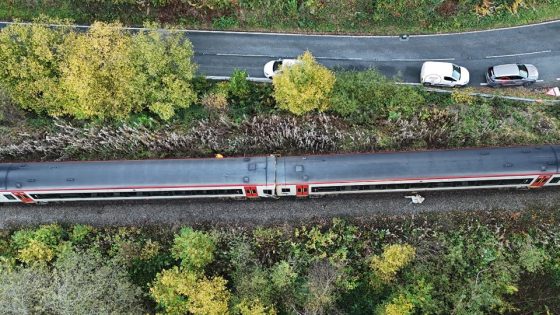

A tragic train collision in Wales resulted in one death, raising safety concerns.
- Faulty wheel slide protection on a train hampered emergency braking efforts.
- Blocked sanding hoses prevented the effective halt of the westbound train.
- Low wheel/rail adhesion contributed to the collision on the Cambrian line.
- Investigations are ongoing to determine further implications and safety failures.
The collision between two Transport for Wales trains on 21 October in Llanbrynmair, Powys, claimed one life, injured several individuals, and brought the safety of rail systems under scrutiny. The incident involved two class 158 diesel multiple units equipped with systems akin to car anti-lock brakes. However, one train’s wheel slide protection system was defective, hampering its emergency stopping capabilities.
One critical issue identified by the Rail Accident Investigation Branch (RAIB) was the blockage of sanding hoses on the 1J25 train, which was travelling westbound from Shrewsbury to Aberystwyth. The sanding hoses are designed to augment friction between wheels and rails during braking, yet, during the attempted emergency stop, the blocked hoses rendered the system ineffective. This malfunction was a significant contributor to the failure to avert the collision.
The Cambrian line employs the European Rail Traffic Management System, a sophisticated signalling method that transmits control data directly to trains, negating the need for traditional lineside signals. This incident occurred on a single track section, positioned 900 meters west of a passing loop at Talerddig. The loop’s function is to enable trains moving in opposite directions to safely pass each other. The westbound train was scheduled to stop at this loop to permit the eastbound train, 1S71, to pass unhindered.
Data from the on-train recorder disclosed that the driver of the westbound train engaged service braking as the train neared the loop but resorted to the emergency brake approximately 40 seconds later. Despite these efforts, wheel slide persisted, as the sanding hoses were unable to deploy sand, exacerbating the situation. Concurrently, the eastbound train decelerated yet failed to stop at the block marker before exiting the loop, resulting in its collision course with the westbound train after about 900 meters on the single track.
Following the crash, RAIB conducted assessments of wheel/rail adhesion levels along the affected track. Findings revealed considerably poor adhesion. Despite conflicting reports regarding the trains’ speeds at impact, preliminary data suggests the eastbound train was moving between 24km/h and 39km/h, while the westbound was travelling at approximately 10km/h. The RAIB’s investigation remains focused on the collision speed, continuing to analyse factors such as braking systems and organisational policies regarding the handling of low adhesion scenarios.
The ongoing investigation seeks to uncover comprehensive insights into the causes and mitigating factors of the train collision in Wales.

