
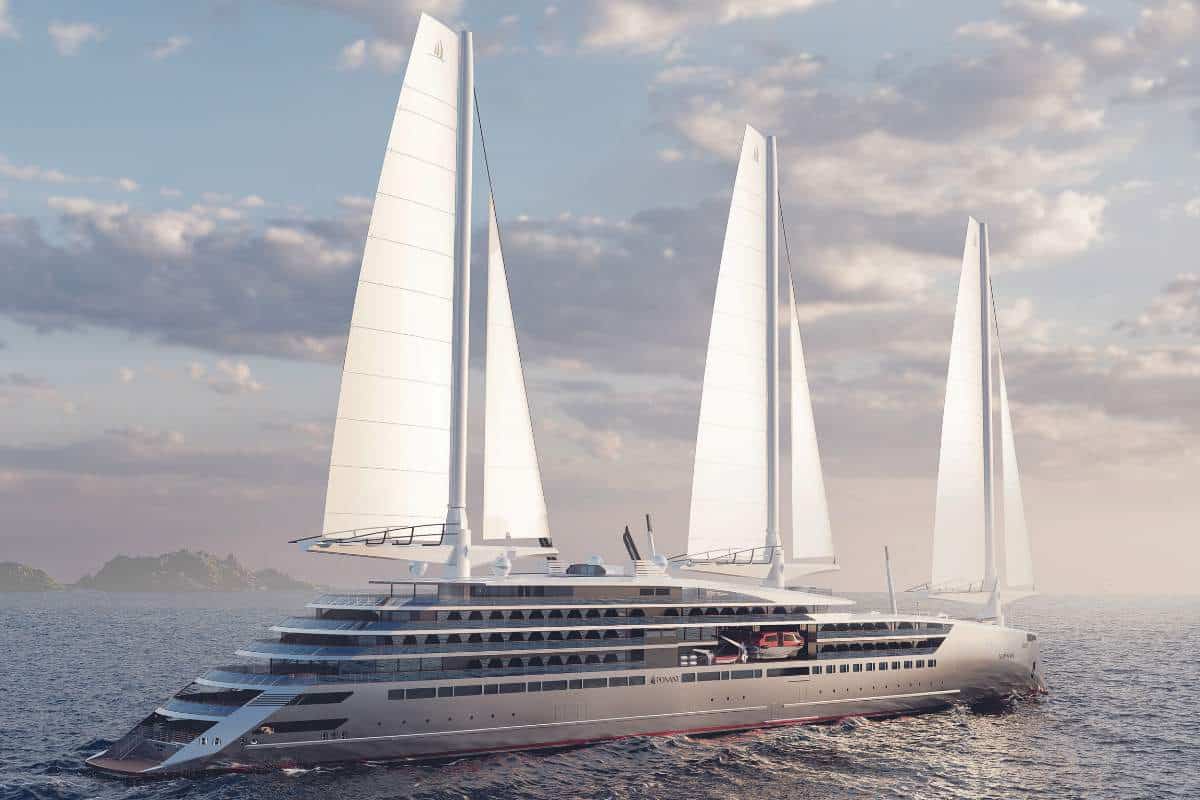

Ponant secures European Commission funding to develop the first transoceanic carbon-neutral cruise ship.
- The European Commission’s INNOVFUND backs Ponant’s Swap2Zero project to drive maritime decarbonisation.
- Funding supports use of renewable energy, aligning with France’s 2030 goals and Green Ship roadmap.
- Ship design includes six decarbonisation technologies featuring sail power, photovoltaic panels, and fuel cells.
- Ponant plans to operationalise this zero-emission vessel by 2030, showcasing French technological prowess.
Ponant has successfully obtained financial backing from the European Commission to realise its ambitious vision of launching the world’s first transoceanic carbon-neutral cruise ship. The project, named Swap2Zero, is supported by the EC’s INNOVFUND, a programme devoted to advancing a mixture of renewable energy sources aimed at meeting decarbonisation targets.
The funds, originating from the EU Emissions Trading System, represent a significant investment in innovative low-carbon technology within the maritime sector. This initiative aligns with France’s broader 2030 objectives and the CORIMER Green Ship roadmap, which focuses on accelerating technological advances in maritime industries. The French government and BPI have also thrown their support behind Ponant’s project through the CORIMER 2023 calls for expressions of interest.
Patrick Augier, Ponant’s general secretary, acknowledged the importance of the grant, stating, ‘Getting this grant sends a very encouraging message to teams working on this ambitious decarbonisation project.’ The Swap2Zero project signifies a milestone for French innovation, aspiring to construct a zero-emission ship that embodies cutting-edge technology.
The design of this pioneering vessel includes the integration of six advanced decarbonisation technologies. A sail power system will harness wind energy to provide 50% of the ship’s propulsion. Additionally, the ship will be equipped with over 1,000m² of next-generation, eco-friendly photovoltaic panels, manufactured in France, and a low temperature fuel cell powered by liquid hydrogen for propulsion.
Moreover, a high temperature fuel cell will meet the ship’s energy needs for onboard services, repurposing emitted heat to generate hot water. The vessel will also feature on-board carbon capture technology, paired with the high temperature fuel cell, and a custom energy management system designed to efficiently distribute power without relying on generators. Ponant’s goal is to have this ground-breaking vessel operational by 2030, highlighting a significant step forward in maritime environmental responsibility.
Ponant’s Swap2Zero project stands as a testament to the potential of technology in achieving sustainable maritime travel.

