
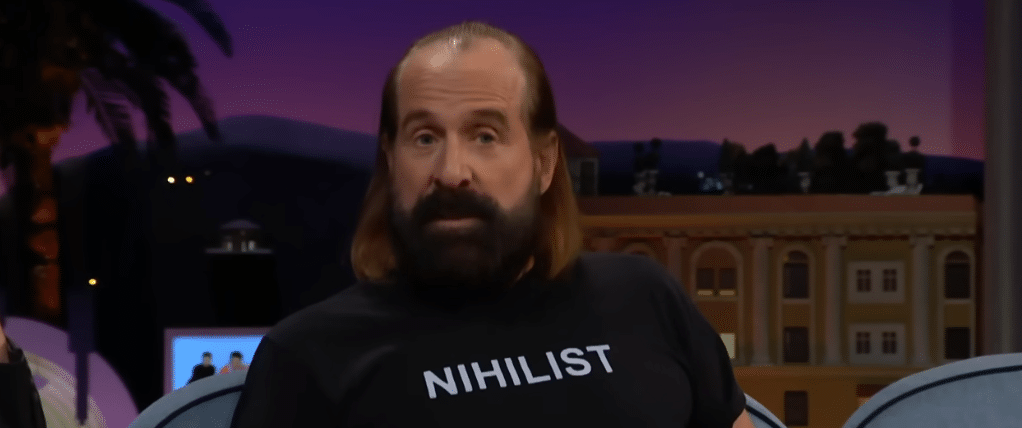

The face of Peter Stormare has the worn, recognizable appearance of a man you’re positive you’ve seen before—possibly in the fluorescent hum of a convenience store or on a highway at night. He has made a living by portraying characters who seem to have been living off the grid, keeping secrets, and keeping an eye on exits. This contributes to the peculiarity of the “net worth” question.
A clean number is what the internet desires. Stormare’s career has consistently resembled a patchwork quilt, made up of prestige TV, studio blockbusters, cult classics, and the kind of work that never goes out of style but never stops.
| Field | Details |
|---|---|
| Full Name | Rolf Peter Ingvar Stormare |
| Born | August 27, 1953 |
| Birthplace | Kumla, Sweden |
| Citizenship | Sweden / United States |
| Profession | Actor (also director, playwright, musician) |
| Years Active | 1976–present |
| Known For | Fargo, Prison Break, The Big Lebowski, Constantine |
| Notable Modern Work | Film/TV plus voice & game roles (incl. recurring game work) |
| Estimated Net Worth Range (online) | Roughly $1M–$5M (estimates vary) |
| Authentic reference link | https://web.archive.org/web/20230307164619/https://www.stormare.se/ |
Stormare has $1 million, according to one of the most popular celebrity finance websites. If you use a different entertainment explainer, his figure is more like $5 million. Then there is the elusive $215 million, which is floating around the internet like a helium balloon that somehow escaped during a birthday celebration and never came down. The last one might be the result of careless aggregation, outdated page errors, or the more widespread online tendency to conflate “famous” with “filthy rich.” In any case, it ought to raise suspicion right away.
A modest fortune earned the unglamorous way—by working nonstop—seems more plausible. Stormare played Gaear Grimsrud in the Coen brothers’ Fargo, a part that endures in popular culture like ice on a windshield. He appears as the memorable complication rather than the main character in The Big Lebowski, Armageddon, Minority Report, and Constantine.
The money story is typically elsewhere, including backend deals (rare for character actors), consistent salaries, residuals, and the lengthy tail of a career that never truly went quiet. Those are the credits people recite at parties.
In contemporary Hollywood, a certain type of actor—dubbed the “recognizable stranger”—succeeds. One excellent example is Stormare. Directors keep calling him because he consistently adds grit without taking away from the entire film, and he’s cast as various nationalities, blending into accents the way other actors blend into wardrobes. That dependability is bankable even though it isn’t glamorous. Not bankable by billionaires. Bankable more like “paid, insured, and still booking.”
The fact that his work isn’t limited to television and movies is one of the more intriguing aspects of his financial puzzle. His significant contribution to video games includes roles in the Destiny universe and Until Dawn, as well as frequent appearances connected to well-known franchises.
Another type of compensation is game performances, which can be smaller initially, more consistent over time, or occasionally increased by recurring partnerships. Although the exact amount of Stormare’s yearly revenue from this lane is still unknown, it probably helps bridge the gaps between on-camera roles.
Then there’s “The Replacer,” the recurring character in advertisements for new Call of Duty games, where Stormy portrays a smiling, slightly insane professional stand-in so that players can take a weekend break. Particularly when it is repeated, commercial work can be the silent engine of a celebrity’s wealth. These jobs seem to be the kind of thing that gives a working actor genuine financial breathing room because they are less prestigious and more reliable.
Along with managing a label and performing under the delightfully odd moniker “Blonde from Fargo,” Stormare also maintains a hand in the music industry. Side projects can be more about leverage—maintaining a personal brand, opening doors, and remaining interesting—than they are about making money. Don’t confuse this with pop-star money. When a casting director is tired of the typical suspects, sometimes being “interesting” is what gets you hired.
What is the “real” net worth, then? The truthful response is that outsiders are unaware. The majority of these figures are educated guesses that are rarely derived from actual balance sheets but rather from industry standards, public credits, and the odd property rumor. However, a low single-digit million estimate doesn’t seem out of the ordinary when you consider the trajectory of his career—decades of consistent work, international projects, television arcs like Prison Break, and continued voice and game presence.
It’s difficult to ignore how the obsession with net worth obscures what Stormare truly stands for: Hollywood’s durability class. The stars erupt.
As the industry revolves around them, the character actors persevere, piling up credits the way a carpenter stacks lumber—job by job, piece by piece, and maintaining their jobs. Perhaps that is the point if people on the internet cannot agree on whether he is worth $1 million or $5 million. His wealth doesn’t make the news. It’s a result of consistently displaying that distinctive face—already in character, already productive.

