
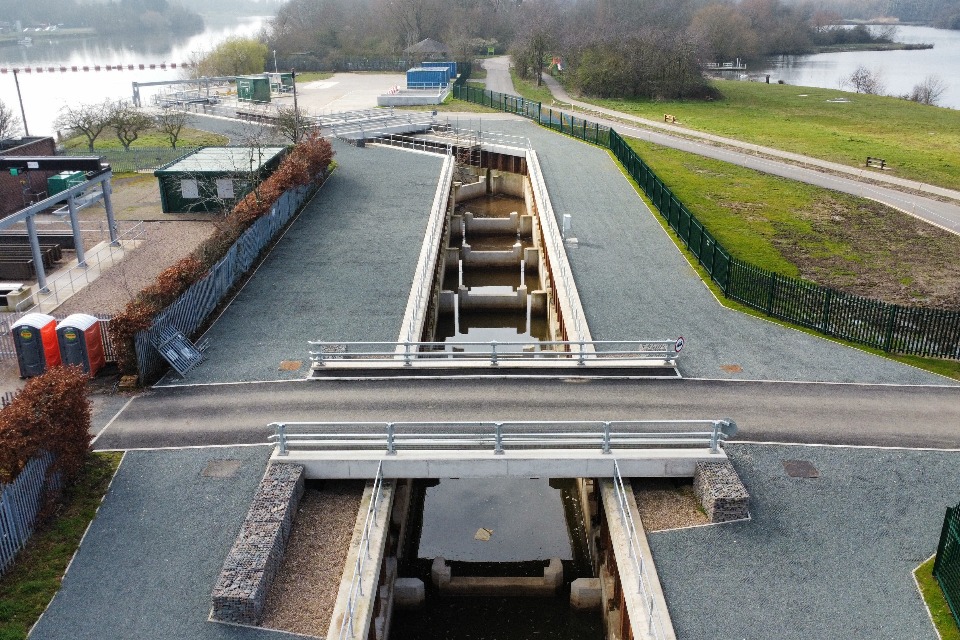

A significant development for aquatic life, the Colwick Fish Pass in Nottinghamshire has been officially opened.
- Constructed at a cost of £12m, this fish pass enables access to habitats for fish such as salmon and trout.
- The Environment Agency’s commitment to ecological restoration is demonstrated through this vital project.
- A sophisticated system of chambers and gates adapts to varying water levels to aid fish migration.
- Public amenities include educational resources to engage visitors with the local ecosystem.
The Colwick Fish Pass has been opened, marking a notable advancement in promoting fish migration along the River Trent and its tributaries. This infrastructure now allows species such as salmon, trout, and eels to reach essential breeding and feeding locations that were previously inaccessible. Built by Jackson Civil Engineering, the structure came at a cost of £12m and has been two years in the making, culminating in its recent inauguration by Alan Lovell, chair of the Environment Agency.
Steve Lawrie, area environment manager at the Environment Agency, remarked on the project’s significance: ‘The fish pass provides a significant step in restoring the River Trent catchment to its former glory for salmon and other coarse and migratory fish.’ The initiative includes an eel pass, addressing the dire needs of the critically endangered European eel, thus reaffirming the Agency’s obligations under the Environment Act 1995.
This state-of-the-art fish pass spans 200 metres in length, stretching to six metres in depth and 6.5 metres in width, featuring a two-metre-high automated radial gate. Such features are crucial for maintaining optimal water levels and flow rates, ensuring seamless passage for aquatic life regardless of seasonal changes. Fish navigate upward through 20 chambers, each designed with narrow slots that facilitate movement and provide resting spaces, enabling them to spawn in tributaries like the River Dove and River Derwent.
Historically, the River Trent faced a decline in fish populations due to the Industrial Revolution’s weirs built for trade. This fish pass is a remedial measure, borne out of statutory duty, aimed at ameliorating historical impediments. The Environment Agency’s initiative reflects a broader ecological recovery strategy, underpinning their legislative mandate to enhance migratory fisheries.
Furthermore, a public viewing platform has been incorporated, featuring interpretive displays that educate and inform visitors about the area’s wildlife and the ongoing ecological efforts. These boards are designed to foster public awareness and support for conservation activities, highlighting the diverse species benefiting from this development.
The Colwick Fish Pass stands as a testament to effective environmental action and forward-thinking ecological management.

