
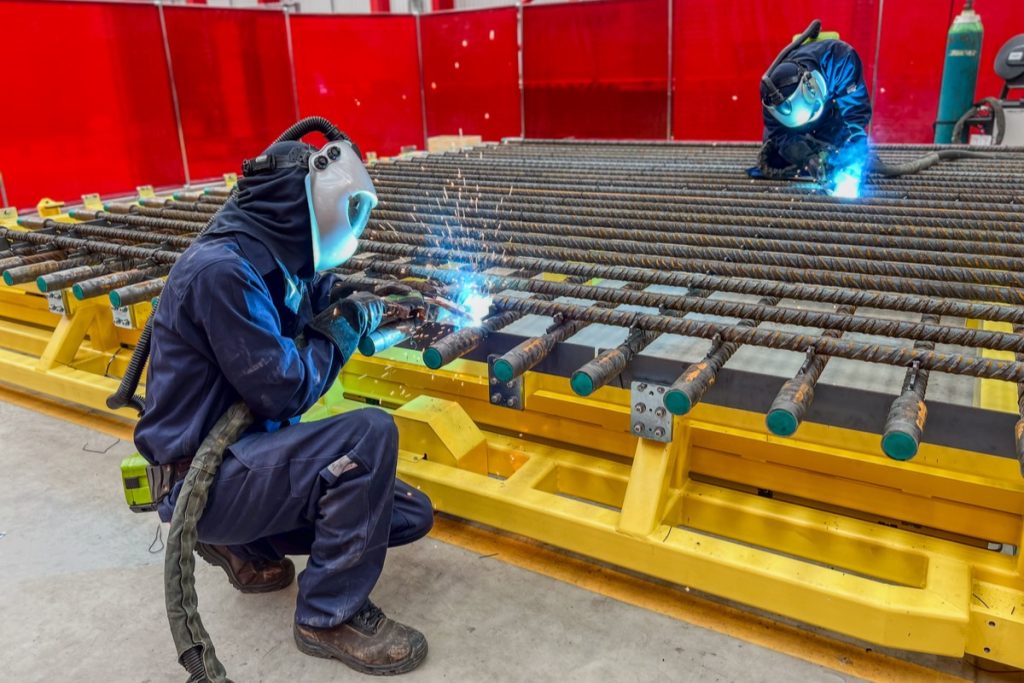

Modular construction is significantly enhancing productivity at Hinkley Point C in Somerset, with large components being prefabricated offsite.
- Factories near Bristol manufacture expansive parts, cutting on-site installation time by 75% and production time by 20%.
- The offsite approach enhances capacity, accelerates the civil programme, and reduces manual handling and traffic.
- Local workforce benefits as they no longer need to reside near the Somerset site, enhancing the industry’s appeal.
- Innovative techniques lead to a 20-30% increase in productivity for Unit 2, setting new directions for future nuclear projects.
Modular construction techniques are playing a pivotal role in the efficiency and productivity of the Hinkley Point C nuclear power station’s construction in Somerset. Factories located in the Bristol area are now producing ‘ever larger pieces’ for the facility, including substantial steel reinforcement cages that significantly bolster concrete structures. According to EDF, this prefabrication strategy has dramatically decreased on-site installation times by up to 75% and curtailed manufacturing time by 20%.
The transition to offsite manufacturing is not merely about time-saving; it also enhances production capacity and expedites the civil construction programme while greatly reducing the necessity for manual handling and local traffic at the construction site. Components are directly shipped from these factories to the site’s jetty, streamlining logistics effectively.
Additional offsite manufacturing efforts include the production of steel rebar at Avonmouth, located on the fringes of Bristol. Remarkably, there have been no reports of non-conformances in these materials, indicating a high standard of fabrication. Furthermore, the French nuclear company Framatome is prefabricating stainless steel cooling water tanks in the same region, reinforcing the project’s reliance on precision and quality.
A notable accomplishment is the prefabrication of a 1,305-tonne structure for fuel handling, marking the largest prefabricated element for the project thus far. This loading pit was assembled within an on-site bunker before being skilfully lifted into place by ‘Big Carl,’ the world’s largest crane.
The workforce dynamics have also benefited from this modular approach. Many factory workers hail from South West England or South Wales, allowing them to work locally without needing to live close to Somerset’s construction site. This convenience is drawing a new generation into the nuclear industry by offering better work-life balance and diminishing the necessity for site-based accommodation.
Stuart Crooks, Managing Director at Hinkley Point C, pointed out that the manufacturing model developed is not only beneficial for the current project but also paves the way forward for Sizewell C, the next major nuclear plant in development in the UK. As Sizewell C will replicate Hinkley Point C, the efficiencies and insights gained are expected to seamlessly transfer, thereby expediting future nuclear plant construction.
Simon Parsons, Hinkley Point C’s Nuclear Island Director, reports substantial productivity improvements in the construction of Unit 2, noting a 20-30% leap compared to Unit 1. This boost is partly attributed to innovative practices such as synergic metal active gas (Smag) welding, a method utilised for the first time on a nuclear project, which has quadrupled the welding pool completion rate in Unit 2 compared to Unit 1.
The application of modular construction at Hinkley Point C exemplifies a transformative step towards efficient nuclear plant construction.

