
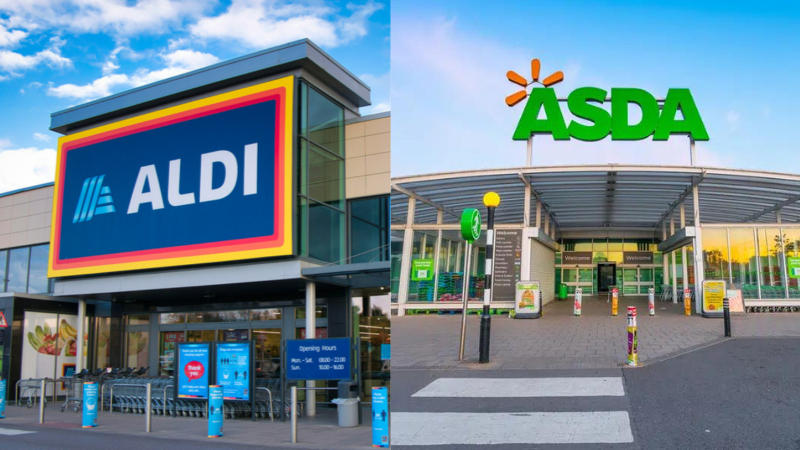

Recent data indicates a notable decline in market shares for both Asda and Aldi, amidst an overall cooling in supermarket sales.
In the 12 weeks leading up to early September, Asda and Aldi experienced significant decreases in their market positions, reflecting broader trends within the supermarket industry.
Current Market Dynamics
The recent analysis reveals a significant decline in the market shares of Asda and Aldi. Asda’s market position has weakened to 11.8% in the 12 weeks up to 7 September, a drop from its former share of 13.1% within a similar timeframe last year. Aldi, experiencing a similar downturn, saw its share decrease from 10.7% to 10.3% during the same period. This data portrays a challenging landscape for these retailers as they face headwinds in maintaining their market positions.
The overall supermarket sector has experienced a cooling off in sales momentum, evidenced by the decrease in total till sales. According to NIQ, sales figures fell from 5.5% in the previous month to 4% in the four weeks ending on 7 September. Consumers’ return to routine following the summer break and cooler weather are contributing factors to this lull in supermarket shopping activities.
Factors Influencing Market Trends
The transition from summer to autumn marks a change in consumer behaviour, notably impacted by the ‘back-to-school’ period. NIQ’s UK head of retailer and business insight, Mike Watkins, notes retailers are adjusting marketing strategies to capture consumer interest as they shift back to regular schedules. This seasonal change requires businesses to adapt swiftly to evolving consumer needs.
With half of the households contending with the rising cost of living, economic pressures are reshaping purchasing habits. Thus, retailers must offer attractive promotions and relevant products to appeal to budget-conscious consumers. This strategic adjustment is essential for driving sales growth in the fourth quarter, a pivotal period for retail performance.
Competitive Response to Market Adjustments
Other supermarkets are exhibiting more vigorous growth despite the general slowdown. Ocado, maintaining its status as the fastest-growing retailer, achieved a remarkable 15.4% increase in sales.
M&S also posted an impressive 12.4% rise in sales, reflecting a strategic alignment with consumer expectations. This performance underscores the importance of responsive business strategies in adapting to market fluctuations.
Supermarkets like Morrisons and Waitrose are leveraging loyalty schemes to stimulate consumer spending. Morrisons has introduced additional More Card offers, enhancing customer value and driving expenditure per visit. Concurrently, Waitrose has succeeded in expanding its customer base, witnessing increased store visits compared to the previous year.
Challenges and Strategic Initiatives
For Asda, the leadership transition, as Lord Rose assumes operational control from Mohsin Issa, comes amid disappointing financial metrics. His leadership could potentially steer strategic pivots necessary to reverse the recent decline.
The firm’s new direction under Rose’s stewardship might involve recalibrating product offerings and intensifying promotional efforts. This strategic overhaul will likely focus on aligning with shifting consumer preferences and enhancing competitive positioning.
These organisational shifts are imperative as Asda seeks to regain its foothold within a competitive grocery landscape characterised by evolving consumer demands and dynamic market conditions.
Implications of Changing Consumer Patterns
Households are gradually planning for the festive season, adjusting their shopping habits to spread costs efficiently. The anticipation of holiday expenses is prompting earlier stocking of essentials.
Retailers are emphasising promotions and media spending to better understand and respond to consumer purchasing drivers. This strategic focus aims to optimise marketing effectiveness and foster increased shopper engagement.
A critical component of this strategy involves understanding the impact of every promotional channel, allowing retailers to refine their approach to target consumer needs more precisely. This understanding is crucial for navigating the complexities of modern retail.
Economic Outlook and Retail Strategy
The economic landscape presents significant challenges, both for retailers and consumers facing heightened inflation concerns. Retailers must identify strategies to remain resilient amidst economic uncertainties, balancing cost considerations with value propositions to sustain customer loyalty.
Retailers must adopt an agile approach to their marketing and product strategies. Emphasising value creation and customer engagement will be vital in navigating through turbulent economic times.
As market conditions continue to shift, retailers must remain vigilant, continuously reassessing their approaches to maintain relevance and competitiveness in a rapidly changing economic environment.
Conclusion Insights
The retail sector, particularly supermarkets such as Asda and Aldi, is facing formidable challenges amidst shifting economic and consumer landscapes. Significant adaptations in strategy and operations are necessary to counteract declining market shares and leverage opportunities for growth in a competitive sector.
Supermarkets must innovate and adapt to changing consumer behaviours and economic pressures to maintain and expand their market presence.
Asda and Aldi must undertake strategic initiatives to address their plummeting market shares and capture emergent growth opportunities.

