
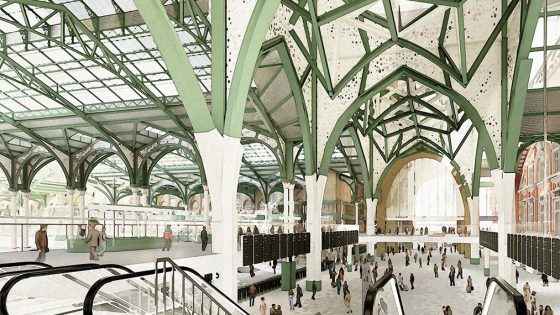

Network Rail announces new redevelopment plans for Liverpool Street station, aiming to address concerns over previous proposals.
- Acme leads the new design team, replacing Herzog & de Meuron, focusing on both modernisation and historical preservation.
- The station, serving over 100 million annually, aims to improve passenger experience with step-free access and expanded facilities.
- Public feedback prompted significant changes, retaining more heritage features and reducing the structural height of the new design.
- Plans include new commercial spaces, enhanced connectivity, and preserving landmark views such as St. Paul’s Cathedral.
Network Rail has put forth a new redevelopment proposal for London Liverpool Street station after facing significant opposition to the initial plan introduced in May 2023. In response to the feedback, a fresh design team led by Acme has been engaged, taking over from Herzog & de Meuron. This new team also includes Aecom as part of the advisory group. The primary goal is to transform the station into a future-ready transport hub while preserving its historical significance.
Currently, Liverpool Street station caters to over 100 million passengers each year, with expectations to accommodate 140 million by 2050. The proposed improvements seek to enhance passenger experience through expanded concourse areas to reduce congestion, implementing step-free access throughout the station, including the Underground, and installing seven new lifts for better platform accessibility. Escalator numbers will be doubled from four to eight, and additional ticket barriers will be installed to alleviate queuing issues. Furthermore, the project envisions new toilets, family-friendly facilities, and multiple landmark entrances at key points around the station.
The revised proposal arose from considerable heritage concerns, with Network Rail committed to maintaining the station’s original charm while delivering outstanding public infrastructure improvements. Network Rail has stated, ‘The new scheme is rooted in a deep understanding of the station’s operational needs and its historic significance’. Key revisions include a lower architectural profile, with the highest point at 97 metres, compared to the previous 108 metres, and greater conservation of the station’s interior heritage elements, such as the 1980s roof.
Public engagement was influential, guiding many of these changes, which also include increasing commercial and leisure activities within the station. New cafes, restaurants, and shops are planned to revitalise the station’s commercial viability. A new concourse will facilitate smoother connections from Broadgate to Bishopsgate and further towards Exchange Square, significantly improving the flow of passengers and integrating the area more effectively with surrounding urban spaces. The redesign also seeks to maintain views of city landmarks such as St. Paul’s Cathedral, with a new green roofed office building supplementing the project’s financial viability without detracting from these views.
During construction, which aims to minimise noise, dust, and traffic disruptions, access to trains will be preserved, with necessary adjustments to pedestrian routes clearly communicated in advance. Network Rail will engage with passengers, local businesses, and heritage groups to ensure the redevelopment aligns with communal interests. Robin Dobson, Network Rail Property’s group property director, emphasized the importance of investing in infrastructure for economic growth, while Acme’s Friedrich Ludewig expressed enthusiasm for crafting a ‘world-class transport gateway’ that honours Liverpool Street’s legacy.
Network Rail’s new proposal for Liverpool Street station smartly marries modernisation with heritage preservation, promising a transformative transport hub fitting for future demands.

