
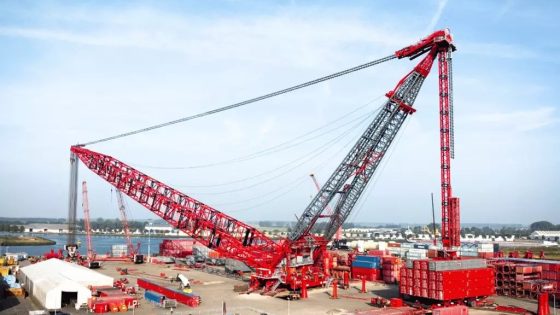

Heavy lifting company unveils world’s most powerful crane.
- SK6000 crane boasts a 6,000-tonne capacity, operating on electric power.
- Innovative design allows for large-scale energy and infrastructure projects.
- Crane supports offshore wind developments tackling component supply issues.
- Currently tested in Netherlands, it readies for deployment this year.
Heavy lifting company Mammoet has introduced the world’s strongest land-based crane, the SK6000, which revolutionises crane capabilities with an impressive loading capacity of 6,000 tonnes. Notably, this crane operates fully on electric power, providing an environmentally friendly solution for massive construction tasks.
The SK6000’s innovative design capitalises on containerisation for facile transport across global locations, leveraging shipping containers for efficient deployment. An optimal synergy of 4,200 tonnes of ballast and a maximum ground bearing pressure of 30t/m² ensures stability and effectiveness during operations, highlighting its strength in undertaking substantial lifting tasks.
This crane is poised to significantly impact large energy and infrastructure projects, specifically addressing the burgeoning scale of offshore wind farms. The rapid enlargement of wind components has strained supply chains, and the SK6000 is anticipated to alleviate these challenges by allowing the lifting of up to 3,000 tonnes to a towering height of 220 metres.
Currently undergoing rigorous testing at Mammoet’s Westdorpe facility in the Netherlands, the SK6000 is being prepared for its inaugural deployment later this year. Gavin Kerr, Mammoet’s global services director, underscores the engineering exceptionalism embodied in the crane, stating, “This crane is truly a world record feat of engineering, with a production schedule to match.”
The adoption of the SK6000 crane represents a formidable advancement in construction and energy project capabilities, as it aligns with contemporary requirements for heightened efficiency and sustainable practices.
The SK6000 crane signifies a pivotal evolution in the construction and energy sectors, poised to meet modern industrial demands.

