
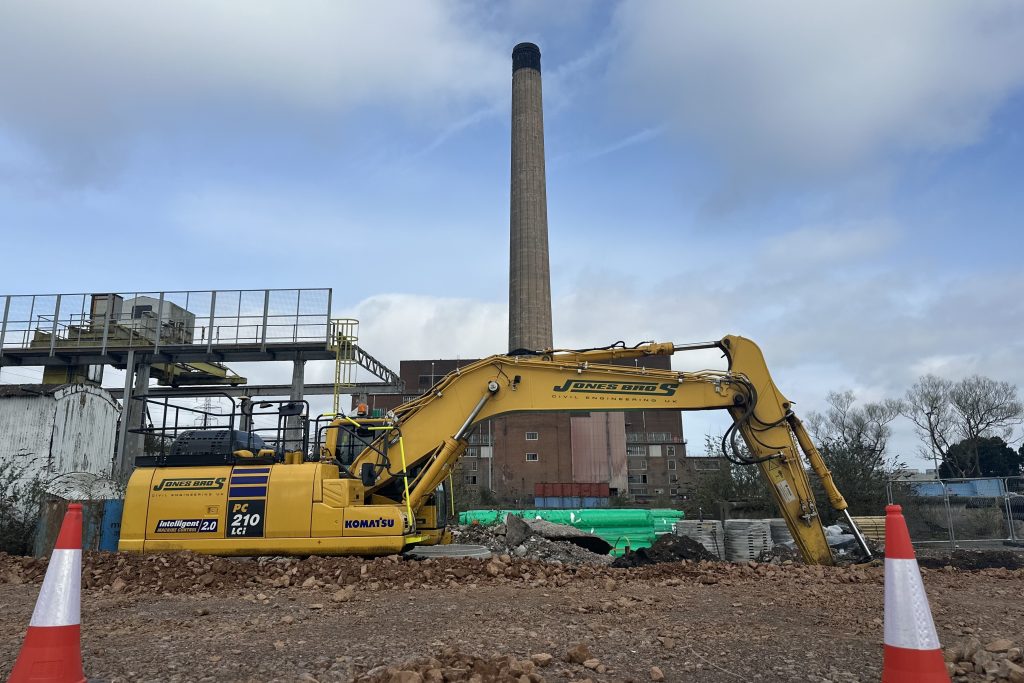

Jones Bros is constructing a significant 230MW battery energy storage system at the Uskmouth site in South Wales.
- The facility is being developed for Quinbrook Infrastructure Partners and E.ON.
- Previously, the Uskmouth site hosted two coal-fired power stations, which have since been demolished or decommissioned.
- The new project repurposes existing infrastructure and aims for completion in early 2025.
- The initiative is expected to contribute to the UK’s energy transition and support renewable energy sources.
Jones Bros Civil Engineering UK is at the forefront of a pivotal project in South Wales, constructing a 230MW battery energy storage system (BESS) on the grounds of the former Uskmouth coal power stations. This enormous undertaking, carried out for Quinbrook Infrastructure Partners and E.ON, highlights the transition from traditional energy sources to more sustainable solutions in the UK. Given its scale, the BESS is poised to become one of the country’s largest storage systems, reinforcing energy security and storage efficiency.
The historical context of the Uskmouth site is significant. The two power stations that once stood there, Uskmouth A and Uskmouth B, have either been demolished or decommissioned. Uskmouth A, operational since 1953, was known for its massive coal consumption and storage capacity. In contrast, Uskmouth B faced closure in 2015 after an explosion halted its planned conversion to biomass.
With Jones Bros leading the transformation, the new battery storage facility is designed to utilise existing infrastructure effectively. Notably, the development work includes cleaning out and repurposing a fly ash tunnel, integral to the new infrastructure for housing cables and components. The firm has already completed vital enabling works, such as establishing the main compound and constructing acoustic fencing to mitigate noise pollution.
A critical component of the venture is the ecological enhancement plan. As part of this initiative, Jones Bros aims to install new fencing and landscaping to attract wildlife, including otters and water voles, thereby promoting biodiversity at the site. Furthermore, the project leverages existing grid connections and other infrastructure elements like industrial water supplies and railway access, significantly reducing the anticipated transportation impact by approximately 370,149km.
Rhys Roberts, the project contact manager at Jones Bros, articulates the excitement surrounding the scheme as it aligns with the nation’s broader energy strategy. The redevelopment of the site is not just a construction endeavour, but a partnership with the environment, seeking to minimise local impact while supporting the transition to renewable energy. Emphasising this sentiment, Roberts notes that parts of the old power station, such as a pre-existing garage, will be adapted to meet the Building Research Establishment Environmental Assessment Method (Breeam) standards for excellent environmental performance.
The transformation of Uskmouth exemplifies the shift towards a sustainable energy future, repurposing historical sites for modern needs.

