

A pioneering project is underway to address water scarcity and climate challenges through innovative pipeline construction techniques.
- Specialist contractor VolkerTrenchless Solutions employs horizontal directional drilling to traverse compromised chalk formations.
- The Strategic Pipeline Alliance comprises key industry players like Costain, Farrans, Jacobs, and Mott MacDonald Bentley, aiming to lay 330km of pipeline.
- Kennet crossing near Peterborough posed significant challenges, requiring precise engineering and hydrofracture analysis.
- Advanced drilling technologies reduced environmental impact and project timelines, evidencing a forward-thinking approach.
The Strategic Pipeline Alliance, a collaborative effort led by Anglian Water, has embarked on a crucial mission to enhance water resilience in the region. The ambitious initiative aims to mitigate risks posed by water scarcity, climate change, and increasing population demands. At the helm of this endeavour is VolkerTrenchless Solutions, a specialist contractor, renowned for pioneering drilling techniques. By employing horizontal directional drilling (HDD), the Alliance is paving the way for a 330km long pipeline network, designed to relocate water from surplus areas in the north to deficit regions in the south and east.
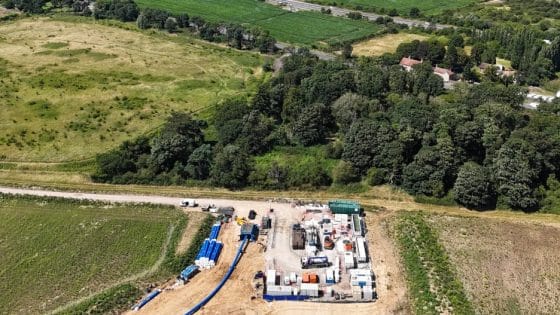
The Kennet crossing, located near Peterborough, exemplifies the difficulties encountered during the project. Engineers faced the arduous task of drilling a 775m HDD bore beneath critical infrastructure such as the Network Rail asset, A14 dual carriageway, and B1506 road. The presence of fractured chalk beneath these structures posed a significant threat of frac-outs, requiring detailed hydrofracture analysis and mud pressure calculations. The collected data enabled engineers to predict and manage potential pressure-induced failures, minimising risks and guiding the drilling operations.
The logistical challenges did not end with geological concerns. Local bridge weight restrictions necessitated a 14.5km detour for each of the 230 tanker movements required for fluid management. These constraints were circumvented through the utilisation of an intersect HDD methodology, whereby rigs drilled from opposite ends to meet in the middle, reducing downhole pressures and the associated risks. This innovative approach not only mitigated the risks of frac-outs but also streamlined operations.
In addition to intersect drilling, VolkerTrenchless Solutions adapted advanced drilling technologies from the oil and gas sector. A swivel master tool and float valves were employed to facilitate the continuous recirculation of drilling fluids, significantly reducing environmental impact and operational costs. These innovations played a pivotal role in realising the project ahead of schedule. Notably, early involvement in the planning phase four years ago was instrumental in circumventing foreseeable challenges.
The successful implementation of advanced drilling techniques underscores a significant advancement in handling geological challenges in pipeline construction.

