
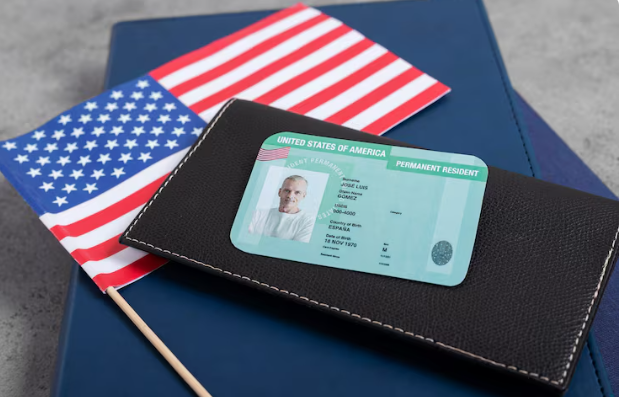

People who have spent months or even years preparing for the interview that will decide whether or not they are allowed to remain in the country they have made their home in sit in waiting rooms at USCIS field offices across the nation, including in Houston, Chicago, and Los Angeles, with folders of meticulously arranged documents, photos, financial records, medical forms, and letters from employers. Those waiting areas have a different vibe in March 2026 than they did two years prior. There is now more monitoring. The inquiries are more specific. Additionally, for an increasing number of applicants, the conclusion that appeared to be procedurally certain is now actually unclear in ways that immigration lawyers are finding difficult to convey to clients who brought all necessary documentation and complied with all regulations.
Certain green card applicants from 19 countries classified as high-risk have had their processing halted by USCIS. This development has caused a great deal of anxiety among the affected applicants, many of whom have been waiting in the system for years and are now watching their cases sit without movement for reasons that haven’t been made clear. No matter how narrowly the policy is phrased, the actual impact on those trapped in that group remains the same. However, the pause pertains to certain asylum-based and refugee-connected applications rather than all green card categories. Cases that were supposed to move are not.
| Category | Details |
|---|---|
| Topic | U.S. Green Card & Immigration Updates (2026) |
| Governing Agency | USCIS (U.S. Citizenship and Immigration Services) |
| Processing Pause | 19 high-risk countries (as of March 2026) |
| Affected Interviews | Marriage-based green cards — waivers largely eliminated |
| Key Policy | Expanded “Public Charge” denial criteria |
| Visa Bulletin (April 2026) | EB-2, EB-3, F2A categories showing major forward movement |
| Travel Risk | CBP confiscating green cards from some returning LPRs |
| Proposed Change | Registry allowing 7+ year U.S. residents to apply for PR |
| Recommended Action | Legal counsel, meticulous documentation, travel caution |
| Reference Website | uscis.gov |
Applicants who prepared according to prior expectations are finding the changes in the marriage-based green card process startling. Interview waivers, which USCIS used to occasionally award to couples with solid, well-supported cases, are no longer frequently used. At rates that were unusual as recently as 2024, applicants with years of joint financial records, clean immigration histories, and copious supporting paperwork are being called in for in-person interviews. The emotional toll on couples waiting to formalize their status is something that statistics do not accurately reflect, but it is very true in the particular situations that immigration lawyers are publicly discussing. As a result, processing times are getting longer.
The policy change with the most possible impact is the enlarged public charge rule. The administration has expanded the circumstances under which immigration officials may refuse a visa or green card on the grounds that the applicant is likely to become a public charge—dependent on government aid. Opponents of the expansion contend that the new requirements are being applied in ways that go far beyond what the underlying legal standard was intended to capture, possibly encompassing applicants whose financial circumstances fall well within what prior administrations deemed acceptable or who have utilized fully permissible benefits. Although the data won’t be available for some time, it’s probable that the denial rate for applications impacted by this rule could increase dramatically over the coming months.
For many job-based applicants who have been waiting through backlogs that have lasted years or even decades, the April 2026 Visa Bulletin offers truly encouraging news. Applicants who have been waiting for a visa number to become available can now apply for an adjustment of status because the EB-2 and EB-3 categories have seen significant progress, with many priority dates becoming current. Significant changes have also been made to the F2A family preference category, which includes spouses and children of lawful permanent residents. After years of witnessing priority dates advance by weeks or months at a time, the April update marks a true turning point for those impacted by these bulletin adjustments.
Perhaps the most notable feature in the present immigration landscape is the travel warning for lawful permanent residents. Some returning LPRs have had their green cards seized by CBP at ports of entry; this would normally be seen as extremely exceptional for someone with established permanent resident status. Immigration lawyers are advised to travel abroad only with a valid, unexpired green card, to bring extra proof of U.S. links, and in certain situations, to stay away from travel altogether until the legal matter is resolved. It is hard to emphasize the significance of that advice, which is aimed at those who have had lawful permanent resident status for years.
As these issues mount, there’s a sense that the 2026 green card system is functioning under a degree of uncertainty that the official regulations don’t adequately capture. The progress on the visa bulletin is genuine. There are actual processing pauses. The cards that were seized are authentic. They coexist in the same system at the same time, resulting in a situation where the cost of making a mistake has rarely been higher and the appropriate advise significantly depends on personal circumstances.
