

The innovative tunnelling company hyperTunnel has entered administration amid a financial crisis, with debts mounting significantly.
- On 23rd July, both hyperTunnel Limited and hyperTunnel Holdings Limited were placed into administration.
- The company’s financial struggles include debts of £9.6M as of 30th April 2023, with £11.3M owed to creditors.
- hyperTunnel’s pioneering technologies aimed to revolutionise the tunnelling industry with faster and more sustainable methods.
- Significant backing from major players like Network Rail and Vinci did not prevent the company’s financial collapse.
hyperTunnel, a company known for its groundbreaking approach to tunnel construction, has entered administration. The decision, announced on 23rd July 2024, involves both hyperTunnel Limited and hyperTunnel Holdings Limited, marking a pivotal moment in the company’s history of pursuing innovative construction technologies.
Financial documentation reveals that hyperTunnel’s debt stood at £9.6 million as of April 2023, with a pressing obligation to creditors amounting to £11.3 million. Despite these liabilities, only £861,000 was owed to hyperTunnel, underscoring the significant financial strain the company faced.
The administration of both entities is now managed by joint administrators, Paul Michael Davis and Timothy John Edward Dolder, from Opus LLP. They oversee the business affairs, acting as agents of the companies, and are coordinating the resolution of the companies’ financial issues. Queries related to hyperTunnel’s current status can be directed to them at hypertunnel@opusllp.com.
Founded in 2018, hyperTunnel made ambitious promises to advance tunnelling technologies using breakthroughs from other fields such as artificial intelligence and swarm robotics. The company touted its methods as not only more cost-effective but also faster and versatile, allowing for deployment in various compact settings.
The company quickly attracted industry attention, securing a contract with Network Rail in 2021 to use its technology in tunnel maintenance. This contract intended to leverage digital twins, robotics, and AI-driven solutions to enhance tunnel management.
In the summer of 2022, a significant investment from Vinci was secured following hyperTunnel’s involvement with Vinci’s innovation platform Leonard. A senior executive from Vinci hailed hyperTunnel as a ‘game-changer’ for making underground construction projects both safer and more sustainable.
Demonstrating its capabilities, hyperTunnel unveiled the world’s first underground structure built entirely by robots at its North Hampshire Downs facility in October 2022. This project illustrated the potential integration of robotics in large-scale construction.
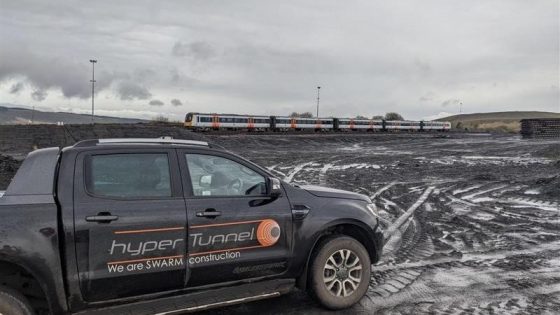
Despite these technological strides and receiving a £25,000 innovation grant for its project at the Global Centre of Rail Excellence, hyperTunnel’s financial woes deepened. The company was involved with the Centre as recently as June 2023, setting up for further demonstrations.
Further attempts to commercialise included a recent contract with AmcoGiffen in October 2023, aimed at deploying its technology across the UK rail network. Nevertheless, these ventures failed to alleviate the company’s escalating debts.
As of the last report, hyperTunnel employed around 40 staff members. The company’s trajectory from a promising start-up to its current financial predicament reflects the volatility and challenges of innovating within the construction sector.
hyperTunnel’s journey reflects both the potential and challenges of innovating in the tunnelling industry, ending in administration despite significant advancements.

