
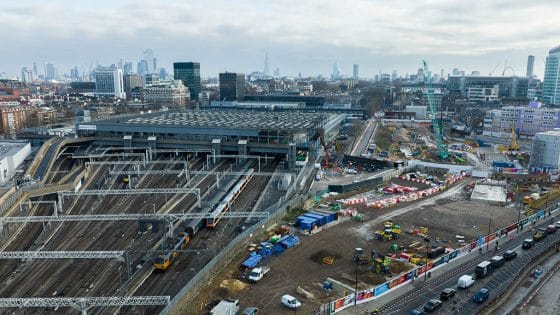

The Labour government confirmed that HS2 will run to Euston Station, marking a significant development in UK rail infrastructure.
- Chancellor Rachel Reeves announced government funding for tunnelling between Old Oak Common and Euston but did not commit public funds for the station build itself.
- The Euston expansion is expected to attract private investment into the area, continuing from previous plans under Rishi Sunak’s leadership.
- The Euston Housing Delivery Group will spearhead local housing and regeneration initiatives, with Bek Seeley appointed as its chair.
- Commitments were extended to various transport projects, including East West Rail and the TransPennine Route Upgrade.
The Labour government has confirmed that the High-Speed 2 (HS2) project will extend to Euston Station in London. This decision signifies a substantial step forward in the development of the UK’s rail infrastructure. Although Chancellor Rachel Reeves announced the allocation of government funds for the tunnelling segment between Old Oak Common and Euston, she refrained from promising public finances for the station’s actual construction. This leaves the station’s funding to potentially rely on private investments, a notion echoed by former Prime Minister Rishi Sunak.
In her budget speech, Chancellor Reeves stated that Transport Secretary Louise Haigh had formulated a strategy to ensure the project’s execution from Old Oak Common to Birmingham while also initiating the tunnelling work towards Euston. Highlighting the broader economic implications, Reeves mentioned that the Euston expansion would serve as a catalyst for private sector investment in the surrounding areas.
The establishment of the Euston Housing Delivery Group marks a concerted effort to push forward housing and regeneration activities in the local vicinity. Proposed during Sunak’s administration, this group’s formation underscores ongoing commitments to regional development, with Lendlease’s Bek Seeley appointed to lead as chair. Lendlease itself spearheads the regeneration plans, aiming for substantial local transformations.
A spokesperson for the High Speed Rail Group expressed optimism regarding Reeves’ announcement, indicating that this step could signify a shift away from fragmented decision-making towards a cohesive vision for the UK’s rail future. Despite this optimism, the spokesperson emphasised the importance of ensuring that phase one extends beyond Birmingham to Crewe and further northward.
Reports earlier this month speculated about the potential rejuvenation of HS2’s phase two via private funding, although the Department for Transport refuted claims of a revival. Richard Risdon of Mott MacDonald highlighted the commitment to Euston as evidence of the government’s understanding of connectivity’s role in driving economic prosperity and opportunity.
The budget delivered by Reeves did not solely focus on HS2. It included commitments to the initial phases of the East West Rail with services anticipated to commence between Oxford, Milton Keynes, and Bletchley next year, extending to Bedford by 2030. The government also plans to consult on the subsequent stages of this project, which aspires to connect Oxford and Cambridge. Reeves further addressed the TransPennine Route Upgrade, promising advancements that will support the Northern Powerhouse Rail.
Further pledges include enhancements to local transport infrastructures. The City Region Sustainable Transport Settlements will see increased funding, facilitating projects like Liverpool’s Baltic Railway Station and improvements to Sheffield’s Supertram and West Yorkshire’s Mass Transit development. On local highway maintenance, Reeves announced a significant boost in funding, a move acknowledged but critiqued by the Asphalt Industry Alliance for lacking a long-term perspective.
The Office for Budget Responsibility (OBR) offered an analysis of the transport budget, projecting a rise for 2024/25 followed by a decrease in 2025/26 due to reduced rail passenger service subsidies. This nuanced financial planning demonstrates the government’s balancing act between immediate investments and long-term sustainability.
The confirmation of HS2’s route to Euston signifies a pivotal development in UK transportation, promising economic growth and improved connectivity.

