
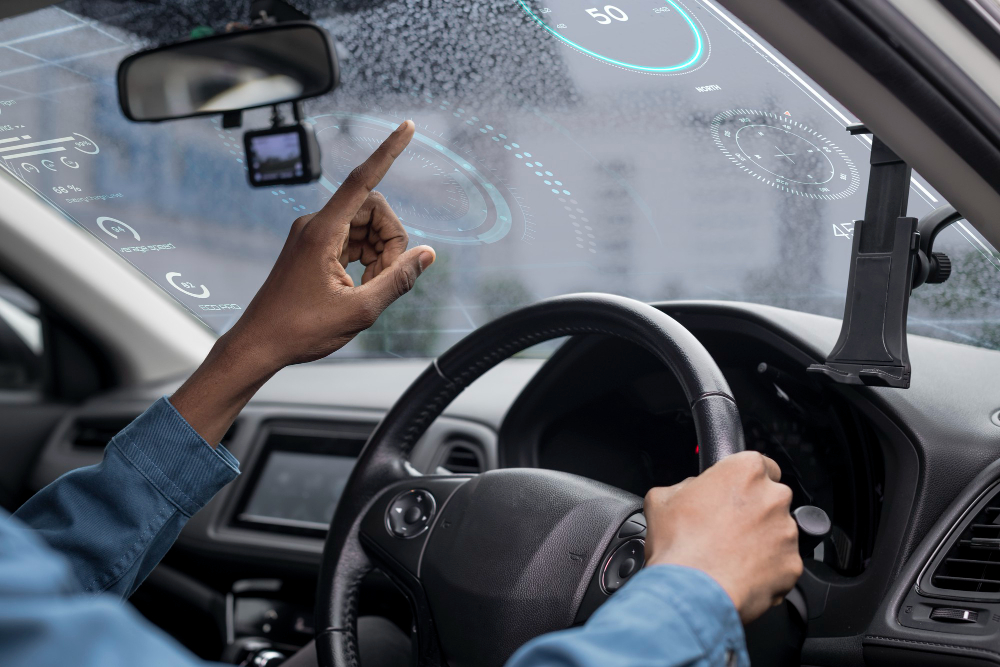

Tesla’s announcements over the past year regarding updated AI safety protocols have struck a tone of confidence that is remarkably similar to previous moments in the company’s self-driving journey—moments that silently left engineers and regulators reaching for their notebooks while promising impending breakthroughs.
The topic of discussion revolves around Full Self-Driving, a system that functions more like a swarm of bees than a single driver. Each AI agent processes camera data, negotiates space, and makes decisions in a matter of milliseconds, sometimes producing remarkably smooth motion and other times surprising even experienced observers.
| Aspect | Key Information |
|---|---|
| Company | Tesla |
| Technology | Full Self-Driving (FSD) software and updated AI safety protocols |
| Regulatory Focus | Investigation into FSD behavior under low-visibility conditions |
| Vehicles Affected | Approximately 2.9 million |
| Oversight Authority | U.S. auto safety regulators |
| Core Debate | Vision-only autonomy versus multi-sensor systems |
This swarm’s reaction to deteriorating visual cues, like fog, sun glare, or dust storms, which human drivers naturally handle cautiously but which are still particularly difficult for vision-only systems, has been the focus of federal investigators at the National Highway Traffic Safety Administration in recent months.
The investigation, which covers about 2.9 million vehicles, looks at dozens of documented incidents, including collisions and injuries, in which FSD-equipped vehicles are said to have disregarded traffic laws by occasionally speeding through intersections or hesitating erratically when decisiveness was crucial.
Experts are troubled not only by the fact that mistakes were made, as all complex systems occasionally malfunction, but also by certain behaviors that seem to be caused by the software itself, as though the digital hive momentarily agreed on the incorrect response and took action before the human supervisor could effectively intervene.
Redundancy, which researchers studying automated driving frequently refer to as exceptionally durable insurance, is where Tesla’s strategy differs from competitors’, as it solely uses cameras instead of layering lidar and radar to cross-check reality. This is especially useful when light fades or weather causes disruptions.
Tesla claims that by using a camera-only architecture, it can scale more quickly, train more effectively, and implement improvements through software updates much more quickly than hardware retrofits. This approach has unquestionably accelerated experimentation throughout its fleet.
However, many engineers argue that speed without sensory diversity can increase risk, likening it to asking a pilot to land solely by sight while purposefully ignoring instruments that could verify altitude, distance, and closure rate.
The problem of “phantom braking,” in which cars occasionally slow down suddenly for objects that only exist in the model’s interpretation—a phenomenon experts claim is caused by AI hallucinations rather than mechanical flaws—illustrates this tension with unsettling clarity.
A sudden stop during a popular robotaxi test ride caused loose objects to slide across the cabin. Although it seemed insignificant on camera, the incident demonstrated how even slow surprises can undermine confidence when they happen to thousands of cars.
I paused that clip and pondered how it would feel to experience the same hesitation in the middle of heavy traffic on a motorway.
According to Tesla’s leadership, the company’s new safety protocols—which are backed by faster chips and more training data—are significantly better than previous versions, enabling the system to contextualize scenes more precisely and return control to drivers more quickly when uncertainty increases.
The company thinks that by incorporating more sophisticated neural networks, decision-making can become incredibly clear, minimizing edge-case confusion and increasing the system’s efficiency in identifying risks that previously went unnoticed.
Because over-the-air updates can alter vehicle behavior overnight, regulators continue to exercise caution. This dynamic makes traditional certification seem out of date because yesterday’s compliance does not always predict tomorrow’s performance.
This discrepancy has contributed to what some experts refer to as regulatory whack-a-mole, in which investigations address problems after they have occurred rather than stopping dangerous configurations before they are put on public roads.
Branding makes things even more complicated because phrases like “Autopilot” and “Full Self-Driving” sound resolutely autonomous, despite user manuals emphasizing continual supervision. Critics contend that this discrepancy encourages over-reliance, especially among drivers who have been operating smoothly for months.
According to scholarly research on driver behavior, trust develops quietly and steadily until vigilance is drastically diminished. Once complacency sets in, no warning sign can completely reverse this human tendency.
Simultaneously, advocacy groups have surfaced advocating for multi-sensor requirements and more transparent disclosures, framing the debate not as anti-innovation but rather as a push toward particularly innovative safety standards that stop businesses from competing by taking sensory shortcuts.
For its part, Tesla highlights that the only way to achieve autonomy is through learning at scale. It makes the case that feedback loops created by millions of miles of actual driving data are extremely versatile and enable quick adaptation to uncommon situations.
Although software experts can relate to that reasoning, transportation engineers remind us that roads are not test sites and that every poorly thought-out move has repercussions that go well beyond data points.
Rivals like Waymo have adopted a slower, more geographically restricted strategy, deploying cars with large sensor suites in specific regions and emphasizing incredibly dependable perception even if growth is still slow.
The contrast shows two ideologies clashing on public roads, one relying on layered certainty and the other on faster iteration, both of which assert that they are headed for the same goal of automated, safer mobility.
In the future, Tesla’s investment in next-generation AI chips indicates confidence that processing power can bridge existing gaps, allowing for more sophisticated reasoning and lowering misclassification in challenging circumstances.
The public’s willingness to share the road with software that increasingly determines when to brake, turn, or continue, as well as regulatory responses, will depend on whether those gains prove adequate in the upcoming years.
For the time being, Tesla’s new safety procedures are a daring experiment that has been significantly enhanced but is still up for debate. This raises the question of how quickly society should permit autonomy to develop when the margin for error is still measured in human lives.

