
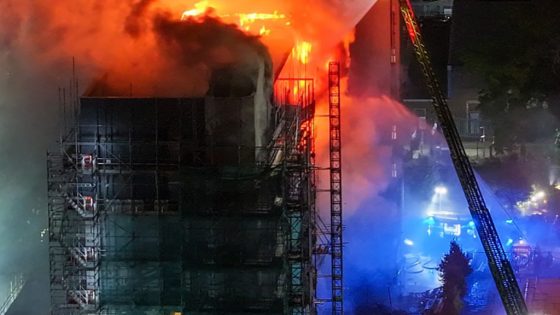

A significant fire incident occurred at Dagenham’s Spectrum Building, raising concerns about scaffolding and fire safety.
- The fire initiated in a ground floor commercial unit and quickly spread to upper floors via surrounding scaffolding.
- Expert Stephen Mackenzie highlighted that scaffolding, although made of high-mass timber, can contribute to fire spread once ignited.
- A confidential industry report had previously warned about fire risks associated with scaffolding in occupied buildings.
- London Fire Brigade has commenced a detailed investigation into the fire’s origin and the building’s fire safety issues.
The Spectrum Building in Dagenham experienced a severe fire outbreak, prompting scrutiny on the role of scaffolding in the fire’s rapid spread. It was reported that the fire began in a commercial unit on the ground floor and ascended the building using the scaffolding as a conduit. This incident has brought to light significant fire safety concerns, especially in structures undergoing remedial work with scaffolding in place.
Independent fire expert Stephen Mackenzie remarked on the potential for scaffolding to aid in the upward spread of a fire, especially once a blaze reaches a steady state. His comments followed observations that high-mass timber, used in scaffolding, can absorb heat and ignite successive layers, thus exacerbating the fire situation.
In February 2023, CROSS UK, a confidential reporting system for the construction industry, issued a warning about the inadequacy of fire risk assessments related to scaffolding on occupied buildings. The report pointed out an oversight in considering fires that start within a building and spread externally to scaffolding. This oversight represents a critical gap in current safety evaluations and standards.
The London Fire Brigade has launched a thorough investigation into the fire, encompassing all aspects of the building’s safety features or lack thereof. Acknowledging that the building already had identified fire safety issues, the Brigade’s investigation will aim to pinpoint the specific factors that contributed to the fire’s severity.
Residents have expressed concerns over the slow pace of safety remediation measures, drawing parallels with the aftermath of the Grenfell incident. The looming publication of the Grenfell Inquiry’s final report adds to the public pressure on authorities to expedite and enforce more stringent safety regulations. Meanwhile, FAA, the contractor responsible for the building’s cladding, has refrained from commenting on the incident.
The Dagenham fire incident underscores the urgency of addressing fire safety issues in buildings with scaffolding and cladding work.
