
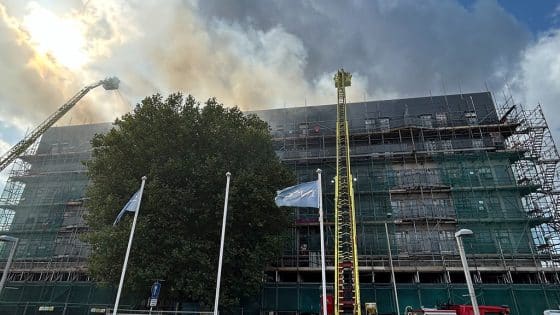

The recent fire at a residential block in Dagenham has reignited concerns about fire hazards associated with construction materials.
- The Institution of Fire Engineers (IfE) suggests flammable materials stored on scaffolding may have caused the fire.
- An independent consultant emphasised the risk posed by scaffolding, which may have accelerated the fire’s spread.
- Investigations by the Health and Safety Executive (HSE) are focusing on whether cladding-remediation works contributed to the blaze.
- Authorities and experts are calling for urgent improvements in safety protocols for buildings under construction.
In a significant incident, a fire erupted at a residential block in Dagenham, drawing attention to the potential dangers posed by building materials. The Institution of Fire Engineers (IfE) has highlighted the likelihood that the blaze originated from flammable materials stored on scaffolding, which may have facilitated its rapid spread. The open, vertical structure of scaffolding can act as a chimney, exacerbating such situations.
The Health and Safety Executive (HSE) has commenced an investigation to determine if ongoing cladding-remediation efforts played a role in the Spectrum Building fire. The involvement of scaffolding in the incident has been underscored in a recent blog post by the IfE, which, alongside experts, has voiced concerns regarding the materials kept on scaffolding during these works.
An independent fire consultant raised alarms over the scaffolding’s involvement, suggesting that a ground-floor residential flat might have been the initial source. Combustible materials, including wooden planks and plastic sheeting common in scaffolding, are potential accelerants. These materials, coupled with temporary wiring during construction, present substantial fire risks if not properly managed.
Fire-safety expert Arnold Tarling, known for his work pre-empting dangers related to cladding prior to the Grenfell Tower fire, visited the scene and suggested that scaffold boards greatly contributed to the fire’s rapid escalation. Upon inspection, he observed that while some cladding remained on the upper levels, the wooden structures behind had been significantly damaged, indicating the role scaffolding played in the fire’s spread.
The regulator, HSE, with the cooperation of the London Fire Brigade, police, and local authorities, is examining how these remediation works were conducted. A key aspect under review is whether the individuals responsible for building safety adhered to regulations intended to prevent such disasters.
In light of these events, the Building Safety Regulator convened a meeting with housing secretary Angela Rayner and building safety minister Rushanara Ali, urging a swift response to the underlying issues laid bare by the fire. Rayner stressed the necessity of fast-tracking building remediation processes, expressing concern over the continued threat that non-compliant cladding poses to public safety.
The Dagenham fire serves as a crucial reminder of the urgent need for stringent safety measures in construction.

