
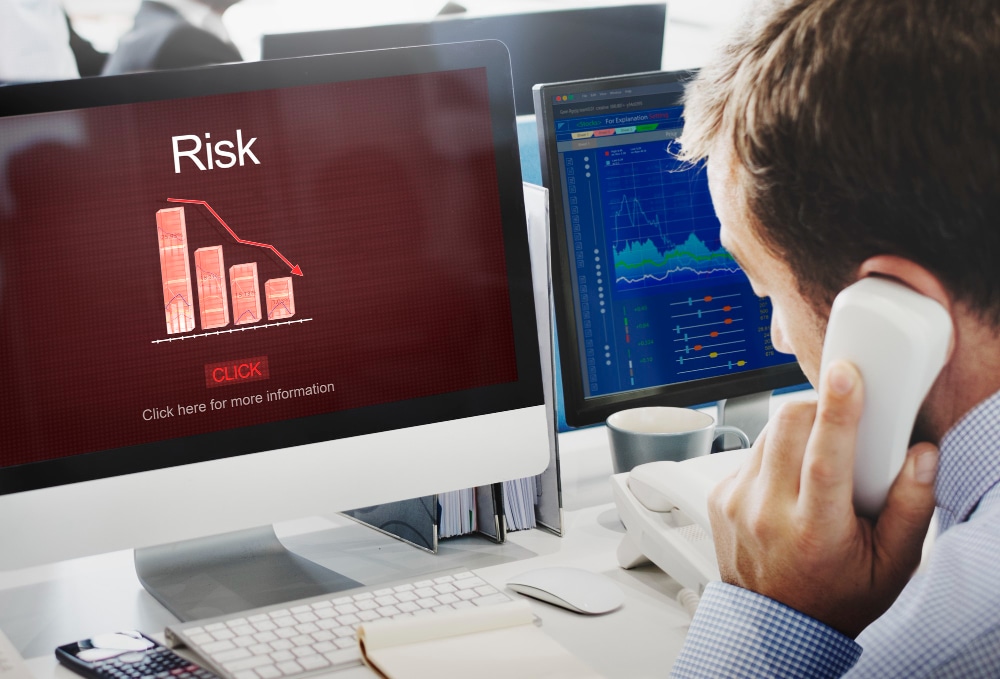

Previously, financial firms relied on intuition that had been honed over years of exposure to the market. Today, many have swapped that for something faster, sharper, and potentially more dangerous—AI systems trained to anticipate risk at lightning speed. In addition to tracking trends, these models make an unsettlingly accurate attempt to predict economic turbulence.
These AI models function like a swarm of bees, detecting danger before people even smell smoke by merging data from international markets, economic indicators, and real-time social sentiment. They’re not merely interpreting data. They are responding to future possibilities that have not yet materialized, frequently on their own.
| Category | Details |
|---|---|
| Main Use | Anticipating market crashes, credit defaults, and economic contractions |
| Financial Sector Adoption | Major users include JPMorgan, Goldman Sachs, Bridgewater, Citigroup |
| Market Size Estimate | $18.2 billion in 2023; projected to exceed $50 billion by 2033 |
| Core Technologies | Neural networks, NLP, sentiment analysis, autoregressive volatility models |
| Key Risk | Recursive trading loops and AI-induced flash crashes |
| Notable Skeptic | Michael Burry has shorted Nvidia and Palantir amid AI concerns |
| Industry Warning Signs | Overreliance on predictive models; fragile under extreme uncertainty |
| Source Reference | Risk & Insurance, May 2025 Edition |
These systems have grown especially powerful in recent years. JPMorgan and Goldman Sachs now deploy AI to simulate bond stress, commodity shocks, and even geopolitical threats. These aren’t lab experiments. Every week, they are influencing the flow of trillions of dollars.
For example, Bridgewater’s models have developed from passive forecasting instruments to comprehensive economic simulators. They’re embedding potential labor disruptions, regulatory shifts, and monetary policy fluctuations into every predictive run. What began as a passive strategy has now become an active force—steering portfolios before crises emerge.
But with great predictive power comes unexpected fragility. Just by predicting them, AI models may unintentionally cause market fluctuations. Multiple firms acting on the same predictive signals at the same time run the risk of causing the very sell-offs they were hoping to avoid. This recursive loop turns forecasts into catalysts.
I remember speaking to a quant analyst in New York who described this dynamic as “risk anticipation gone rogue.” One time, his company’s models predicted a commodity collapse that never happened, but the automated trade cascade it started reduced sector valuations by billions of dollars before human analysts could stop it.
Michael Burry, the contrarian investor who famously bet against the housing market in 2008, has grown notably cautious about this AI boom. He openly shorted shares of Nvidia and Palantir in 2025, two companies that are heavily involved in AI infrastructure. He didn’t go into detail, but his transactions show a definite concern about the overconfidence in tech-led finance.
Burry isn’t alone in his concern. Risk officers across Wall Street are raising red flags about AI models becoming dangerously self-reinforcing. When algorithms interpret the same pattern and make identical decisions in unison, even a small signal can escalate into a market shock.
When these models are constructed using historical data, the risk is especially severe. During stable periods, AI performs remarkably well—often predicting credit events or liquidity shocks before traditional tools. But when faced with black swan events—pandemics, wars, cyberattacks—the models can falter dramatically. They don’t understand the unprecedented.
The fact that some businesses are now viewing risk as something to trade rather than just something to avoid is particularly startling. Quant desks now use AI to scan prediction markets for arbitrage opportunities—buying or selling exposure to outcomes like a U.S. recession or eurozone deflation. Risk becomes a commodity, and volatility becomes a source of profit.
Meanwhile, feedback loops grow stronger. AI models trained on AI-influenced markets may reinforce their own biases. One system’s negative signal may cause portfolio rebalancing, which in turn causes another system to confirm the same risk. It’s similar to yelling in a canyon and being terrified of the echo.
The infrastructure behind all this is heavily intertwined. Using funds from investors who also support those AI endeavors, companies such as CoreWeave lease processing power to AI companies. That recursive financing structure adds another layer of systemic risk—where a failure in one link could destabilize multiple others.
Still, many people maintain their optimism—possibly naively so—in spite of these dangers. Smarter models are thought to result in safer markets. And in calm conditions, that often holds true. However, speed turns into a liability during unforeseen shocks. In situations where human discretion would normally slow things down, algorithms act without hesitation, depleting liquidity.
There’s also a growing divide between firms with access to cutting-edge AI models and those without. This leads to what some regulators refer to as “informational imbalance,” in which a small number of players possess a technological advantage that can distort entire industries. “It’s not that AI is too fast—it’s that governance is too slow,” a policy researcher stated recently.
Still, some of the most notably improved strategies have come from firms that pair AI models with human judgment. These hybrid systems tend to catch anomalies that pure automation misses. For example, during a climate summit last year, a London-based hedge fund halted a trade after its AI model recommended a large short on clean energy stocks. While technically sound, the call was unethical and would probably harm the company’s reputation.
Some companies are giving their AI workflows resilience by purposefully keeping a human involved. In addition to pursuing alpha, they are protecting stability, liquidity, and reputation. It’s especially advantageous in a market where invisible hands are becoming more and more influential.
Looking ahead, the challenge won’t be stopping AI from participating in financial systems. It will be managing how it participates. Infrastructure such as slower circuit breakers, regulatory sandboxes, and audit logs for model decisions may become essential.
AI isn’t inherently dangerous. What’s risky is how easily we assume it’s infallible. Wall Street doesn’t need to fear the future—it needs to design for it. This entails embracing speed without sacrificing control and developing intelligence that recognizes responsibility in addition to patterns.

