
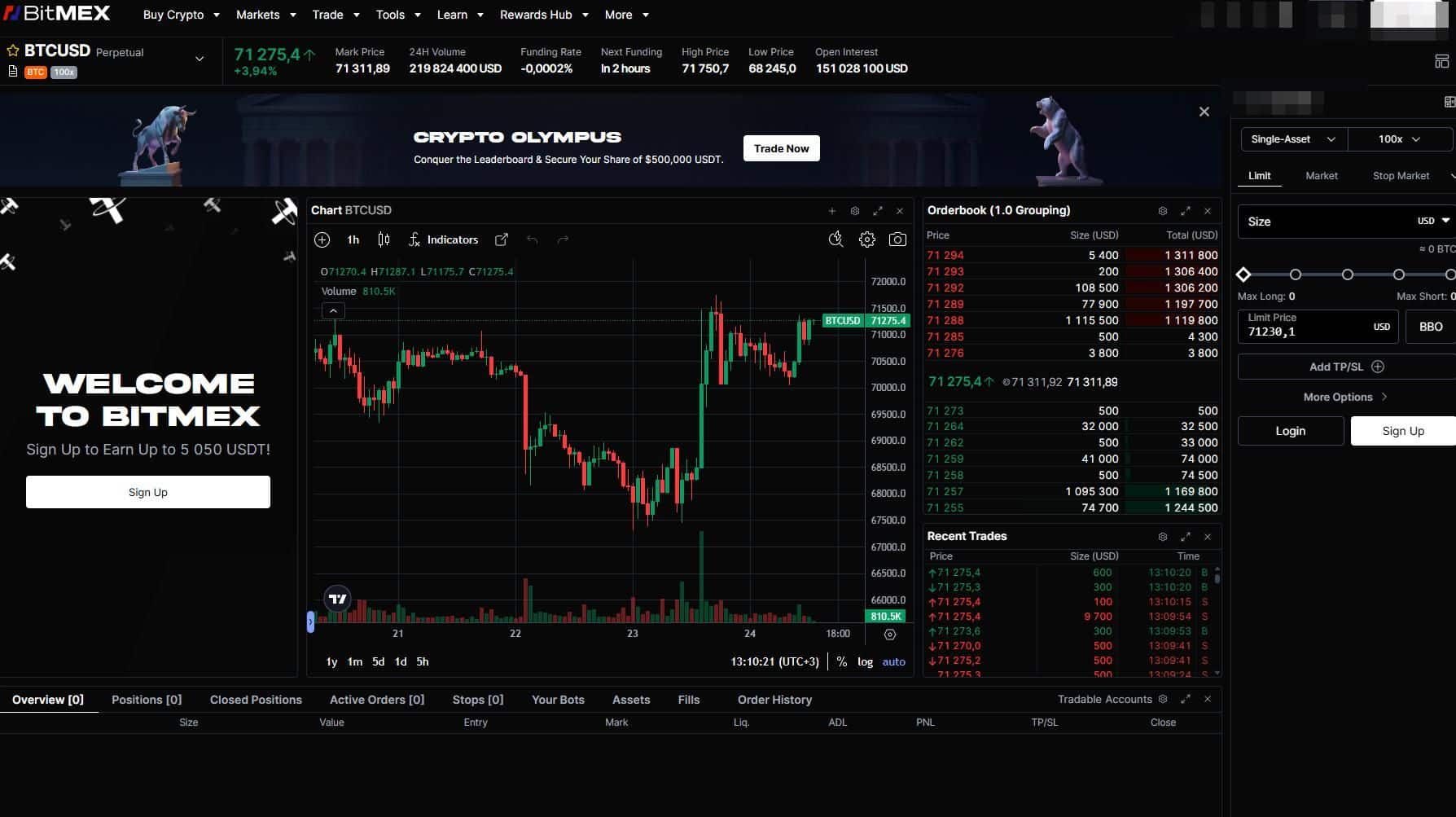

Nine months ago, the priority was clear: proper perpetual swap depth, real leverage, and a crypto trading platform that wouldn’t get in the way. Nine months later, that’s still the case — and far more of what this cryptocurrency exchange offers is now in use than originally expected. Spot, options, equity perps, copy trading. This review reflects the actual experience, not the marketing version.
Registration and KYC
Creating an account takes two minutes. KYC takes longer. BitMEX requires it before you can trade or withdraw anything, and there’s no anonymous tier. You’ll need a government-issued photo ID, proof of address from the last three months, and a short video verification. Mine processed same-day. The whole experience felt closer to opening a brokerage account than most crypto onboardings, which tells you something about the kind of trading platform this is. BitMEX is clearly built for experienced cryptocurrency traders, not casual dabblers.
Once cleared: full access immediately, no secondary tiers, no limits that unlock gradually. FATF-aligned KYC standards, one-time process. For a cryptocurrency exchange handling derivatives at this scale, the verification standard is appropriate.
Deposits: Crypto only: BTC, USDT, ETH and others. No fiat on-ramp. Withdrawals up to 5 BTC are processed via accelerated withdrawals at 15-minute intervals. Larger amounts or anything flagged by risk screening go through the once-per-day process at 13:00 UTC. All requests pass automated risk scoring before broadcast, that’s the security layer.
Security: Why I Trust the Custody Model
BitMEX security is built around MPC (multi-party computation). No single private key ever exists in one place. Signing any withdrawal requires multiple independent components to cooperate. Compromise one and you have nothing usable. Over 95% of client assets sit in cold storage wallets under this model.
Track record: Zero client funds lost to hacks since 2014. Eleven years. That covers the Bitfinex hack in 2016, Binance in 2019, and FTX in 2022. BitMEX went through all of it without losing a penny of client money. Past record doesn’t guarantee the future, but architecture that produces this result is worth something.
Proof of Reserves: Published twice a week using a Merkle tree structure: any user can independently verify their own balance is included in the total. I’ve run the verification myself. It works exactly as described. Most exchanges do this monthly or quarterly at best; twice-weekly is above the industry standard.
Insurance Fund: Over $250 million. This absorbs losses from liquidated positions before they cascade onto other traders. Auto-Deleveraging (where your profitable position gets partially closed to cover someone else’s loss) is the last resort. In nine months through volatile markets I’ve never seen it trigger. That’s the fund doing its job.
Two-factor authentication (2FA) is mandatory for all logins and withdrawals. It is one of the core security measures applied to every account. Active bug bounty through HackerOne. BitMEX customer support is available 24/7 in English, Chinese, Russian and Turkish.
What You Can Trade on BitMEX
The range of products you can trade on BitMEX is significantly wider than I expected. The BitMEX platform has evolved far beyond the Bitcoin-only exchange it was in 2014.
Spot Trading
17+ spot pairs, BTC (ticker XBT on BitMEX), ETH, SOL and a solid range of majors and mid-caps. No leverage, you own the asset. I use it mainly for building base positions and for the zero-fee crypto converter when swapping between assets without leaving the platform.
Perpetual Swaps
BitMEX invented the perpetual swap and has been refining it since 2016. The matching engine runs at sub-4ms latency, that matters for active crypto trading strategies where execution quality is part of the edge.
These perpetual contracts track an underlying spot price indefinitely with no expiry date. The funding mechanism, payments between longs and shorts every eight hours, keeps the derivative anchored to reality. When the perp trades above spot, longs pay shorts. Below spot, shorts pay longs. Simple in concept. Significant in practice: if you’re long through a strong uptrend and holding overnight, that 8-hour funding tick is a real cost. Most cryptocurrency traders figure this out after they see it in their PnL for the first time.
Max leverage on XBTUSD is 250x, technically “with up to 250x leverage”, though most serious traders use 10-20x. At 250x, a 0.4% adverse move liquidates the position. For reference, even 100x leverage means a 1% move wipes the trade. Leverage trading at these levels requires clear risk management before touching it. Available assets for perps: ETH, SOL, ADA, AVAX, MATIC, DOGE, SHIB and more beyond the obvious majors. The selection has grown considerably.
Options, Futures and Other Products
Standardised options on BTC and major assets, I use them for hedging, buying puts to cap downside on long positions when macro risk shifts. The defined max loss (premium paid) is the whole point. Dated futures with fixed settlement are useful for structured directional trades with a specific time horizon. The platform also offers copy trading with a public leaderboard and a reverse copy feature, plus built-in trading bots, including grid bots, that work without any API setup. I ran a grid bot on XBTUSD for three weeks during a ranging market with consistent modest profit.
Equity Perpetual Contracts
The product that surprised me most. Equity perps are perpetual contracts linked to real US stocks and indices, NVDA, TSLA, AAPL, AMZN, META, GOOGL, MSFT, COIN, SPY, QQQ and others. Up to 20x leverage, 24/7 trading, with crypto as collateral. No fiat conversion, no separate brokerage account needed.
When NVIDIA had its earnings cycle in late 2025, I traded the NVDAUSDT perp on a Saturday afternoon using USDT. Outside US market hours, the index price is maintained via Pyth and Chainlink data feeds, tracks well enough for directional trades. These are cash-settled contracts: you’re speculating on the price, not buying the stock. No dividends, no shareholder rights. No other major crypto exchange currently offers this product in comparable form.
Fees: What You Actually Pay
Maker-taker model. Trading with BitMEX: limit orders resting in the book make you a maker. Market orders make you a taker. One of the things that distinguishes cryptocurrency trading on BitMEX from most platforms: it pays you a rebate when you’re a maker on perpetuals. If you’re running systematic trading strategies that place limit orders most of the time, fees work for you rather than against you, and that structural advantage affects long-term profit meaningfully.
| Instrument | Maker | Taker | Note |
| XBTUSD Perp | -0.010% | 0.050% | Maker rebate |
| Altcoin Perps | -0.010% | 0.050% | Varies by pair |
| Spot | 0.050% | 0.050% | Flat |
| Options | 0.020% | 0.020% | Per contract |
| Futures | 0.010% | 0.075% | |
| BTC Withdrawal | Network fee | — | Once daily, manual |
| Crypto Conversion | Zero | — | Free |
Taker fees: 0.050% standard on most perpetuals and spot. Drops to 0.0320% minimum with BMEX staking. The maker rebate is the more interesting number for active traders.
Funding, the one that catches people: Perpetuals charge funding every 8 hours between longs and shorts. In a strong uptrend longs can pay 0.03-0.05% per interval, over 0.1% per day. Most crypto exchanges with perpetuals work the same way, but BitMEX shows funding data publicly in real time. I track it on anything I hold overnight. Don’t, and you’ll notice the gap between your expected and actual profit later.
BMEX staking: Staking the platform’s native token gets you up to 75% off trading fees, zero withdrawal fees, and lets you earn up to 7.5% APY. The commission savings compound quickly at volume, worth calculating against your actual trade frequency.
Leverage and Liquidation: The Architecture of Risk
The 250x headline gets cited constantly. Let me give it context, because leverage trading on BitMEX and leverage trading in general are two different conversations. 250x means a 0.4% adverse move liquidates the position. It exists for institutional market-makers and advanced investors running short-duration hedges, not retail directional trading. I’ve never used it and wouldn’t. The risk isn’t the existence of 250x, it’s using more leverage than your analysis supports.
What actually matters is the risk architecture across all the contracts available on BitMEX:
| Layer 1 | Leverage. You set the multiplier before entry. I use 10-20x, a 5-10% adverse move to liquidation gives time to respond. |
| Layer 2 | Margin mode. Isolated: fixed collateral on one position, only that amount at risk. Cross: full account balance backs all positions. I use isolated almost exclusively. |
| Layer 3 | Maintenance margin. When unrealised losses erode margin below the threshold, the liquidation engine closes the position automatically, before total capital loss. |
| Layer 4 | Insurance Fund. $250M+ absorbs losses from liquidations before they cascade to other traders. This makes ADL unnecessary in normal conditions. |
| Layer 5 | Auto-Deleveraging. Last resort only. Profitable opposing positions partially closed to cover losses. Rare in practice, has occurred a handful of times, including October 2025, but the Insurance Fund absorbs the vast majority of liquidation losses before ADL is needed. |
One thing that catches traders across all the contracts available on BitMEX: the liquidation price isn’t static. Funding payments every 8 hours slowly erode margin, moving your liquidation price closer to market, even when the price hasn’t moved. A long held for a week in a flat market with steady positive funding can have a liquidation price 0.5-1% closer to market than when opened. Check it regularly on multi-day positions.
Stop-loss and take-profit orders are available and work as expected. Set them before you enter. I learned early that defining exit levels in advance is what separates a trade from a gamble.
UK Access and How BitMEX Compares
BitMEX is registered in the Seychelles and is not regulated by the FCA. Traders in Great Britain should check current FCA guidance on crypto derivatives before trading, the regulatory picture for offshore platforms is not static, and it’s each trader’s responsibility to ensure they’re operating within the rules that apply to them. BitMEX does restrict access from a number of jurisdictions, primarily the US, Hong Kong and sanctioned countries. What matters more for platform selection is whether the exchange is transparent about reserves and whether the security architecture holds up. On both counts, BitMEX has the stronger track record.
On compliance: BitMEX does sanctions screening across OFAC, EU, UK, UN and three other lists, has FATF Travel Rule compliance in place, and monitors on-chain transactions in partnership with Chainalysis.
| Feature | BitMEX | Binance (UK) | Kraken |
| Founded | 2014 | 2017 | 2011 |
| Spot (pairs) | Yes, 17+ | Yes | Yes |
| Perps | Yes, wide range | Restricted in UK | Limited |
| Options | Yes | Restricted in UK | No |
| Equity Perps | Yes, unique | No | No |
| Copy Trading | Yes + reverse copy | Yes | No |
| Trading Bots | Yes, built-in | Yes | No |
| Max Leverage | 250x | 10x (UK cap) | 5x (UK cap) |
| Insurance Fund | >$250M | Yes | Yes |
| Proof of Reserves | Yes, daily | Yes | Yes |
| Testnet | Yes | No | No |
| TradingView | Native built-in | No | Yes |
| UK Derivatives | Available | Significantly limited | Limited |
Worth noting on the comparison: Binance’s derivatives offering is significantly more restricted in Britain than its global version, FCA pressure led Binance to limit retail crypto derivatives access, so the 10x figure in the table reflects that constrained version. Kraken is solid and well-rated among more cautious investors, but the 5x leverage cap and narrower instrument range put it in a different category for active derivatives trading. For traders who want perpetuals across a wide range of assets, options, and the unique product of equity perps, BitMEX is the only one of these three that delivers it across the board.
Verdict After Nine Months
BitMEX does what I came for, and more. The perpetual swap mechanics are the best-implemented I’ve used across any crypto trading platform. Equity perps opened a category of instruments I couldn’t access anywhere else in crypto. The fee structure works in my favour more often than not once you understand the maker rebate. The security record, eleven years, no client funds lost, is the strongest in the market.
Right for: Active derivatives traders, algorithmic and systematic traders (negative maker fees + REST/WebSocket API), anyone wanting equity exposure via crypto collateral, Ethereum and Bitcoin traders who’ve outgrown conservative leverage caps.
Five-word verdict: better than I expected, stays.
Three Questions Worth Answering Properly
Is BitMEX actually safe?
MPC custody, no complete private key in one place. Over 95% in cold storage wallets. Client funds ring-fenced, not lent or staked. Proof of Reserves published twice a week, independently verifiable, I’ve checked it. $250M+ Insurance Fund. Zero client funds lost since 2014. BitMEX isn’t FCA-regulated, but that’s the standard situation for offshore crypto derivatives platforms. The custody architecture is what matters practically, and here it’s strong.
How does leverage work, and is 250x usable?
250x: liquidation at 0.4% adverse move. Not usable for retail directional trading, 10-20x is where I operate. The critical disciplines: set leverage before entry, use isolated margin so one bad trade doesn’t touch your whole account, set stop-losses before entering, and understand that funding payments shift your liquidation price over time on overnight positions. The risk isn’t 250x existing. It’s using leverage you haven’t thought through.
What is Testnet and why does it matter?
testnet.bitmex.com is a full mirror of the live platform on simulated funds, free, everything works identically. I spent several weeks there before going live. Watching your liquidation price move as funding accumulates. Figuring out why cross margin nearly wiped my simulated account where isolated would have contained the damage. You won’t internalise leveraged trading mechanics by reading about them. Testnet removes the financial cost from learning. Use it first, there’s genuinely no excuse not to.
About the author: Derivatives trader based in the UK. Using BitMEX as main platform for perpetual swaps, equity perps and options since mid-2025. No commercial relationship with BitMEX. All data verified against BitMEX’s official documentation and independently cross-checked.
Risk notice: Crypto derivatives trading involves significant risk of loss. Leverage amplifies both gains and losses. BitMEX is not FCA-regulated. Do not trade with money you cannot afford to lose. For information only, not financial advice.

