
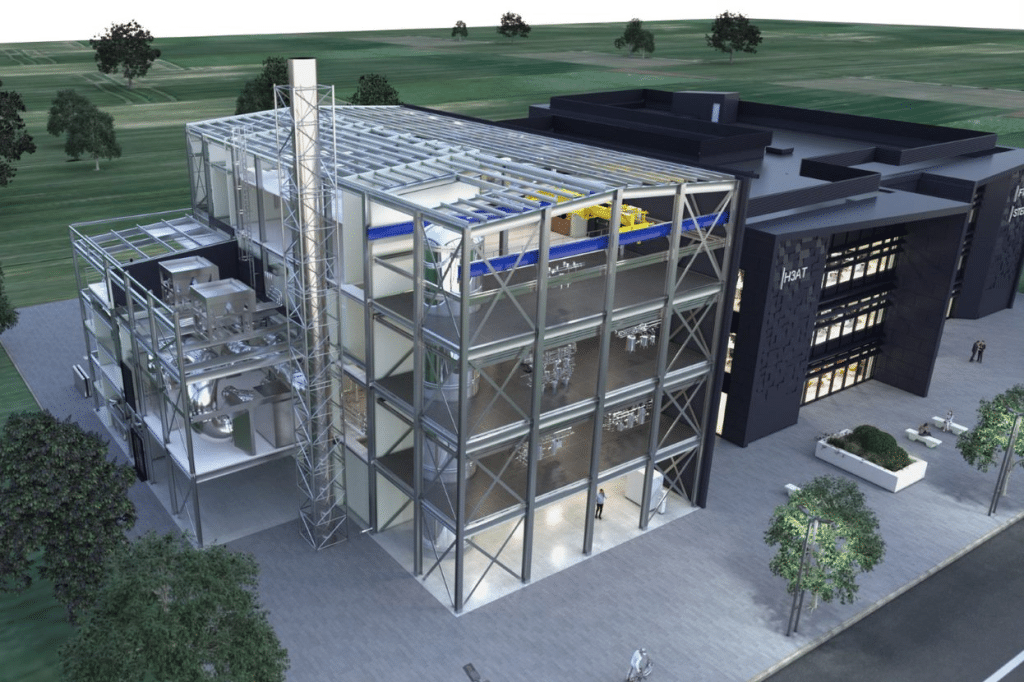

AtkinsRéalis, a renowned engineering firm, has been chosen by the UK Atomic Energy Authority (UKAEA) to design an isotope separation system for a pioneering tritium processing facility.
- This system will be part of the UK’s Hydrogen-3 Advanced Technology (H3AT) facility, a significant development in fusion research.
- The facility aims to support both industrial and academic study of tritium processing, storage, and recycling.
- Utilising advanced technologies like 4D design and digital twin simulations, AtkinsRéalis is set to enhance understanding and performance of the system.
- This project positions the UK as a leader in fusion technology, with potential economic benefits.
The UK Atomic Energy Authority (UKAEA) has entrusted AtkinsRéalis with the detailed design of an innovative isotope separation system, a project touted as a groundbreaking advancement in nuclear fusion research. This system will feature prominently within the Hydrogen-3 Advanced Technology (H3AT) facility, a state-of-the-art tritium fuel cycle research station that incorporates a prototype process plant and experimental platform. The H3AT facility is planned as a scaled model of the design used in Iter, a large international initiative focused on simulating solar fusion processes to generate energy.
AtkinsRéalis has a notable history with the H3AT project, having already completed both the concept and detailed process design of the main facility currently under construction at UKAEA’s Culham Campus in Oxfordshire. Furthermore, they have advanced the preliminary design of the isotope separation system itself. The current phase involves delivering comprehensive process and mechanical designs, entailing both cryogenic and ambient temperature equipment vital for the collection, processing, and recycling of tritium fuel.
Jason Dreisbach, head of advanced energy technologies at AtkinsRéalis, emphasised the importance of this project, asserting that the H3AT facility will be a pioneering research centre designed to bolster international efforts in advancing tritium fuel cycle technology. “The isotope separation system is crucial for demonstrating the performance of the fusion fuel cycle at a significant scale,” he stated, highlighting the firm’s extensive experience in fusion engineering as a valuable asset towards achieving the UKAEA’s objectives.
UKAEA executive director Stephen Wheeler echoed these sentiments, describing the system as the world’s first industrial-scale tritium facility for fusion purposes. This facility is expected to facilitate comprehensive research into the processing, storage, and recycling of tritium, which is a critical element in fusion fuel. Wheeler noted that fusion energy holds immense promise not only as an abundant and low-carbon energy source but also as a catalyst for economic advancement within the UK. Collaborations with industry leaders such as AtkinsRéalis equip the UK to emerge as a frontrunner in the global fusion technology landscape, enhancing its industrial capabilities and export potential.
To effectively develop and evaluate the design and performance of the system, AtkinsRéalis plans to employ cutting-edge methodologies, including 4D design, digital twinning, and AR/VR simulations. Such technologies will enable researchers and academic institutions to gain deeper insights into the complex intricacies of the design, thereby facilitating a more refined understanding of its operational dynamics.
The AtkinsRéalis-UKAEA collaboration signifies a monumental step in advancing fusion technology and establishing the UK as a leader in the field.

